• Skip to main content
  • Skip to secondary menu
  • Skip to footer

Travel Marketing

Travel and Tourism Trends

  • Sponsored Post
  • Travel Event Calendar
  • Travel Market
  • Travel Magazine
  • About
  • Contact

Louvre Robbery Reverberations: A New Era of Museum Security Anxiety

November 6, 2025 By admin

The courtyard outside the Louvre looks almost too calm for the kind of worry it now carries. In the image, the iconic glass pyramid stands gleaming under a bright blue sky, its angles cutting sharply against the soft drifts of cloud. Tourists scatter the plaza in quiet constellations — some strolling, some waiting in loose, patient lines, others pausing beside yellow rental bicycles mid-conversation, as if Paris always arranges itself into a scene that could be painted. To the right, the immense palace façade rises in ornate stone, sculpted figures frozen in their permanent watch. And there, further back — almost easy to overlook — a dark triangular lift sits near the center of the courtyard. It looks like standard maintenance equipment, the kind of thing you’d usually ignore without thought. But now, after the recent robbery, it has taken on a different tone. It resembles the same type of lift used in the heist, and suddenly it feels like a clue left in plain sight, or maybe more accurately, a reminder of how the ordinary can shift into something dangerous when intention changes.
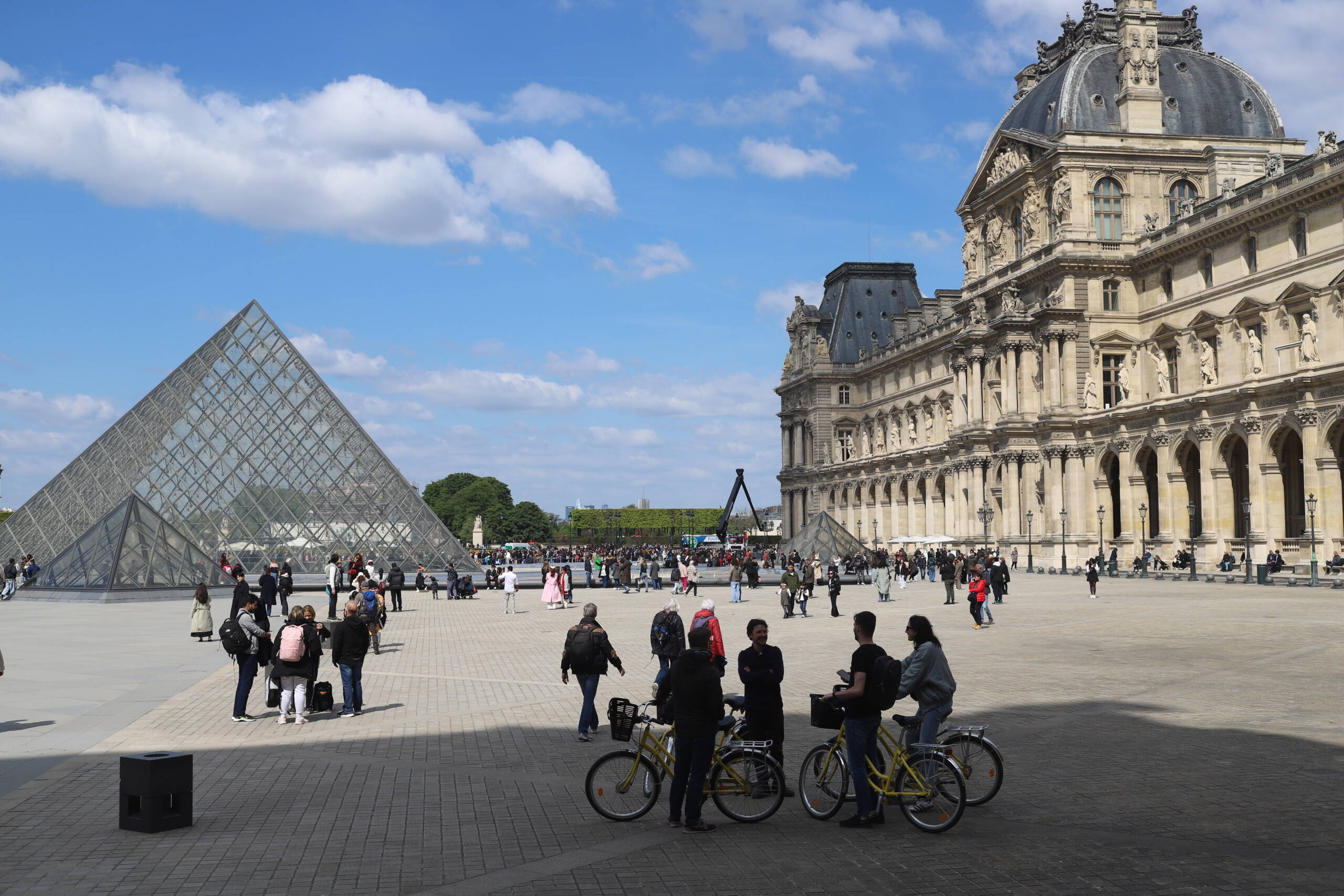
Louvre Robbery Reverberations: A New Era of Museum Security Anxiety
Shot with Canon EOS R6 Mark III and RF45mm F1.2 STM

The news has settled like a thin layer of dust on marble floors: the robbery has shaken the museum world in a way that feels both surreal and somehow inevitable. You don’t expect thieves to stroll into the world’s most visited museum and walk out with something priceless, and yet here we are. Directors are calling emergency meetings; curators are pacing their offices. Even the quiet guard, the one who stands still for hours beneath vaulted ceilings, is likely replaying the possibility of what they could have missed. The Louvre isn’t just a museum — it’s a symbol of what humanity wants to remember about itself. To see it breached is to feel something foundational flicker.

And the anxiety is spreading. Museums everywhere are now interrogating their own assumptions. For years, security has been a choreography of cameras, badges, and sensors — precise, rehearsed, confident. But any system observed long enough becomes predictable. This is the challenge of museums: they must remain open. They must welcome strangers, day after day, millions of them. Art wants to be seen. The act of protecting art and the act of sharing it are always in quiet conflict, and that conflict is now sharper, harder-edged, no longer theoretical. It’s the sort of problem that keeps people awake long after everyone else has gone home.

And this has reminded us of something almost uncomfortable: our relationship with cultural heritage is fragile. We assume the paintings and sculptures we love will always be there when we’re finally ready to visit them. We forget that their survival is not inevitable but actively maintained, daily — through care, surveillance, funding, and yes, vigilance. A painting can endure five centuries and still vanish in five minutes. Beauty is not guaranteed; it is constantly defended.

So museums are beginning to shift. Some are leaning into barriers, controlled distances, thicker glass. Others are moving toward invisible guardians: AI systems that analyze patterns of movement, biometric signals that read intent, microchips embedded deep in the grain of canvases, giving each artwork a kind of silent pulse. The future museum may look the same on the surface but will hum with hidden awareness beneath it. The danger is that museums could feel less like sanctuaries of art and more like laboratories crossed with airports. Beauty observed, yes — but also continuously monitored.

Yet the courtyard in the photograph remains full of life. People talking, laughing, leaning on bicycles, drifting toward the pyramid with that gentle tourism curiosity. The sky is bright. The day feels open. And maybe that’s the most important tension: the world continues, and the art is still there, waiting, vulnerable but present.
Maybe the worry isn’t entirely something to fear. Perhaps it sharpens our sense of value. When we recognize that something can be taken, we remember how deeply we want it to stay.

Filed Under: News

Footer

Recent Posts

  • TOURISE Summit 2027: March 23-25, Riyadh, Saudi Arabia
  • Wrocław’s Market Square in Fisheye: Why I Kept the Distortion
  • Salamanca’s Stone Faces: A Photo Essay in Five Frames
  • Europe’s Tourist Crime Belt: Pickpockets, Bracelet Scams, and Why the Same Offenders Keep Working
  • The Beach Racket in Italy, Greece and Spain: Turnstiles, Cheap Concessions, and a Shoreline You Can’t Reach
  • Why Lisbon Cafés Are Putting Up No Laptops Signs: Coffee, Instagram, and the Remote Work Terrace
  • Four in Ten Travelers Visit Landmarks Mainly for the Photo: How Instagram and Reels Reshaped Tourism
  • Why Comporta Still Feels Empty: The Rice Estate Behind Portugal’s Most Coveted Beaches
  • Travel in 2026: Five Photos That Explain the Year’s Real Trends
  • Tiny Tourism: Why Travellers Are Choosing Towns Nobody Photographs

Media Partners

  • Virtual Travel Guide
  • Ancient Rome
Largo do Chiado at Night: A Brasileira, the Bronze Poet and a Floor Made of Waves
Sintra at Noon, Venice at Midnight: Six European Cities and the Hour That Suits Them
Porto’s Chestnut Season Is the Shoulder Season Worth Booking
Venice at Night Is the Version No Access Fee Covers
The 18th-Century Fountain Hidden Inside Bordeaux’s Customs Museum Courtyard
The Bilbao Effect, 500 Years Early: Jerónimos Monastery And The Guggenheim
Bilbao’s Quiet Renaissance: From Industrial Port to Design Destination
Lisbon’s Seven Hills: A Walking Guide That Tells You the Truth
New Orleans: An American City That Plays by Different Rules
Ha Long Bay Without the Cruise Brochure
Sponsored Post
About
Contact
A Freed Slave in Augustan Rome Paid to Have His Wrinkles Carved in Marble
The Badminton Sarcophagus Was Carved While the Roman Empire Was Coming Apart
The Boscoreale Bedroom at the Met May Be Named for the Wrong Roman
The Met's Augustus Was Carved After He Died, and It Shows Him Half His Age
The Met's Caracalla Denarius Promised Imperial Heirs and Then Rome Erased the Bride
Mapping 186,000 Miles of Roman Roads Shows Rome Was Never the Empire's Main Hub
How Much Silver Was in a Roman Denarius? Debasement Tables From Augustus to Diocletian

Media Partners

  • Media Forum
  • Market Analysis
Four Nights in Europe: What Mixed Artificial Light Does to a Photograph
Brussels Social Housing Standoff: MR Freezes €131 Million Over Foyer Anderlechtois Chairman
Syracuse Has No Town Beach, So Ortigia Swims Off the Rocks
Weekly Network Analytics Summary: August 30 to September 5, 2026
SanDisk (SNDK) Rallied 11.9% Into an S&P 100 Add That Forces Almost Nobody to Buy
Texas A&M Is Spending $11.8 Million on a Water Tower Before Its Semiconductor Institute Can Open
Cloudflare's September 15 AI Crawler Block Turns the Ad Tag Into an Access Key
Pedro Sánchez Lost Control at Ceuta and Blamed Everyone Else
Three European Cities Where Architecture and Festival Collide
Duane Davis Convicted in Tupac Shakur's 1996 Murder
The Immersive Experience in the Museum World
Japan, China, and Taiwan: A New Triangle of Risk — and a Window of Opportunity for Japan
Ghost Kitchens as Infrastructure: The Shift from Restaurants to Intelligent Food Networks
The Zoom Divide Nobody Saw Coming
The Perfect Budget Content-Creator Kit
Reimagining Prague’s Tourism Future Through Immersive Media and VR Museums
Israel’s Urban Paradox: Tel Aviv Moves, the Rest Stand Still
American Express Global Business Travel (GBTG): Understanding the Business and the Investment Case
Why the Canon R8 Paired With the New RF 45mm f/1.2 Lens Quietly Becomes the Content Creator’s Sweet-Spot
The Future of Travel: A $15.5 Trillion Industry

Copyright © 2026 Travel Marketing

Media Partners: Timey · Publishing House · Ancient Rome · Photography · Calendarial · Transportational