• Skip to main content
  • Skip to secondary menu
  • Skip to footer

Travel Marketing

Travel and Tourism Trends

  • Sponsored Post
  • Travel Event Calendar
  • Travel Market
  • Travel Magazine
  • About
  • Contact

Lost in the Grandeur of the Sagrada Família

November 21, 2025 By admin Leave a Comment

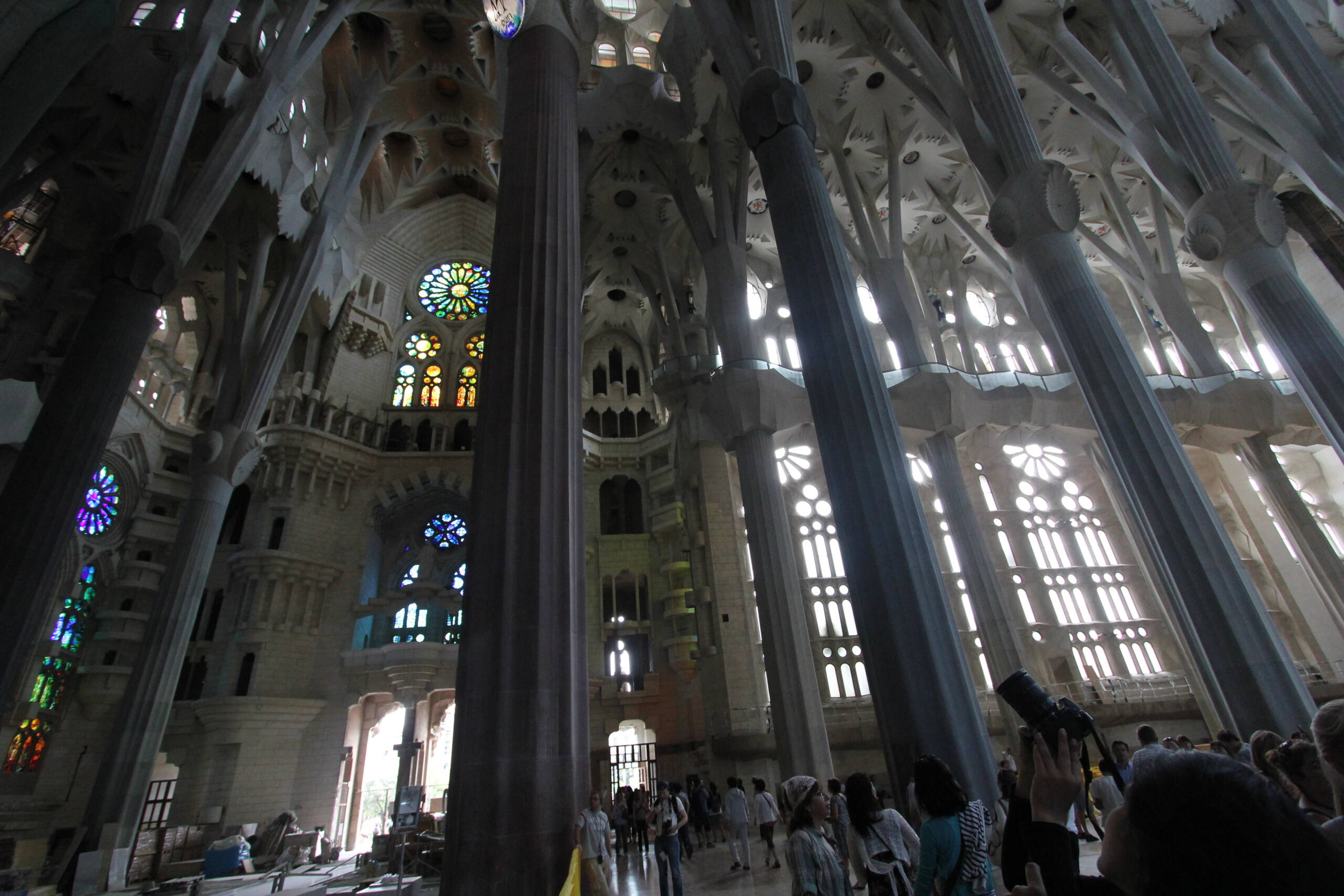
There’s a strange feeling that hits the moment you step inside, almost like the air itself thickens and every sound dulls into a hushed awe. The forest of pillars rises in impossible height, stretching upward until the ceiling becomes less architecture and more celestial geometry—angled ribs, organic curves, and those signature branching supports that feel closer to bones or trees than anything human-made. In the photo, your angle makes the space even more towering; the columns lean slightly, almost like they’re breathing or shifting, and the height seems to swallow perspective.
Sagrada Família

Light falls differently here—never harsh, never flat. Near the center, the stained-glass windows glow in gradients: emerald fading into gold, sapphire bleeding into violet, a soft fire suspended in stone. The way Gaudí calculated the spectrum is visible only after a quiet pause; the warm tones collect on one side where morning sun enters, the cooler tones seep into shadows where the columns stand in muted grays and soft blues. That rainbow above isn’t decoration—it’s choreography. You see it particularly in the upper rose window in your shot: a radiant wheel of color surrounded by delicate stone tracery, almost floating against the massive wall behind it.

People move at the bottom of the frame—tiny figures, some looking up with cameras, some standing still, some walking as if they’ve forgotten where they were going. Their presence is almost comical, small and uncertain, because everything around them feels larger than intention. The woman at the right, mid-gesture with her camera lifted, looks like she’s trying to capture the impossible: scale, light, awe—all fighting against a lens too small for a place like this.

The floor feels unfinished in places, almost like a reminder that this basilica is still becoming—not a relic but a living project. That slight rawness softens the grandeur. It reminds you this wasn’t built by gods, even though it feels like something close.

And honestly, there’s a beautiful contradiction here: the architecture is overwhelming, yet oddly delicate. Monumental, yet soft. Ordered, yet organic. You stand there not really sure whether to admire the engineering or surrender to the emotion. And maybe that’s the whole point—you’re allowed to get lost, to feel small, to let your eyes wander upward and forget for a moment how ordinary the rest of the world feels outside those doors.

If you felt lost in the grandeur, you weren’t lost at all—you were exactly where the architect wanted you: humbled, lifted, and just a little breathless.

Filed Under: News

Reader Interactions

Leave a Reply Cancel reply

Your email address will not be published. Required fields are marked *

Footer

Recent Posts

  • Fora Hits $1 Billion Valuation as AI Transforms the Future of Travel Planning
  • The Open Kitchen Experience: Dining Where You Can Watch the Cooking
  • Holland America Line Adds Flåm and Hellesylt to Five 2027 Norway Fjord Cruises
  • La Cité du Vin, Bordeaux: The Building That Looks Like Wine in a Glass
  • EU Border Delays: ETIAS Pre-Travel Authorization Pushed to Late 2026 as EES Chaos Continues
  • Toledo’s Old Town: A Mudéjar Watchtower Hiding an Antiques Shop
  • Piazza del Duomo, Catania: Where a Black Lava Elephant Guards Sicily’s Baroque Heart
  • Château de Fougères: Inside Europe’s Largest Medieval Fortress
  • Château de Vitré: The Medieval Fortress Guarding Brittany’s Eastern Gate
  • Miroir d’eau at Blue Hour: Bordeaux’s Water Mirror Comes Alive

Media Partners

  • Virtual Travel Guide
  • Ancient Rome
Lisbon’s Seven Hills: A Walking Guide That Tells You the Truth
New Orleans: An American City That Plays by Different Rules
Ha Long Bay Without the Cruise Brochure
Istanbul at the Threshold: A City That Has Always Been Two Things at Once
Iceland’s Ring Road: What the Drive Teaches You That No Photograph Can
Marrakech’s Medina: How to Read a City That Was Not Designed for You
Torres del Paine: What You Are Actually Getting Into
Kyoto in Autumn: What the City Looks Like When the Maples Turn
Disneyland Paris Rewrites Its Script With World of Frozen and Disney Adventure World
Wallace Fountain: Carrying Water, Carrying Values
Water Across the Empire: Roman Aqueducts and the Hydraulic Logic of Conquest
The Oath of the Horatii: David's Roman Republic in Paint
Jean-Léon Gérôme: The Victorian Gaze on Rome
Ostia: The Port That Fed Rome
Roman Naval Warfare: The Sea They Called Their Own
The Roman Grain Ship: How Rome Fed Itself Across the Sea
Trajan's Column: Rome's Greatest Comic Strip
Caesarea Maritima: A Roman City Built from Nothing
Damnatio Memoriae: Rome's War on Memory
Faustina the Younger: The Woman Behind the Philosopher Emperor

Media Partners

The Immersive Experience in the Museum World
Japan, China, and Taiwan: A New Triangle of Risk — and a Window of Opportunity for Japan
Ghost Kitchens as Infrastructure: The Shift from Restaurants to Intelligent Food Networks
The Zoom Divide Nobody Saw Coming
The Perfect Budget Content-Creator Kit
Reimagining Prague’s Tourism Future Through Immersive Media and VR Museums
Israel’s Urban Paradox: Tel Aviv Moves, the Rest Stand Still
American Express Global Business Travel (GBTG): Understanding the Business and the Investment Case
Why the Canon R8 Paired With the New RF 45mm f/1.2 Lens Quietly Becomes the Content Creator’s Sweet-Spot
The Future of Travel: A $15.5 Trillion Industry

Copyright © 2026 Travel Marketing

Media Partners: Timey · Publishing House · Ancient Rome · Photography · Calendarial · Transportational