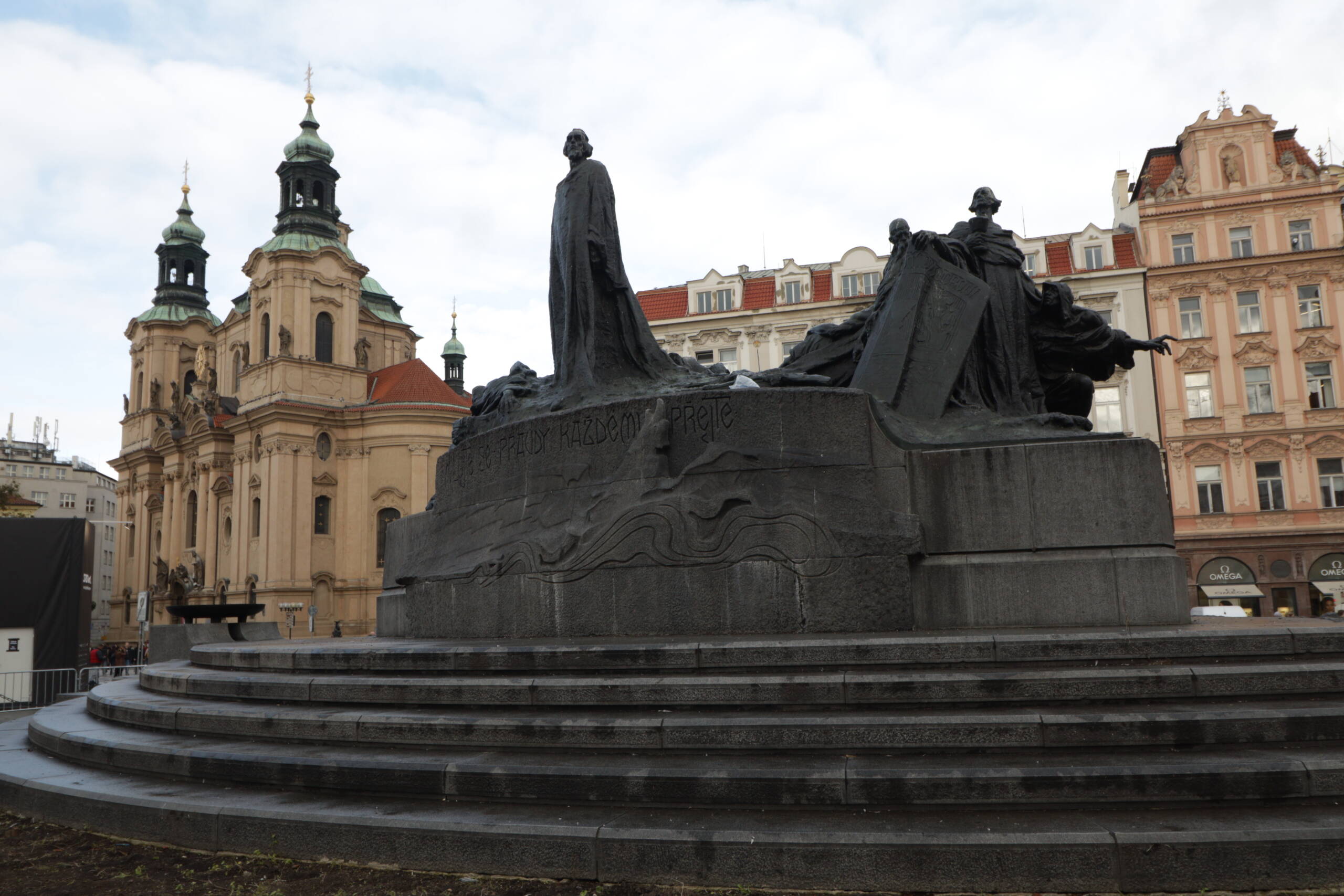
The statue stands there almost like a pause in the middle of the square, a heavy thought cast in bronze. You walk up to it and you realize it’s not simply a monument to a historical figure, but a sort of weathered conscience of Prague itself. Jan Hus stands tall in the center, robed, facing outward with that particular calm that looks more like defiance when you stare long enough. The figures around him look worn, tired, slumped under the weight of things that took too long to change. There’s always this slight echo of something unresolved in the scene, like the past hasn’t finished speaking yet. Behind it, the pale Baroque facade and green domes of St. Nicholas Church rise almost theatrically, like a soft curtain drawn behind a rather severe stage play. You can almost feel the centuries in the stone, the smoke of old markets, the slow swirl of languages layered over time.
Jan Hus was a Czech priest, thinker, and reformer who lived in the late 1300s and early 1400s. He wasn’t one of those distant intellectuals tucked safely behind library walls. He preached in the local language at Bethlehem Chapel in Prague, which already made him different. Most sermons back then were in Latin, meant mainly for clergy and scholars, but Hus believed that ordinary people deserved to understand ideas about faith, morality, and the world they lived in. That alone made him stand out. But what really cemented his place in history was his insistence on calling out corruption in the Catholic Church—selling indulgences, moral hypocrisy among the clergy, the gap between what was preached and what was practiced. He didn’t say these things quietly or indirectly; he said them straight to the people, and people listened.
This didn’t go unnoticed. The Church, which at that time held both spiritual and political power, did not appreciate being publicly criticized. Hus was summoned to a church council in the German city of Constance, supposedly under a promise of safe passage. He went anyway, believing that truth had to be spoken even in uncomfortable places. That faith cost him his life. The safe passage was ignored. Hus was imprisoned, tried for heresy, and burned at the stake in 1415. The accounts say he prayed aloud while the flames rose around him. Whether one views him religiously or historically, it’s hard not to feel something in that image.
His death sparked something bigger than the Church expected. People in Bohemia (what is now the Czech Republic) rose in outrage. His followers became known as Hussites, and they launched a series of resistance movements that shaped Czech identity and European religious history long before Martin Luther came along with the Reformation. In fact, Luther himself later said Hus had been right—and that he was simply carrying forward what Hus began. So you could say Hus was the quiet spark that set off one of the biggest shifts in European history.
That statue in Old Town Square carries all of this, though it doesn’t shout. Hus stands upright, not triumphant, not crushed—just steady. He looks like someone who said what he knew was true and accepted the consequences, which is not a small thing to do. And the people of Prague keep him there, in the center of the city, as a reminder that conviction, even when it burns, leaves a trace that can’t quite be erased.
If you stand a bit to the side, you catch the details in the copper roofs and the pastel houses that ring the square like a cheerful chorus completely unaware of the drama the monument is referencing. But that is Prague’s particular talent: beauty draped over history that was often anything but gentle. Jan Hus was burned for saying things that today wouldn’t raise an eyebrow. Truth, integrity, reform, conscience. Words that feel simple until someone risks something real to say them. And somehow, the monument holds all of that tension without trying to explain itself. It just waits for people to slow down long enough to notice.
I like that there are always tourists circling it, some taking photos in five seconds and heading off for trdelník or beer, others reading the inscriptions while the wind tugs at their coats. The square is full of life—street performers, café chatter, pigeons doing questionable pigeon things—but the monument stays still, as though all it has to offer is time. If you let yourself rest there for a moment instead of treating it as scenery, you start wondering about your own convictions, what you stand for, what you’d defend even when the tide is against you. This is the kind of place that gets into your head a little.
Maybe that’s why Prague doesn’t feel like just another beautiful European city. It wears its contradictions openly: ornate architecture beside the memory of bonfires; pastel facades beside quiet tragedies; beer halls beside philosophical revolutions. The Jan Hus Memorial keeps all of that in balance, without making it dramatic. It’s just standing there, as if saying: here is what was, and here is what remains. And somehow, that feels enough.