• Skip to main content
  • Skip to secondary menu
  • Skip to footer

Travel Marketing

Travel and Tourism Trends

  • Sponsored Post
  • Travel Event Calendar
  • Travel Market
  • Travel Magazine
  • About
  • Contact

Inside St. Stephen’s Cathedral, Vienna

November 9, 2025 By admin Leave a Comment

The first thing you notice is how the ceiling seems to rise forever, like stone ribs stretching upward in an impossible breath. The vaults curve in long, sweeping arches, pale and ghostlike, while the pillars below are darker and impossovingly tall, their surfaces worked over centuries into lace made of stone. There’s this warm glow from chandeliers—golden drops of light suspended, flickering gently as if the air itself remembers the prayers that have risen here. The crowd below moves as one soft tide, jackets rustling, necks craned. People speak in hushed tones not because anyone told them to, but because the space itself insists on quiet, like a polite but absolute command.
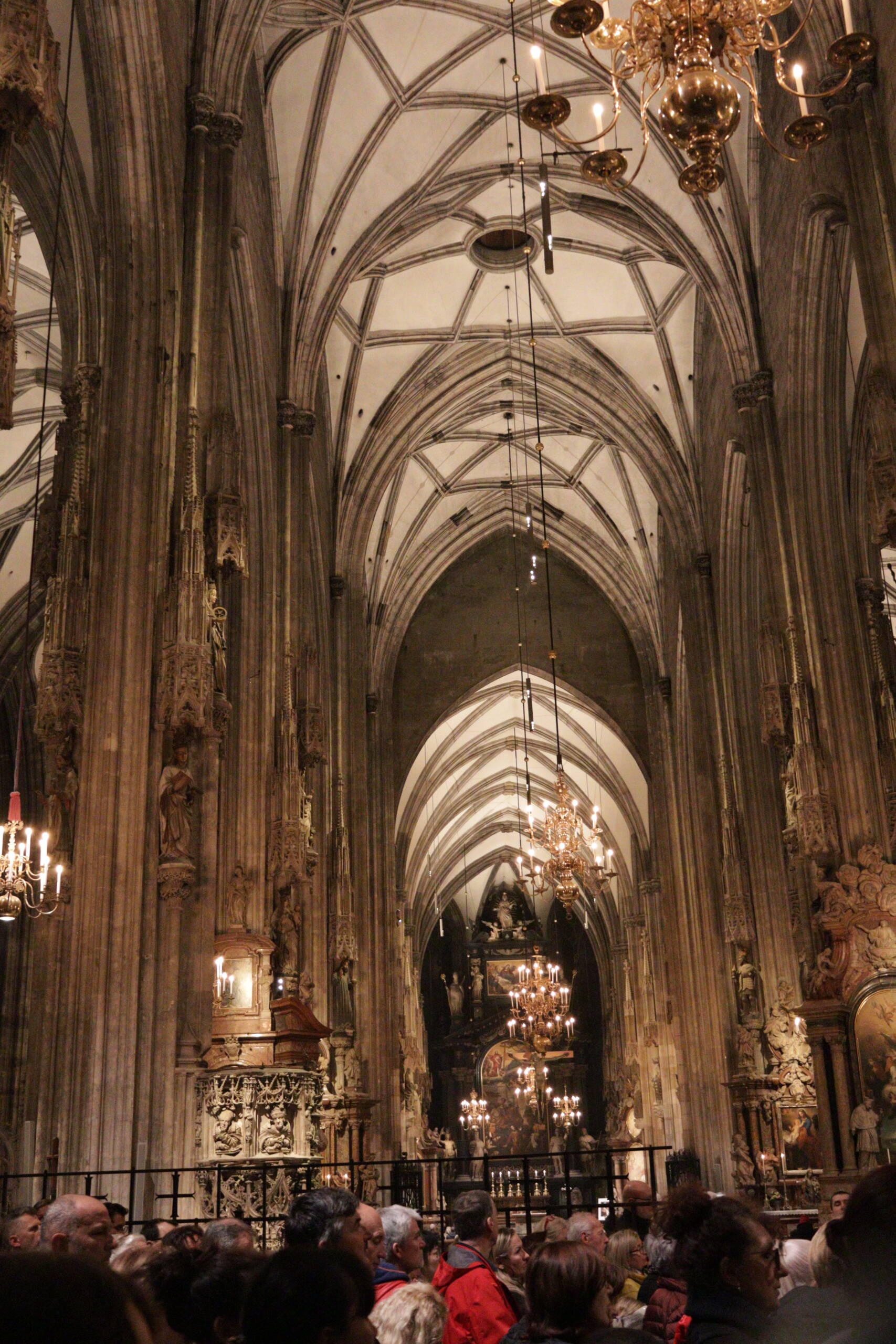
Inside St. Stephen’s Cathedral, Vienna

The statues carved into the pillars watch everything. Some faces look stern, others compassionate, all of them worn down a little by time, candle smoke, and the small erosions of history. You can stand quite close and still feel like they’re a step removed, their expression somewhere between human memory and immortal witness. The pulpit to the left is like a miniature cathedral in itself. Every inch is carved: apostles, saints, creatures tucked into corners, sermons made permanent in stone. If you lean in, you start to notice the absurd amount of detail—little curls of hair, folds of robes frozen mid-movement, the kind of craftsmanship that feels almost unreal now.

The central aisle pulls your eye toward the far altar, where paintings and gilded ornament cluster in a kind of controlled visual storm. The chandeliers hanging down the nave form a rhythm of light, each one marking distance like celestial checkpoints. Everything is symmetrical but also slightly irregular, because Gothic spaces were built by hand, hand by hand, decade after decade. It’s that slight unevenness that makes it feel alive. You almost sense that the building is breathing, just slowly, at the pace of centuries.

Standing here, it’s hard not to think about how many lives have passed through this nave. Weddings, funerals, daily masses, coronations, moments of private despair and quiet hope. The stone has heard confessions that were never spoken aloud. It has felt footsteps from emperors and tourists in equal measure. Someone once lit a candle here for a loved one far away. Someone else stood here to escape the cold. It’s a place of grandeur, yes, but also of strange intimacy, where the scale overwhelms yet the atmosphere pulls you inward.

You walk out feeling a little smaller, but not in a bad way. More like someone reminded you that time is large, and we are just passing through it. And that there’s something wonderful about things built to last longer than any single lifetime.

Filed Under: News

Reader Interactions

Leave a Reply Cancel reply

Your email address will not be published. Required fields are marked *

Footer

Recent Posts

  • St Mark’s Basilica in Venice: The Gold Mosaics Are Dimmer Than the Photographs Suggest
  • China Fines Trip.com $770 Million for Locking Hotels Into Exclusive Deals
  • Château de Monbazillac, Dordogne: A difficult childhood. One château too many.
  • Fora Hits $1 Billion Valuation as AI Transforms the Future of Travel Planning
  • The Open Kitchen Experience: Dining Where You Can Watch the Cooking
  • Holland America Line Adds Flåm and Hellesylt to Five 2027 Norway Fjord Cruises
  • La Cité du Vin, Bordeaux: The Building That Looks Like Wine in a Glass
  • EU Border Delays: ETIAS Pre-Travel Authorization Pushed to Late 2026 as EES Chaos Continues
  • Toledo’s Old Town: A Mudéjar Watchtower Hiding an Antiques Shop
  • Piazza del Duomo, Catania: Where a Black Lava Elephant Guards Sicily’s Baroque Heart

Media Partners

  • Virtual Travel Guide
  • Ancient Rome
The 18th-Century Fountain Hidden Inside Bordeaux’s Customs Museum Courtyard
The Bilbao Effect, 500 Years Early: Jerónimos Monastery And The Guggenheim
Bilbao’s Quiet Renaissance: From Industrial Port to Design Destination
Lisbon’s Seven Hills: A Walking Guide That Tells You the Truth
New Orleans: An American City That Plays by Different Rules
Ha Long Bay Without the Cruise Brochure
Istanbul at the Threshold: A City That Has Always Been Two Things at Once
Iceland’s Ring Road: What the Drive Teaches You That No Photograph Can
Marrakech’s Medina: How to Read a City That Was Not Designed for You
Torres del Paine: What You Are Actually Getting Into
Water Across the Empire: Roman Aqueducts and the Hydraulic Logic of Conquest
The Oath of the Horatii: David's Roman Republic in Paint
Jean-Léon Gérôme: The Victorian Gaze on Rome
Ostia: The Port That Fed Rome
Roman Naval Warfare: The Sea They Called Their Own
The Roman Grain Ship: How Rome Fed Itself Across the Sea
Trajan's Column: Rome's Greatest Comic Strip
Caesarea Maritima: A Roman City Built from Nothing
Damnatio Memoriae: Rome's War on Memory
Faustina the Younger: The Woman Behind the Philosopher Emperor

Media Partners

The Immersive Experience in the Museum World
Japan, China, and Taiwan: A New Triangle of Risk — and a Window of Opportunity for Japan
Ghost Kitchens as Infrastructure: The Shift from Restaurants to Intelligent Food Networks
The Zoom Divide Nobody Saw Coming
The Perfect Budget Content-Creator Kit
Reimagining Prague’s Tourism Future Through Immersive Media and VR Museums
Israel’s Urban Paradox: Tel Aviv Moves, the Rest Stand Still
American Express Global Business Travel (GBTG): Understanding the Business and the Investment Case
Why the Canon R8 Paired With the New RF 45mm f/1.2 Lens Quietly Becomes the Content Creator’s Sweet-Spot
The Future of Travel: A $15.5 Trillion Industry

Copyright © 2026 Travel Marketing

Media Partners: Timey · Publishing House · Ancient Rome · Photography · Calendarial · Transportational