• Skip to main content
  • Skip to secondary menu
  • Skip to footer

Travel Marketing

Travel and Tourism Trends

  • Sponsored Post
  • Travel Event Calendar
  • Travel Market
  • Travel Magazine
  • About
  • Contact

Hundertwasserhaus in Autumn, Vienna’s Most Playful Landmark

October 29, 2025 By admin

Vienna is often celebrated for its imperial palaces, stately concert halls, and the orderly elegance of its boulevards, but tucked away in the Landstraße district there’s a corner of the city that feels more like stepping into an artist’s dream. The Hundertwasserhaus, designed by the eccentric Austrian painter and architect Friedensreich Hundertwasser, refuses the discipline of straight lines and uniform façades. Instead, it bursts forth with irregularity, colors that collide rather than align, and shapes that seem to have grown organically rather than been drawn on an architect’s blueprint. And when autumn drapes itself across the city, this building somehow becomes even more alive, as though the season itself was collaborating with Hundertwasser in his mission to soften the rigidity of modern life.
Hundertwasserhaus in Autumn, Vienna’s Most Playful Landmark

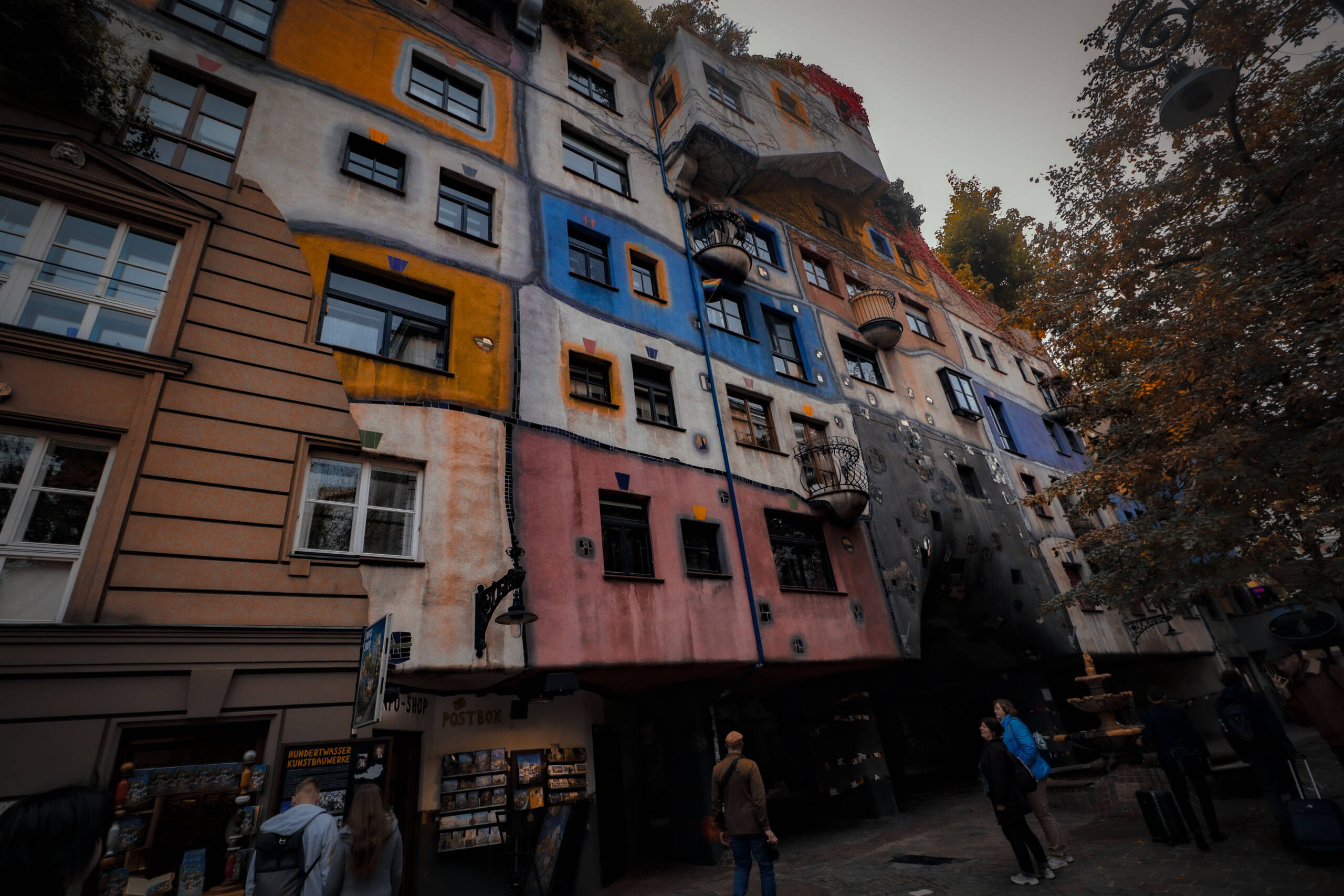
In the image, the façade immediately overwhelms with its patchwork of color—mustard yellows, terracotta reds, deep cobalt blues, and chalky pinks stitched together like a giant quilt. Each window is framed differently, some accentuated with painted triangles, others surrounded by uneven brushstrokes, as though the building were dressed in mismatched patterns on purpose. A conventional architect would have winced at the unevenness, but Hundertwasser cherished these differences, believing every person deserved a unique “window right,” where individuality could be literally built into the walls. In autumn, the play of sunlight and shadow across these tones blends perfectly with the surrounding trees. Their leaves, caught in the middle of their seasonal transformation, mirror the ochres and reds of the walls, as though nature and architecture are in an ongoing conversation.

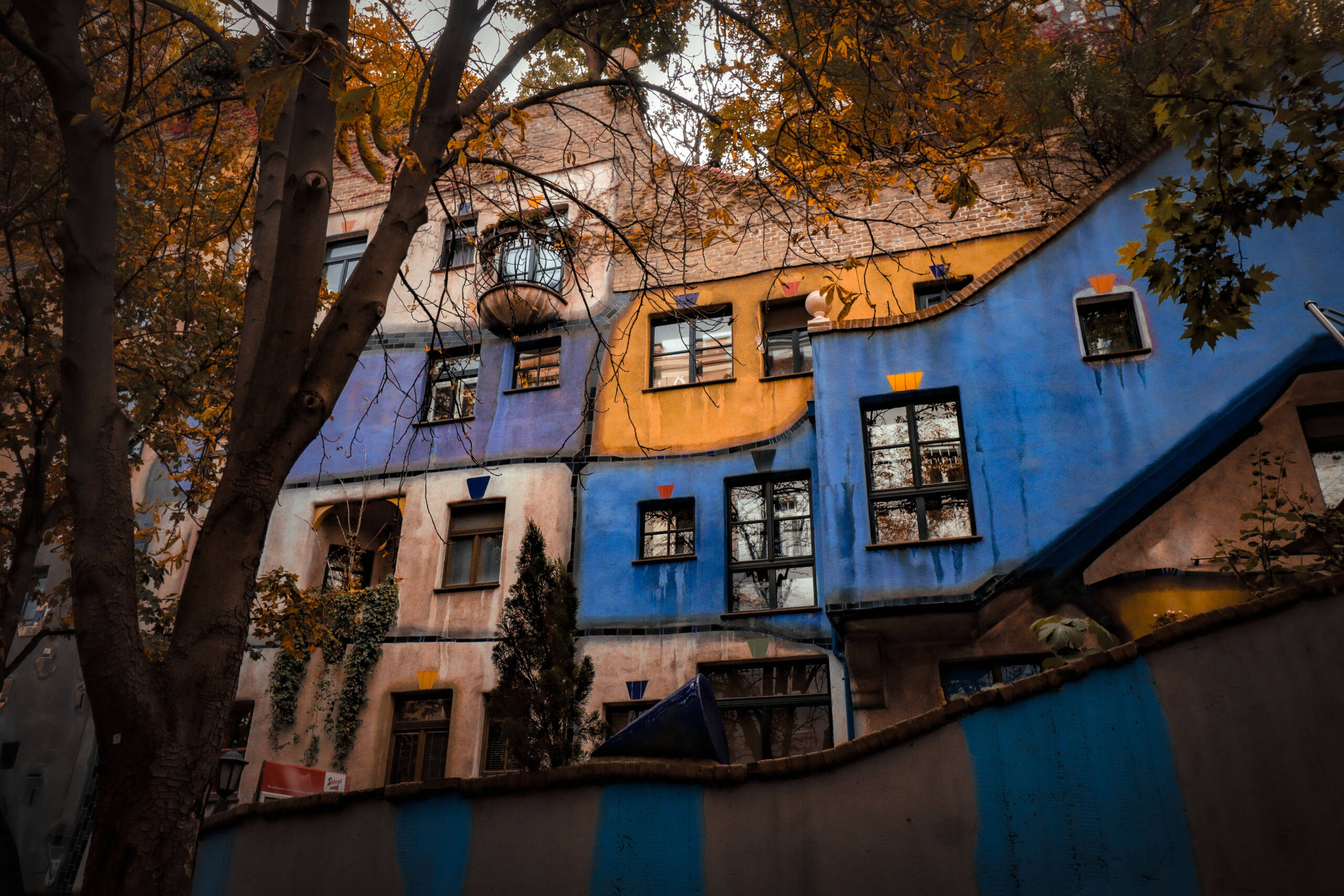
It’s not only color that makes Hundertwasserhaus feel alive—it’s the way it incorporates nature at every level. From the roof sprout trees and bushes that look as if they’ve claimed their rightful place on the structure, spilling downward with roots and branches that defy the line between man-made and organic. In the crisp fall air, you can see the crowns of these trees tinged with gold and red, blending seamlessly into the canopy of the street below. The whole building seems to breathe with the same rhythm as the season, as if it were less a block of apartments and more a hillside that had simply sprouted windows.
Hundertwasserhaus in Autumn, Vienna’s Most Playful Landmark

At street level, the atmosphere is playful and inviting. Small shops tucked under the irregular arches sell Hundertwasser-inspired souvenirs, colorful postcards, and quirky art books. In the photo, visitors are caught in moments of wonder—some craning their necks to admire the eccentric balconies, others quietly observing the way the walls seem to melt into one another. A small fountain sits to the right, water trickling into its basin as people gather around it, half tourists, half accidental philosophers, reflecting on why such whimsy feels so comforting in a city usually associated with discipline and formality. The air has that cool heaviness of autumn, and you almost imagine the faint smell of roasted chestnuts or damp leaves drifting nearby.

Friedensreich Hundertwasser himself was something of a crusader against monotony. He often proclaimed that “the straight line is godless” and argued that buildings should adapt to human beings, not the other way around. He railed against the soulless grids of postwar architecture, insisting that homes should have irregular floors, walls that refused to be symmetrical, and facades that allowed for color, imperfection, and even chaos. Hundertwasserhaus, completed in 1985, became his most famous built manifesto. It is still lived in today—real tenants occupy the patchwork apartments, their daily lives unfolding behind the irregular windows, which gives the building its curious energy. It is not frozen in time like a museum, but instead it shifts with the lives within it, much as trees do with the seasons.

Autumn seems to highlight this philosophy more than any other season. Summer’s brightness can feel too uniform, winter’s gray too stark, and spring’s greens too fresh. But autumn, with its patchwork of decay and vibrancy, its imperfect leaves scattered across cobblestones, feels like the season Hundertwasser himself would have painted. The leaves cling unevenly to branches, just as colors cling unevenly to his walls. Shadows lengthen in distorted ways across the façade, making the irregular balconies and jutting overhangs seem even stranger. Even the worn patches of paint, faded slightly with age, look like natural weathering, as though the building had chosen to molt in sympathy with the trees.

Standing before it in fall, there’s a kind of quiet comfort in realizing how deliberately human the building feels. Unlike most landmarks, which dominate you with scale or impress you with perfection, Hundertwasserhaus invites you to accept imperfection as beautiful. It feels as though the building itself is whispering: life doesn’t need to be aligned to be meaningful, and beauty isn’t found in the flawless but in the surprising, the playful, the irregular. Autumn amplifies that whisper, reminding you that everything, from trees to architecture to ourselves, is always in a state of uneven, messy transformation—and that’s not something to hide, but something to celebrate.

Filed Under: News

Footer

Recent Posts

  • Royal Caribbean Buys 50% of Sandals Resorts for About $3 Billion, Bringing Cruises and All-Inclusives Together
  • TOURISE Summit 2027: March 23-25, Riyadh, Saudi Arabia
  • Wrocław’s Market Square in Fisheye: Why I Kept the Distortion
  • Salamanca’s Stone Faces: A Photo Essay in Five Frames
  • Europe’s Tourist Crime Belt: Pickpockets, Bracelet Scams, and Why the Same Offenders Keep Working
  • The Beach Racket in Italy, Greece and Spain: Turnstiles, Cheap Concessions, and a Shoreline You Can’t Reach
  • Why Lisbon Cafés Are Putting Up No Laptops Signs: Coffee, Instagram, and the Remote Work Terrace
  • Four in Ten Travelers Visit Landmarks Mainly for the Photo: How Instagram and Reels Reshaped Tourism
  • Why Comporta Still Feels Empty: The Rice Estate Behind Portugal’s Most Coveted Beaches
  • Travel in 2026: Five Photos That Explain the Year’s Real Trends

Media Partners

  • Virtual Travel Guide
  • Ancient Rome
  • Travel Magazine
Largo do Chiado at Night: A Brasileira, the Bronze Poet and a Floor Made of Waves
Sintra at Noon, Venice at Midnight: Six European Cities and the Hour That Suits Them
Porto’s Chestnut Season Is the Shoulder Season Worth Booking
Venice at Night Is the Version No Access Fee Covers
The 18th-Century Fountain Hidden Inside Bordeaux’s Customs Museum Courtyard
The Bilbao Effect, 500 Years Early: Jerónimos Monastery And The Guggenheim
Bilbao’s Quiet Renaissance: From Industrial Port to Design Destination
Lisbon’s Seven Hills: A Walking Guide That Tells You the Truth
New Orleans: An American City That Plays by Different Rules
Ha Long Bay Without the Cruise Brochure
Sponsored Post
About
Contact
George Loring Brown's Temple of Peace Painting and the Roman Forum's Most Misnamed Ruin
Half of This Roman Mosaic Glass Bowl Is Plaster, and the Smithsonian Kept It
Julius Caesar's 44 BCE Denarius: The Coin That Helped Get Him Killed
Juno Moneta: How a Roman Goddess Gave Us the Words Money and Mint
Piranesi's Altar to Apollo and the 18th-Century Business of Selling Ancient Rome
A Freed Slave in Augustan Rome Paid to Have His Wrinkles Carved in Marble
The Badminton Sarcophagus Was Carved While the Roman Empire Was Coming Apart
Dolma in Baku: What to Order, How It's Served and Why UNESCO Lists It
Belém Tower Reopened in 2026: Timed Slots, a €15 Ticket and Whether to Go Inside
Big Buddha Temple on Koh Samui: The Naga Staircase, the Dress Code and When to Go
Burgos Cathedral: El Cid's Tomb, the Papamoscas and Free Tuesday Mornings
Caesarea Maritima: Herod's Harbour City, the Ticket and the Free Aqueduct Beach
Catania's Piazza del Duomo: The Lava Elephant, Sant'Agata and the Fish Market Next Door
Château de Fougères: 13 Towers, a Moat and Brittany's Border Fortress
La Cité du Vin in Bordeaux: What €23 Gets You, From the Exhibits to the Rooftop Glass
Haifa Cruise Port in 2026: A New Terminal, One Regular Ship and Which Lines Might Return
Hundertwasserhaus in Vienna: You Can't Go In, So Here's What to Do Instead

Media Partners

  • Travel Market
  • Timey.org
American Museum of Natural History: $37 for Out-of-State Adults and a $465 Million Gilder Center
EU Entry/Exit System Is Live at Every Border, and ETIAS Is Delayed Again With No Date
Hofbräuhaus Munich Pours a Litre for €11.60, About €4 Less Than an Oktoberfest Mass
Hundertwasserhaus Vienna: Free to Look At, Closed to Visitors, With a Paid Museum Five Minutes Away
Les Halles de Bacalan: Bordeaux's Food Hall Next to the Cité du Vin, With About 20 Stalls and No Mondays
Les Machines de l'île Nantes: €12 to Ride a 48-Tonne Elephant, With Rides Paused From November
The Met Charges Visitors $30, While New York State Residents Still Pay What They Wish
Munich Residenz Antiquarium: The Largest Renaissance Hall North of the Alps for a €10 Ticket
Musée des Confluences Lyon: A €255 Million Building, 700,000 Visitors a Year and a €12 Ticket
National Gallery London Stays Free After the UK Drops a Plan to Charge Foreign Visitors
Martian Moon eXplorer 2026, October 19, Yoshinobu Launch Complex LP-2, Tanegashima
Orbital Launch Schedule, Late September and October 2026, With Crew-13 and Starship Flight 14
Why Lisbon Left the Carmo Convent Roofless
Gauguin's Arearea: The Red Dog Paris Mocked in 1893 and the Painting He Bought Back
Plum Tart Is Coming, and These Are the Plums Going Into It
Bandinelli's Hercules and Cacus: It Looks Like a Forced Sexual Act Prelude
The Fencer of Wroclaw: A 1904 Fountain That Outlived the City That Commissioned It
Taobuk and the Infiorata: Two Kinds of Public Culture in One Taormina Square
The Padrão do Salado in Guimarães: Why Portugal's Birthplace Commemorates a Castilian Victory
Wawel Hill in Kraków: The Castle, the Bronze Model, and the Churches Drawn on the Grass

Copyright © 2026 Travel Marketing

Media Partners: Timey · Publishing House · Ancient Rome · Photography · Calendarial · Transportational