There’s this cheerful stretch of street in Prague where time feels a bit slower, and people don’t walk like they’re late to anything. The photo shows rows of market stalls tucked beneath awnings, each one a little treasure cave of souvenirs, wooden toys, handmade bracelets, and those embroidered tablecloths that look like your grandmother’s Sunday best. The buildings lining the street are painted in those soft Czech pastels that always look sunlit, even in winter—pale yellow, warm orange, cream that somehow hasn’t faded despite centuries of wind and tourists brushing past. People are bundled in light jackets, not quite winter coats, just enough to signal that the air has a chill but nothing serious, nothing that could spoil a day of strolling. And the crowd moves in that relaxed, unhurried way you only find in cities that are used to being admired.
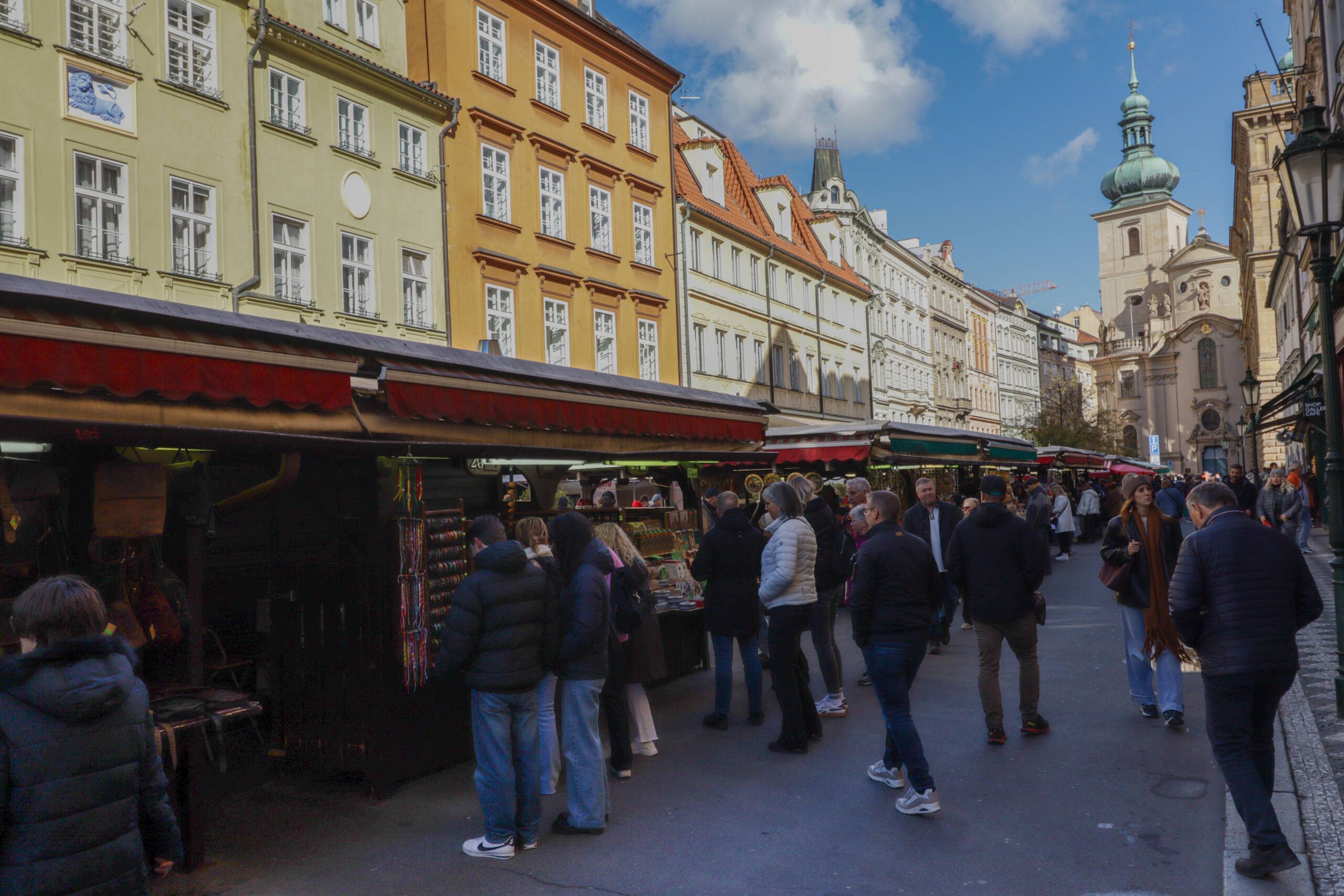
On the right, there’s a church tower rising up with that sort of elegance old European churches have, the greenish copper dome catching the sky. You can almost hear a street musician somewhere behind the stalls, maybe a violin or accordion playing those slightly sentimental Prague melodies that feel like they’ve been echoing through these alleyways forever. The market stalls themselves are dark inside, but the goods hang brightly—rows of bracelets, wooden marionettes, small trinkets that all feel like they carry a piece of the city. People lean in, touch, negotiate softly, exchange a smile with the vendor. There’s something comfortable about it, familiar even if you’ve never been there before.
The whole place has that blend of everyday life and quiet magic. A market that has existed long before Instagram came along to declare what is charming. It is the sort of street where you stop not because you need to, but because you want to see what the world looks like at a slower pace, where old pastel facades and tiny stalls make it easy to believe that traveling is still about wandering and discovering little things.
Walking further down the same market, the scene shifts from handcrafted trinkets to colors so bright you almost forget the chill in the air. The fruit stalls look like someone turned the idea of “abundance” into a display: strawberries piled high, raspberries tucked into every space they can fit, plums with that soft dusky bloom on their skin, grapes the color of champagne pearls. Everything is arranged in little baskets and crates, almost too perfect, as if someone carefully built each mound with the same attention you’d give to stacking a miniature stone garden. The freshness is obvious from the way the berries shine under the low winter sunlight—bright and soft at the same time—like they were picked just enough hours ago that they haven’t had time to wilt or lose their sweetness.

The people around the stall are layered up in scarves, hats, gloves, the kind that make you look cozy instead of just cold. There’s a woman in a white coat with a knit beanie, studying the berries with the seriousness of someone choosing a gift instead of groceries. Another woman holding a takeaway coffee—steam rising just a little—looks on with that pleasant indecision of “do I buy now, or do I come back after I’ve walked the rest of the market?” You can tell she’ll probably come back. Everyone does. Because this is one of those places where the food is not just food, but a small celebration of being here, wandering, unhurried, hungry in the nice way where eating feels like a part of exploring.
And somehow, even though the world has become obsessed with fast and efficient, here is a reminder that the simplest things—a handful of berries on a cold day, picked up from a street market—remain one of the purest pleasures of travel.
There’s something almost theatrical about those fruit stalls—you see them before you smell them, before you realize you’re already slowing down to look. Strawberries piled in little red mountains, raspberries balanced precariously so they seem to defy gravity, glossy plums that look like they were polished by hand. It’s all very charming, very Prague in a postcard, and people love it for good reason. But it’s also one of those moments where you have to quietly remind yourself to take a breath and not just pull out your wallet. Because yes, this is one of the city’s most pleasant tourist traps. A friendly one, a beautiful one, the kind you forgive even as you pay a few extra euros for what is essentially the same fruit you can get from a corner grocery store five streets away. And yet here you are, considering a plastic cup full of berries like it’s a souvenir made of summer.
There’s a kind of psychology at work: the cold air makes the colors pop; the chatter of people creates a sense of “everyone is doing it”; the vendor hands over a sample berry that just so happens to be perfect. The whole thing is designed to feel special. And honestly, it sort of is. It’s part of the wandering ritual. You stroll, you look, you pretend you’re just comparing prices, but then you end up paying the full market-for-tourists price because somehow it feels justified. You’re traveling. You’re in Prague. You’re letting yourself enjoy something simple. And maybe that’s okay, as long as you know what game you’re playing.
If you want the hack, though, it’s easy: go a few blocks to a regular produce shop or one of those small grocery markets tucked under apartment buildings—same berries, lower cost, fewer crowds. Then bring your snack back to the Old Town streets and stroll as if you got it from the market anyway. But if you do end up buying from the stall, don’t feel bad. Some tourist traps are traps because they’re appealing, not because they’re malicious. Think of it like paying for the moment, the atmosphere, the being part of something that feels very Prague on a cold morning. A reminder that travel isn’t just about being wise—it’s also about letting yourself be charmed, even when you know exactly what’s happening.