There’s something quietly cinematic about walking up to this building. The sky was the color of clear glass rinsed after breakfast, that soft autumn-blue that Vienna gets when the air turns cool but the sun still insists on being generous. In front of me rose the Haus des Meeres, the city’s famous aquarium and living museum, standing bold and upright like a modern lighthouse planted in the middle of Mariahilf. Its facade is tall and clear-lined, all glass panels catching bits of sky and reflecting the gold and copper of the surrounding trees, which are already halfway into their autumn costume. The building itself was once a WWII flak tower, and you still sense that history in its proportions — tall, sturdy, a little stubborn — though now it’s softened by glass walkways, observation decks, and the shimmer of water worlds inside. Funny how cities repurpose their scars into places of wonder.
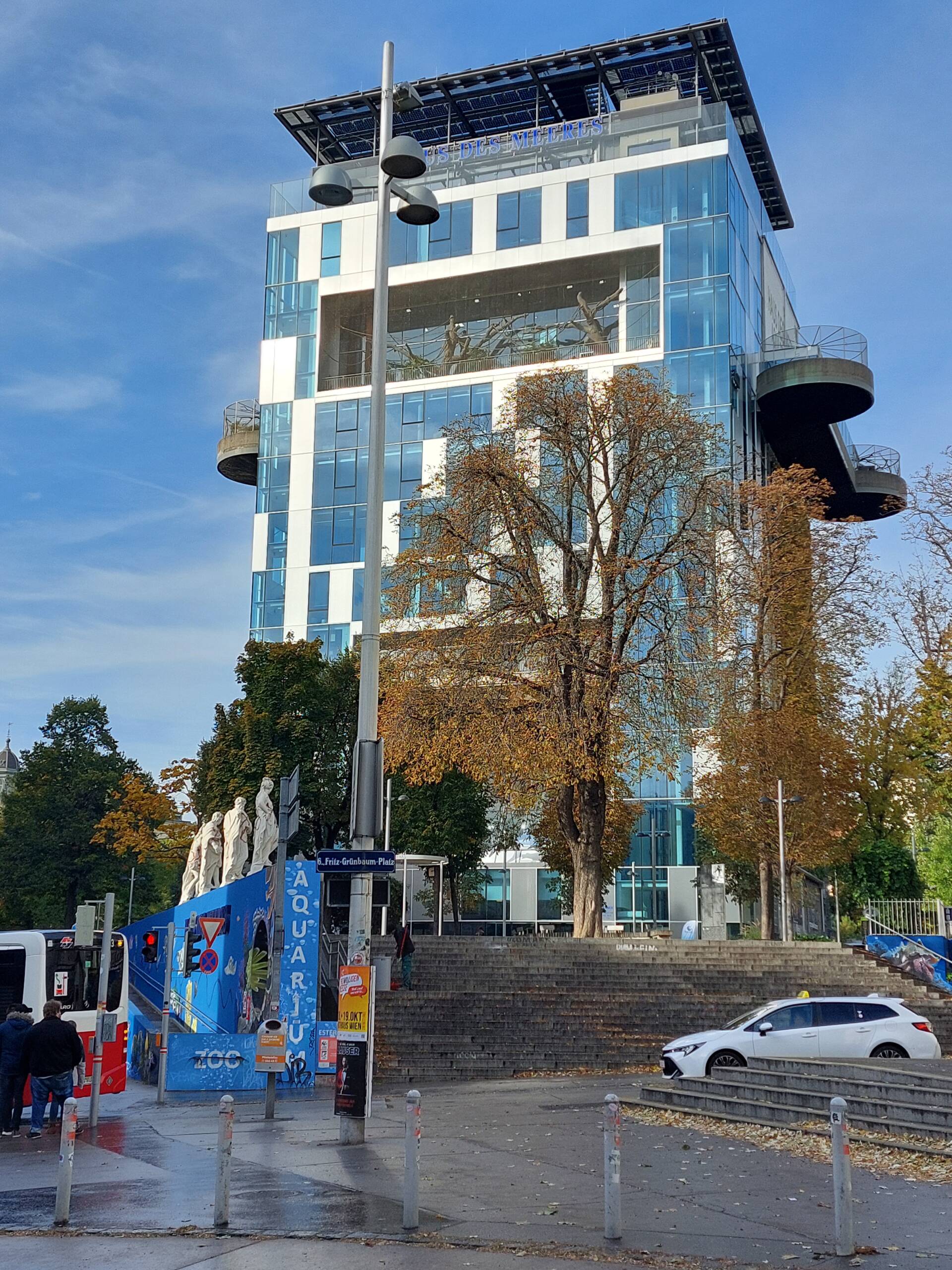
At street level, the view tilts into something more everyday and human. You see the steps leading up, a bit worn from decades of footsteps, with a mixture of tourists, families, and the occasional stroller-pushing local pausing halfway up to catch their breath or take a photo. There are bold murals around the entrance, patches of street art that feel like someone wanted to remind us that science and nature don’t have to be serious all the time. The statues lined along the wall are almost like guardians, their profiles facing outward, watching over a scene where buses circle, people chat, and someone drops a croissant crust for the pigeons. I stood for a moment just watching the small interactions — a taxi idling, a couple deciding whether to go in or just get coffee instead, the way the sun glints off the building’s glass panels like a slow-moving stage light.
Once you step inside, the mood changes and wraps around you with that briny, blue-tinted stillness of aquariums everywhere. But this one is vertical — it goes up, level after level, from the deep-sea tanks with swaying kelp gardens to the rainforest terrace near the roof, where warm air touches your skin and birds fly past just a little too close. It’s strange and lovely to watch sharks glide silently a few meters above Viennese rooftops, or to sip a drink at the rooftop café while the city spreads out like a quiet tapestry below. Vienna feels calmer from up there, almost shy. You remember it’s a city of layers — imperial facades, local bakeries, apartment windows, and somewhere behind the skyline, people hanging their laundry or reheating soup.
I didn’t rush. I let myself move slowly through the tanks and walkways, pausing whenever I saw something colorful or something beautiful or something just slightly weird. It felt like the right pace for this place. And when I stepped outside again and the air was crisp and the leaves were still falling lazily, it felt like I had come back not from an aquarium, but from somewhere softer.
If you ever find yourself in Vienna with a free afternoon and curiosity still intact, come here. Let the stairs lead you up, let the glass hold the sky for you, and let yourself drift a little. It’s a city, after all, but moments like these make it feel like a story.
A flak tower was basically a massive concrete fortress built by Nazi Germany during World War II, designed to protect cities like Berlin, Hamburg, and Vienna from Allied air raids. The name comes from “Flak,” short for Flugabwehrkanone, meaning anti-aircraft cannon. These were not small structures; they were enormous, bunker-like towers with thick walls that could withstand heavy bombing. On the rooftops, giant anti-aircraft guns fired into the sky to defend the city, while inside the towers there were shelters where thousands of civilians could hide during air raids. They were meant to be indestructible, and in a strange way, many of them still stand because taking them down would require more explosives than the buildings around them could survive.
Vienna has a few of these towers, and the one in your photo was transformed into the Haus des Meeres, this glassy, modern, slightly surreal aquarium rising out of the old concrete shell. You can still sense the heaviness of its past in the shape and bulk of the building. It’s a strange feeling when you think about it: a structure once built for war now filled with coral reefs, tropical birds, and schoolchildren pointing at turtles. History doesn’t disappear, but sometimes it gets reimagined, softened, almost rewritten by new uses. And that contrast gives the place a mood that’s hard to describe — part solemn, part hopeful, part alive.
Leave a Reply