There’s something quietly cinematic about standing in front of this monument in Burgos, watching the bronze horse rear with such conviction that you almost expect its hooves to clang against cobblestone. The sky here was gray when I stood before it — that soft northern Spanish gray that doesn’t apologize for existing — and in a strange, almost childish way, it fit the mood. Because this statue isn’t just metal and posture. It’s memory. It’s myth. And for some of us, it’s a fragment of childhood preserved in film grain and VHS texture.
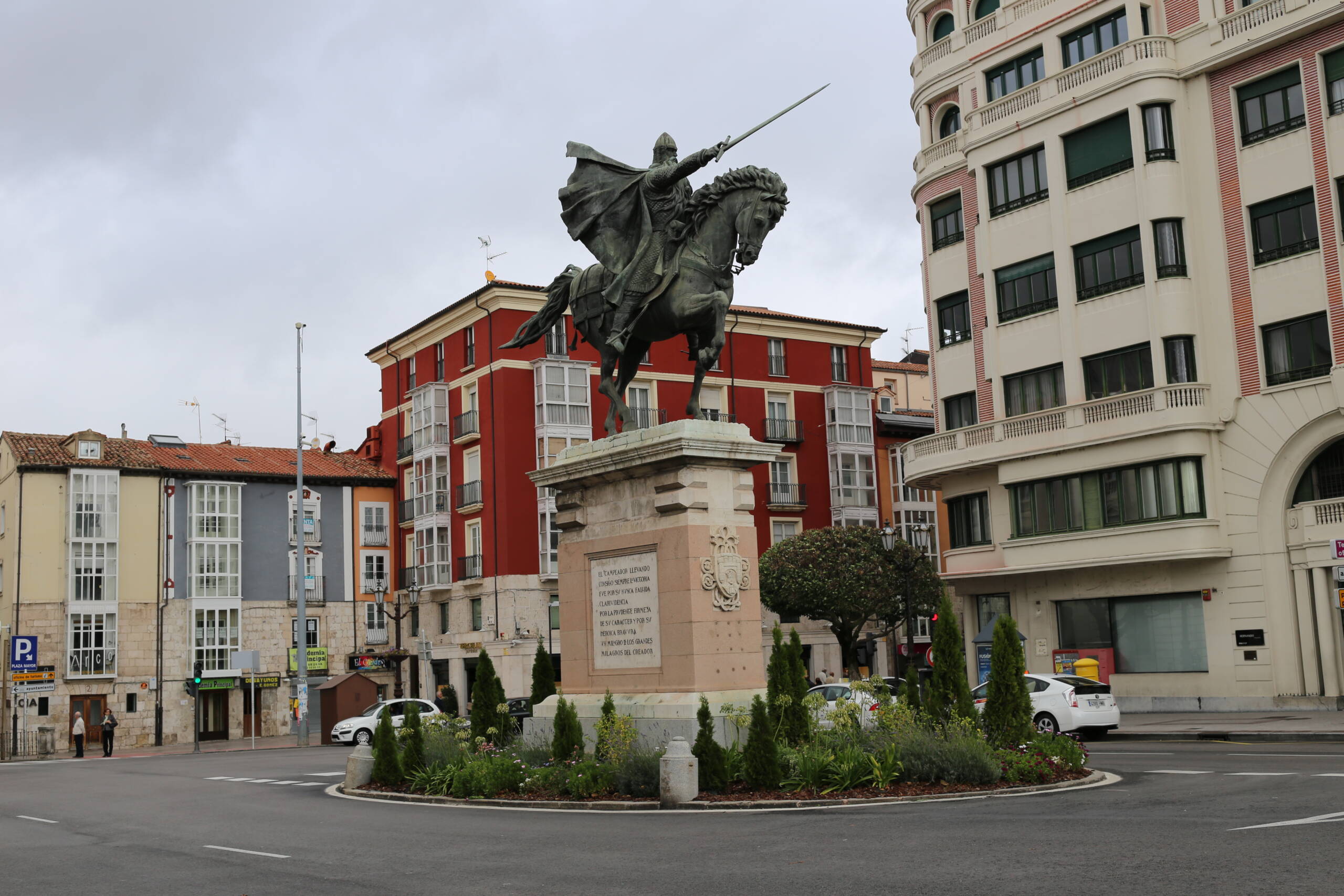
The statue depicts Rodrigo Díaz de Vivar — El Cid — the medieval knight whose life blurred the line between history and legend. Born near Burgos in the 11th century, he fought as both hero and mercenary, serving Christian and Muslim rulers alike. Spain still argues about what that means. Was he a patriot of a yet-unborn Spain? A sword-for-hire navigating fractured kingdoms? A man simply trying to survive and leave his mark on time? History never gives clean answers, and part of me loves that. Clean stories are boring — messy lives are the ones that become legends.
What I kept thinking, absurdly enough, was Charlton Heston. When I was younger, the 1961 epic film El Cid felt impossibly grand. Heston on horseback, Sophia Loren looking impossibly beautiful and vulnerable — the kind of Hollywood storytelling that made medieval Spain feel like destiny rather than dusty stone, dynastic feuds, and uncertainty. As a kid, you don’t question accuracy; you just absorb myth. And standing here years later, with the real statue towering above traffic and daily life, it’s impossible not to feel that old cinematic emotion stirring again — just gentler, quieter, enriched with history rather than spectacle.
The real sword — Tizona — rests here in Burgos, displayed in the museum just a short walk away. Seeing it is strange. Movies and stories exaggerate weapons into impossible objects, glowing with destiny. The real sword is… well, a sword. Iron, weight, workmanship, yes — but still a thing built by hands, swung by muscle, carried by a man who was neither immortal nor invincible. It makes the myth somehow more intimate. And more tragic.
Around the monument, Burgos hums with its own rhythm: narrow streets, stone façades, balconies with their enclosed wooden glasswork typical to northern Spain. Life continues around El Cid, the way life always continues around monuments — indifferent yet respectful, as though acknowledging that this bronze figure is part of the city’s identity even if the past no longer dictates the present.
As I lingered a moment longer — probably longer than necessary — it struck me how travel and memory intersect. We go to places wanting to see history, but what we find is ourselves reflected in it. A childhood film becomes a real landscape. A legend becomes a man. And a statue becomes a moment — standing in the drizzle of northern Spain, realizing time isn’t linear; it loops. Stories return to us when we’re old enough to read them differently.
Walking away, I glanced back once more. El Cid still pointed his sword forward — forever advancing, forever fighting battles that no longer exist. But maybe that’s the point. Some legends don’t need to win. They just need to endure.
And standing in Burgos, with the air smelling faintly of rain and stone, I felt a quiet certainty: the story has endured. And so has the feeling that made a child believe in knights, destiny, and the impossibly romantic past.
Some places do that to you. Burgos is one of them.