Few paintings capture the subtle choreography of social interaction as powerfully as Edouard Manet’s In the Conservatory (1879), and to stand before it in the Gemäldegalerie in Berlin is to feel time slow into an extended moment of human tension. At first glance, the scene is calm: a fashionable woman sits stiffly on a bench in a lush conservatory, gloved hands folded over a pale parasol, while a bearded man leans toward her, resting his arm casually along the backrest, his gaze intent. Yet beneath this surface composure simmers an extraordinary drama—not of action, but of implication.
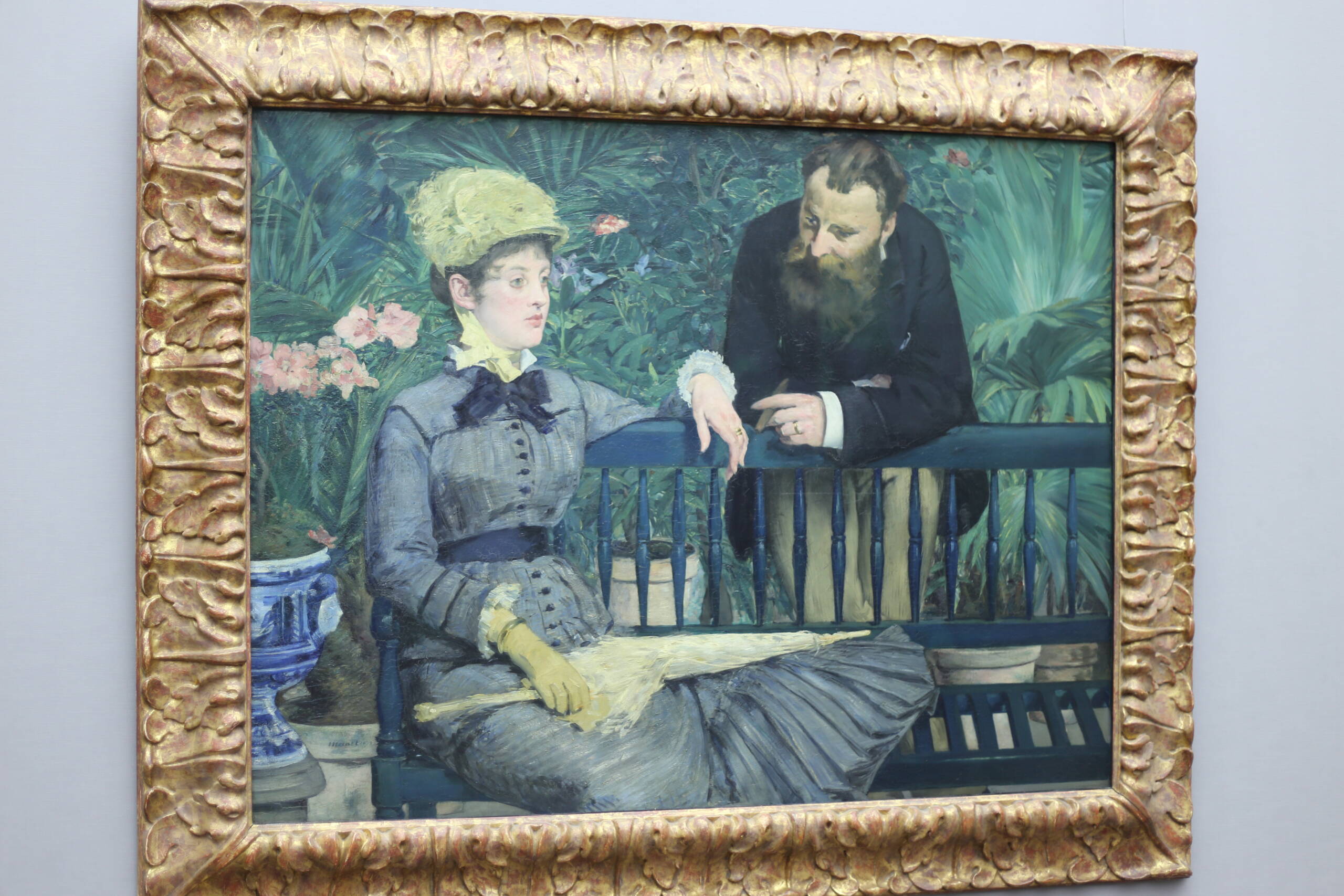
The conservatory setting itself is significant. Glasshouses in 19th-century Paris were symbols of cultivation, leisure, and modern bourgeois refinement. They offered an artificial paradise, carefully ordered nature held under human control. Against this backdrop of cultivated greenery, Manet stages a different kind of cultivation: that of gendered roles, marital dynamics, and social performance. The woman, her torso held upright, gaze slightly averted, appears both present and absent—an elegant mannequin of Parisian fashion, corseted into propriety. Her expression resists reading, as though a veil of indifference shields her thoughts. The parasol in her lap, closed and resting, becomes a metaphor of containment, of restrained possibility.
The man, by contrast, leans forward into the space, pointing with his hand, his beard thick and dark, his posture suggesting control and assertion. He looks at her, not at us, and in doing so makes us complicit in the act of overhearing. Is he persuading, scolding, wooing, or lecturing? The ambiguity is deliberate. Manet offers no textual anchor—no mythological allusion, no historical reference—only the silence of a private moment rendered public. The scene feels intensely modern because it stages, with psychological precision, the unspoken negotiations of power within an intimate relationship. The conservatory becomes less a garden and more a theatre of tension.
What makes this painting particularly fascinating is how it embodies the Impressionist era’s transformation of subject matter. Manet, often described as the bridge between Realism and Impressionism, turned his gaze not to heroic myth but to the fleeting, everyday interactions of contemporary Parisians. Yet his brush still carries a weight beyond mere observation. The flowers and foliage behind the figures form an almost suffocating density, their abundance pressing forward, contrasting with the cold reserve of the human encounter. Nature here is lush and free; the couple, by comparison, appear constrained, scripted by social roles and unspoken rules.
Seen in person, the colors hum with a restrained brilliance: the cool steel gray of the woman’s dress, accented by pale yellow gloves and hat, harmonizes uneasily with the earthy blacks of the man’s suit. Between them runs the diagonal of the bench’s backrest, a literal and symbolic barrier. Even the detail of her hand—resting just beyond his reach, fingers curled slightly inward—communicates distance more effectively than words could. It is a masterclass in composition as psychology.
Standing in front of this canvas, one cannot help but feel the push and pull of time. On the one hand, this is unmistakably a 19th-century Parisian couple, dressed in the fashions of their era. On the other, the mood is startlingly contemporary. Who has not sat through conversations heavy with subtext, where words matter less than glances, posture, and silence? Manet renders not dialogue, but the impossibility of dialogue—two figures occupying the same bench yet divided by an invisible gulf.
For the travel writer, this painting serves as more than just a visual highlight of Berlin’s Gemäldegalerie. It reminds us that travel itself is not only about landscapes and monuments, but about entering the psychological landscapes of past centuries. Art museums hold these preserved fragments of human tension, allowing us to witness moments that are both historically specific and eerily timeless. In the Conservatory is not just a window into Manet’s world but into ours, where relationships, power, and silence still perform their endless dance, beneath different fashions but with the same human intensity.
Leave a Reply