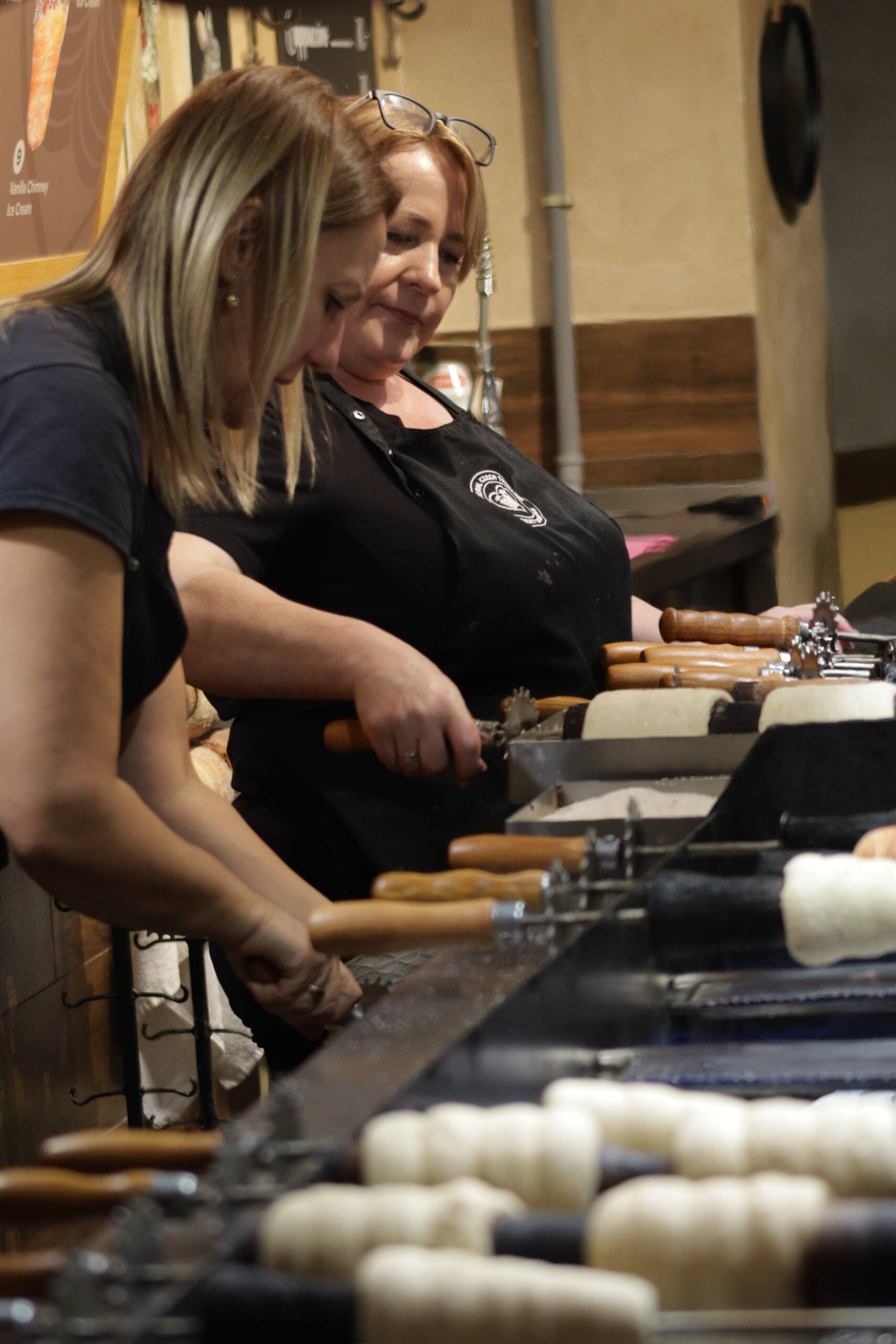
Everywhere you walk in Prague’s Old Town, the air seems thick with the smell of caramelized sugar and warm pastry dough. The little stalls with their wooden rollers glowing under heat lamps pull you in like a stage set, and there’s always someone watching, snapping photos, waiting for their fresh spiral of dough to be pulled from the fire. The photo I took shows exactly that moment of craft—two women bent over their work, each turning the handles with concentration, watching the rows of rolled dough bake into perfect golden tubes. It looks rustic, it feels authentic, and for a moment you believe this must be a centuries-old Czech tradition.
The truth is both less romantic and more fascinating. These pastries—known as trdelník or “chimney cakes”—are not originally Czech at all. Their roots can be traced back to Hungarian and Slovak variations, and the Prague boom is surprisingly recent, only taking off in the 2000s when tourism became the city’s main industry. Clever marketing transformed what was once an obscure regional specialty into the defining street food of Prague, at least for visitors. If you’ve been to the historic center, you’ve seen the queues of tourists waiting for theirs, often piled with ice cream, Nutella, whipped cream, or strawberries. It’s not so much about the flavor as it is about the spectacle—the rolling, the baking, the sugar dusting, and finally the social media moment when the chimney cake becomes a prop.
And yet, if I’m brutally honest, the pastry itself rarely lives up to its performance. Bite into it and you’ll likely get a sugar-crusted exterior that feels promising, followed by a bland, slightly rubbery interior that tastes—well, to me—like cardboard. The dough is often underbaked on the inside, overcooked on the outside, and entirely dependent on whatever topping you’ve paid extra for. Strip away the Nutella and whipped cream, and what remains is a hollow shell with very little character. This is why most Prague locals steer clear of them, and why the real Czech pastry treasures—koláče filled with poppy seed, větrník with its caramel glaze, or even a simple apple strudel—remain hidden in neighborhood cafés away from the tourist funnel of Old Town Square.
That being said, there’s something hypnotic about watching chimney cakes being made. It’s almost theatrical, like watching glassblowers or candy makers at work, where part of the appeal lies in the process itself. The women in the photo lean into their craft, brushing and rolling, giving the impression of dedication and tradition. Tourists love that kind of imagery—it makes them feel they are not just buying a snack, but experiencing a piece of culture. In reality, it’s a carefully engineered performance, designed to align with the image of Prague as a medieval fairytale city. The irony is that this “authentic” snack is more recent invention than genuine heritage.
If you think about it, chimney cakes are not alone in this. Europe is full of these culinary tourist traps, where presentation and photogenic appeal matter far more than taste. Take the rainbow-colored gelato cones in Florence, piled absurdly high to lure passersby, even though locals stick to the understated artisan shops. Or the giant paella pans simmering on La Rambla in Barcelona, which look dramatic but serve rice that’s watery and lifeless compared to what you’d find in a Valencian home. In Vienna, it’s the café Sachertorte that commands long lines, while most Viennese prefer other, less hyped desserts. These foods aren’t inherently bad—they’re simply hollowed out by tourism, transformed into commodities that rely on visuals rather than substance.
Still, there’s no denying the chimney cake has become a rite of passage for visitors to Prague. Maybe it’s worth trying once, just to say you did, just to hold that steaming pastry in your hands and see how the light sugar dust sparkles in the evening air of the Old Town. Maybe it’s worth the Instagram photo, even if the first bite disappoints. Travel, after all, is not only about discovering the best flavors but also about experiencing the cultural theatre staged for you. Sometimes it’s kitschy, sometimes it’s fake, but it tells you something important about how cities present themselves to outsiders. Prague’s chimney cakes are exactly that—an edible souvenir of the city’s global rebranding, a sugary shell as hollow as the pastry itself.
So, if you find yourself in Prague, here’s my advice: buy one, laugh about the taste, take your picture, and then seek out the real flavors of the city. Wander into a small café off the beaten path, order a slice of poppy seed cake or a custard-filled pastry, and you’ll taste the difference immediately. Chimney cakes may look magical, but the true sweetness of Prague is elsewhere, waiting quietly for those who look beyond the crowd.
Leave a Reply