• Skip to main content
  • Skip to secondary menu
  • Skip to footer

Travel Marketing

Travel and Tourism Trends

  • Sponsored Post
  • Travel Event Calendar
  • Travel Market
  • Travel Magazine
  • About
  • Contact

A Facade in Josefov, Prague, Where History Rests in the Walls

November 7, 2025 By admin Leave a Comment

The Jewish Quarter in Prague has a particular way of holding its breath. The streets don’t shout; they remember. This building, just by the Old-New Synagogue, appears almost like a guardian of those memories. You stand beneath it and feel layers: Art Nouveau curves and ornamental flourishes, yes, but also the quiet trace of a neighborhood that endured centuries of joy, scholarship, trading, prayer, expulsion, return, loss, survival. The name on the mosaic band — “U Staré Synagogy” — isn’t decoration. It’s geography of identity. It reminds you that you are standing just steps from one of the oldest functioning synagogues in Europe, where prayers have been spoken in continuity since the 13th century. The building seems aware of this, the way a respectful guest might lower their voice.
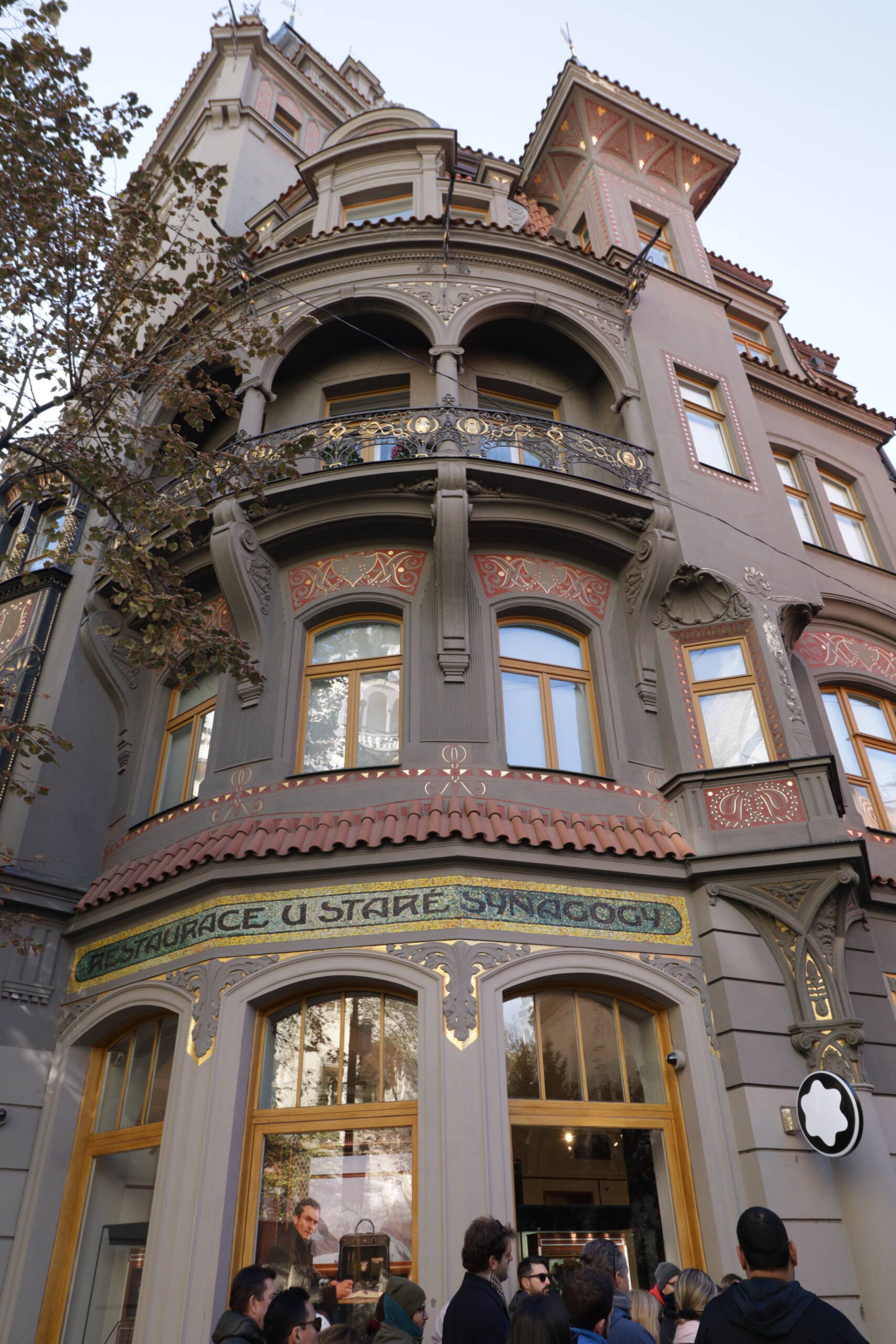
A Facade in Josefov, Prague, Where History Rests in the Walls

Looking up, you see warm wooden windows reflecting the narrow street and the people passing below. The iron balconies swirl in careful gold, like someone tried to translate Hebrew calligraphy into metal. The soft grey walls don’t try to overpower anything; they allow the street itself to remain the main character. It’s almost funny how many people queue here without quite noticing that the architecture is speaking — quietly, politely — about the past. The people below, wrapped in coats and scarves, are chatting, taking photos, thinking about coffee or lunch, unaware that the building is part witness, part storyteller.

Josefov is like that. The quarter has been rebuilt and reimagined more than once. Much of what surrounds this facade came after the great urban renewal at the turn of the 20th century, when Art Nouveau visionaries reshaped the district into a modern boulevard quarter. But the memory of the ghetto, of the rabbis, of the cemeteries with gravestones leaning like folded paper, didn’t vanish. They seeped into details. Into names on signs. Into decorative motifs that resemble vines and scrolls and protective symbols. Into the way the buildings never feel entirely carefree, but rather dignified, observant.

Standing there, you feel the city isn’t trying to teach anything or insist on solemnity. It just invites you to slow down long enough to notice where you are. And maybe that’s the beauty of the Jewish Quarter — the idea that history isn’t a museum exhibit behind glass. It’s the street, the stones, the corners of windows, and façades like this one, quietly holding the echoes of prayers, laughter, arguments, and everyday life across hundreds of years.

Filed Under: News

Reader Interactions

Leave a Reply Cancel reply

Your email address will not be published. Required fields are marked *

Footer

Recent Posts

  • Fora Hits $1 Billion Valuation as AI Transforms the Future of Travel Planning
  • The Open Kitchen Experience: Dining Where You Can Watch the Cooking
  • Holland America Line Adds Flåm and Hellesylt to Five 2027 Norway Fjord Cruises
  • La Cité du Vin, Bordeaux: The Building That Looks Like Wine in a Glass
  • EU Border Delays: ETIAS Pre-Travel Authorization Pushed to Late 2026 as EES Chaos Continues
  • Toledo’s Old Town: A Mudéjar Watchtower Hiding an Antiques Shop
  • Piazza del Duomo, Catania: Where a Black Lava Elephant Guards Sicily’s Baroque Heart
  • Château de Fougères: Inside Europe’s Largest Medieval Fortress
  • Château de Vitré: The Medieval Fortress Guarding Brittany’s Eastern Gate
  • Miroir d’eau at Blue Hour: Bordeaux’s Water Mirror Comes Alive

Media Partners

  • Virtual Travel Guide
  • Ancient Rome
Lisbon’s Seven Hills: A Walking Guide That Tells You the Truth
New Orleans: An American City That Plays by Different Rules
Ha Long Bay Without the Cruise Brochure
Istanbul at the Threshold: A City That Has Always Been Two Things at Once
Iceland’s Ring Road: What the Drive Teaches You That No Photograph Can
Marrakech’s Medina: How to Read a City That Was Not Designed for You
Torres del Paine: What You Are Actually Getting Into
Kyoto in Autumn: What the City Looks Like When the Maples Turn
Disneyland Paris Rewrites Its Script With World of Frozen and Disney Adventure World
Wallace Fountain: Carrying Water, Carrying Values
Water Across the Empire: Roman Aqueducts and the Hydraulic Logic of Conquest
The Oath of the Horatii: David's Roman Republic in Paint
Jean-Léon Gérôme: The Victorian Gaze on Rome
Ostia: The Port That Fed Rome
Roman Naval Warfare: The Sea They Called Their Own
The Roman Grain Ship: How Rome Fed Itself Across the Sea
Trajan's Column: Rome's Greatest Comic Strip
Caesarea Maritima: A Roman City Built from Nothing
Damnatio Memoriae: Rome's War on Memory
Faustina the Younger: The Woman Behind the Philosopher Emperor

Media Partners

The Immersive Experience in the Museum World
Japan, China, and Taiwan: A New Triangle of Risk — and a Window of Opportunity for Japan
Ghost Kitchens as Infrastructure: The Shift from Restaurants to Intelligent Food Networks
The Zoom Divide Nobody Saw Coming
The Perfect Budget Content-Creator Kit
Reimagining Prague’s Tourism Future Through Immersive Media and VR Museums
Israel’s Urban Paradox: Tel Aviv Moves, the Rest Stand Still
American Express Global Business Travel (GBTG): Understanding the Business and the Investment Case
Why the Canon R8 Paired With the New RF 45mm f/1.2 Lens Quietly Becomes the Content Creator’s Sweet-Spot
The Future of Travel: A $15.5 Trillion Industry

Copyright © 2026 Travel Marketing

Media Partners: Timey · Publishing House · Ancient Rome · Photography · Calendarial · Transportational