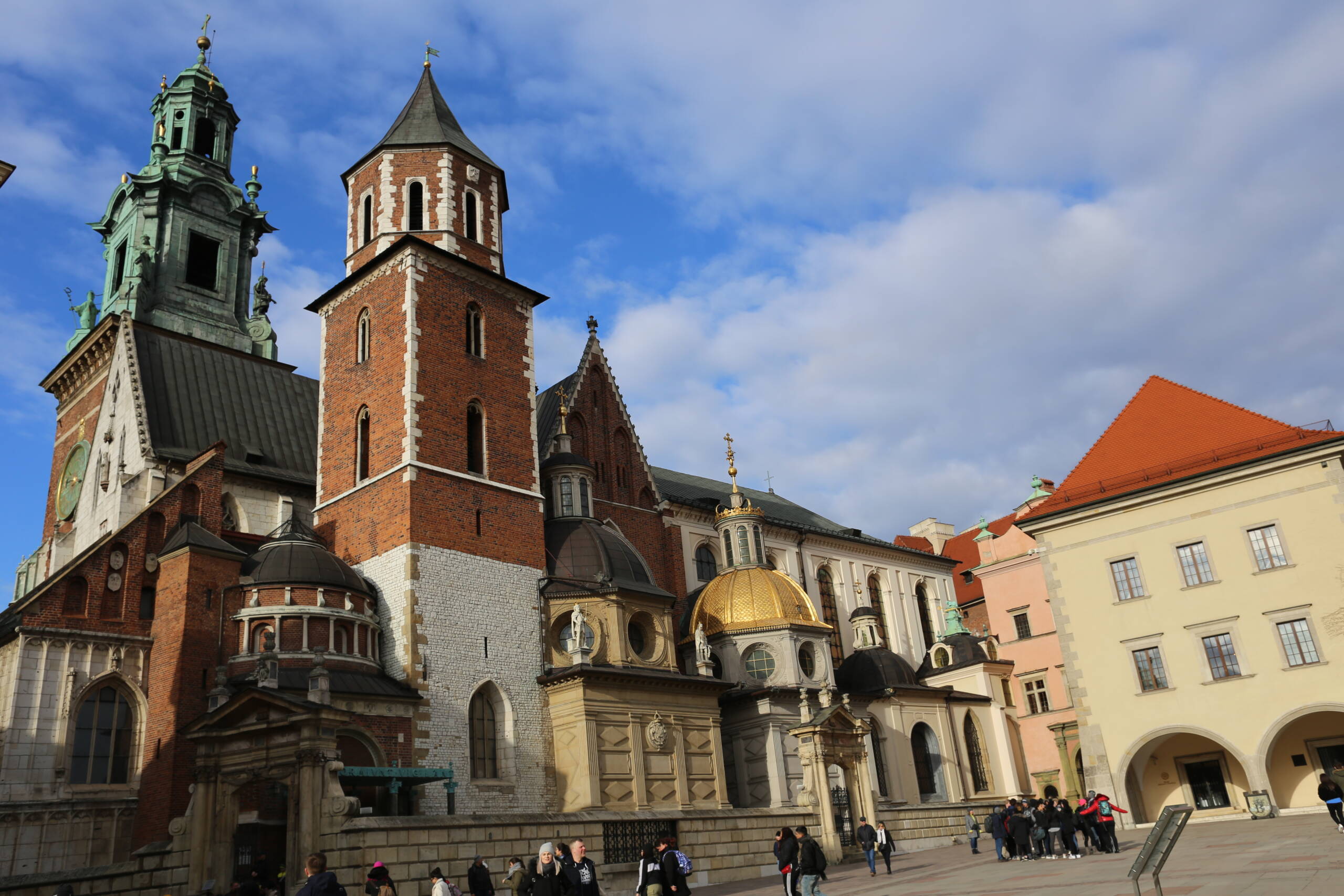
The scene unfolds with a kind of layered grandeur that feels almost accidental at first glance, as if centuries simply stacked themselves here without asking permission. The image captures the unmistakable silhouette of Wawel Cathedral, its red brick tower rising sharply into a sky that can’t quite decide between blue and drifting cloud. That central tower—tall, slightly austere—anchors the composition, while around it a cluster of domes, chapels, and architectural moods gathers like a conversation between eras. To the left, a green-patinated bell tower leans into the skyline, its oxidized copper hinting at age and endurance, while below it, smaller rounded chapels press outward, almost protective.
Street and Travel Photography with the Canon EF 28mm f/1.8 USM
Closer in, the golden dome of the Sigismund Chapel catches the light in a way that feels deliberate, almost theatrical. It’s not just reflective—it glows. That dome, one of the most iconic Renaissance elements in Poland, sits nestled against Gothic walls, creating a contrast that somehow works better in person than in theory. The stonework beneath it is dense with detail—arches, niches, carved figures—yet from a distance it resolves into something calm, almost orderly. You can see how Kraków built its identity here, not through uniformity but through accumulation.
At ground level, the scale shifts again. Visitors gather in small clusters, some pausing near informational plaques, others just standing and looking up, which seems to be the default behavior here. There’s a slight randomness to their movement—tour groups forming and dissolving, a couple drifting off toward the courtyard edge, someone pointing upward as if trying to explain history in a sentence or two. The open square gives the cathedral breathing room, framed by softer-toned buildings with red-tiled roofs that feel almost modest compared to the cathedral’s layered intensity.
This is the heart of Wawel Hill, and it carries that weight in a very physical way. Polish kings were crowned and buried here, national stories were shaped here, and even now, standing in the courtyard, there’s a subtle sense that this isn’t just a monument—it’s a reference point. Not loud, not overwhelming, just… present.
Traveling here isn’t about ticking off another cathedral, even if it might start that way. It’s more about noticing how the place resists simplification. Gothic meets Renaissance, stone meets gold, tourists meet something older than tourism itself. And somewhere in between, you find yourself lingering longer than planned, looking up again, trying to catch how the light hits that dome just right before it shifts.
Leave a Reply