The scene holds together in a way that feels almost accidental at first, like you just happened to turn a corner and everything aligned. A stretch of open space, pale stone underfoot, and then rising sharply into the sky, the layered domes of the Basilica of Saint Anthony of Padua. They don’t follow the usual Italian rhythm; there’s something slightly eastern in their shape, something that hints at Venice, trade routes, and a broader world folded into this one place. The façade, with its arches and geometric calm, anchors that complexity back into something more grounded, more familiar.
And then your eye shifts—almost automatically—to where a second presence should be. For centuries, that space has been occupied by Donatello’s Gattamelata. Bronze, dark, composed. A rider and horse caught mid-stride, though not in any dramatic sense. The movement is restrained, almost deliberate in its lack of spectacle. The horse advances with controlled energy; the rider sits upright, calm, authoritative. But now, at least for a while, that anchor point is missing.
Donatello’s Gattamelata—arguably one of the most important bronze sculptures ever made—has been removed from its historic piazza and taken indoors for restoration. After nearly six hundred years outdoors, exposed to rain, pollution, temperature shifts, and the slow, persistent chemistry of corrosion, the statue has reached a point where intervention is no longer optional.
It’s easy to forget how radical this work once was. When Donatello completed it in 1453, he wasn’t just creating a monument—he was reviving an entire artistic language that had been dormant since ancient Rome. Large-scale bronze equestrian statues had effectively disappeared for over a millennium. Here, suddenly, was a condottiere—Erasmo da Narni, known as Gattamelata—elevated into something timeless, almost imperial. Not theatrical, not exaggerated, just controlled power rendered in metal.
The basilica beside it reaches back even further. Built in the 13th century to honor Saint Anthony of Padua, it remains one of the most important pilgrimage sites in Europe. Pilgrims still arrive daily, drawn to the tomb inside. Architecturally, it feels less like a single design and more like a record of time—Romanesque mass, Gothic articulation, Byzantine-influenced domes layered together. It doesn’t resolve into one style, and that’s part of its character.
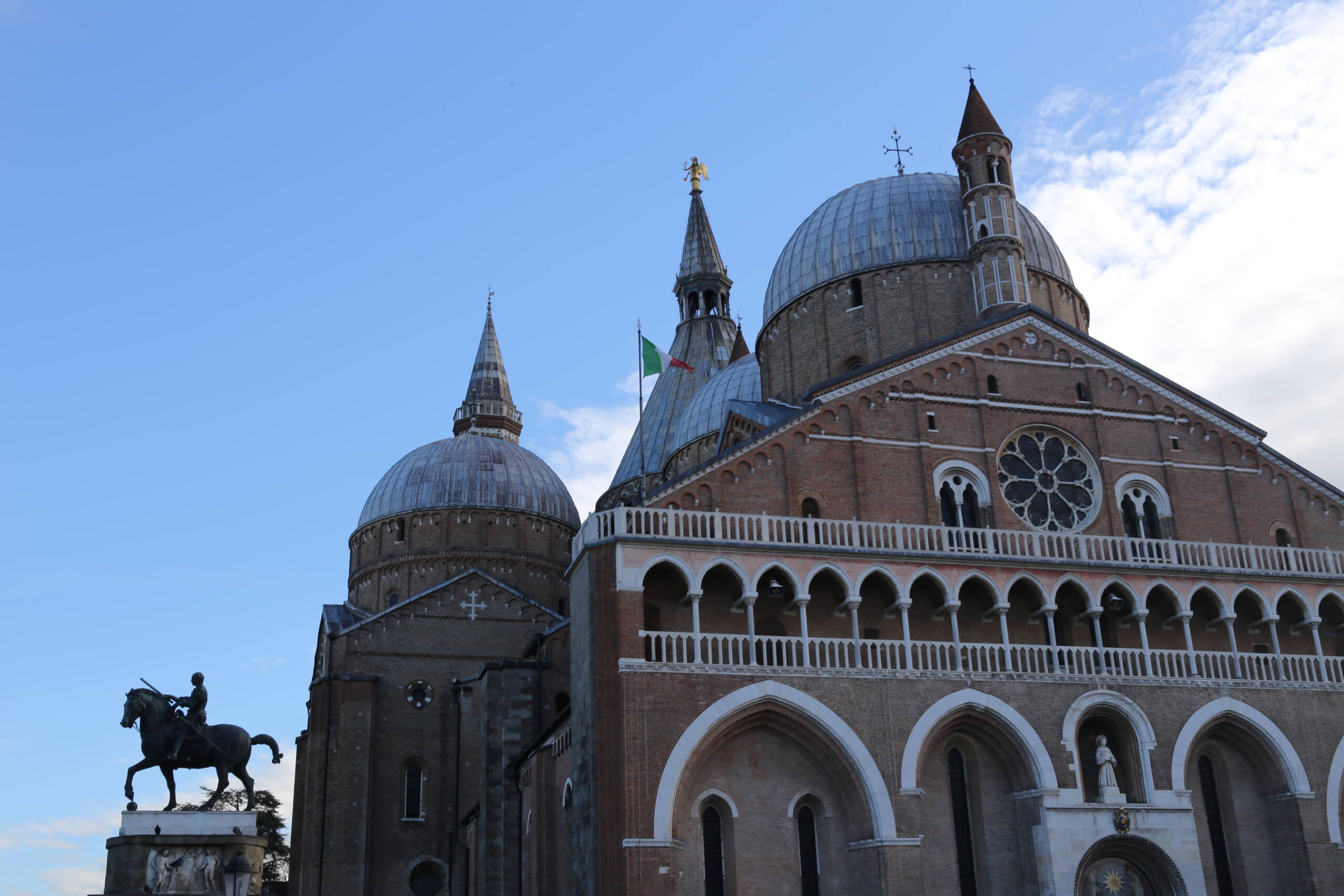
Standing here, you begin to notice how the two presences interact—or used to. The basilica pulls your gaze upward, into sky and abstraction, something spiritual, almost weightless despite the scale. The statue does the opposite. It pulls you back down—to metal, to gravity, to human ambition. Between them, the square becomes a kind of quiet tension point, where different ideas of permanence meet.
Which is why its removal feels less like maintenance and more like interruption.
The reasons are entirely practical. Bronze doesn’t survive unchanged in open air forever. Conservators have identified corrosion processes—often referred to as bronze disease—as well as internal structural issues caused by water infiltration over centuries. These are not superficial concerns; they affect the integrity of the sculpture itself. Left untreated, the damage becomes irreversible.
So the statue goes indoors. Controlled climate, detailed study, careful stabilization. All necessary. Possibly overdue.
But what happens next is not a technical question—it’s a philosophical one.
Return it to the piazza, and the cycle continues: exposure, slow degradation, periodic intervention. Keep it indoors, and you preserve the object, but detach it from the space that defines it. The relationship with the basilica changes. The light changes. The scale changes. Even the meaning shifts, subtly but unmistakably.
You can almost read that dilemma in the image itself. Late in the day, the brick of the basilica warms slightly, holding onto detail, while the bronze figure—when it is present—darkens into silhouette. The rider becomes less a person and more a shape, a memory of form. Without it, the square doesn’t collapse, but it does feel different. Less anchored. Less resolved.
Padua doesn’t present itself in dramatic gestures. It layers meaning slowly, through proximity, through time, through these visual relationships. Stone and bronze, faith and power, vertical and grounded—all held in balance for centuries in a single view.
For now, one of those elements is missing. And what replaces it, if anything, will say as much about our time as Donatello’s original did about his.