Spring has arrived at the Empire State Building with a full slate of seasonal activations designed to turn one of New York’s most recognizable landmarks into a destination not just for views, but for themed experiences, family visits, limited-time treats, and a little bit of spectacle. Framed as a celebration of the season high above Manhattan, the spring 2026 program brings together photo installations, food pop-ups, Easter-themed appearances, sunrise access packages, birthday celebrations, and one of the building’s signature pastel tower light displays. It is, really, a reminder that the modern observation deck is no longer just about looking out over the city. It is increasingly about packaging the visit itself as an event.
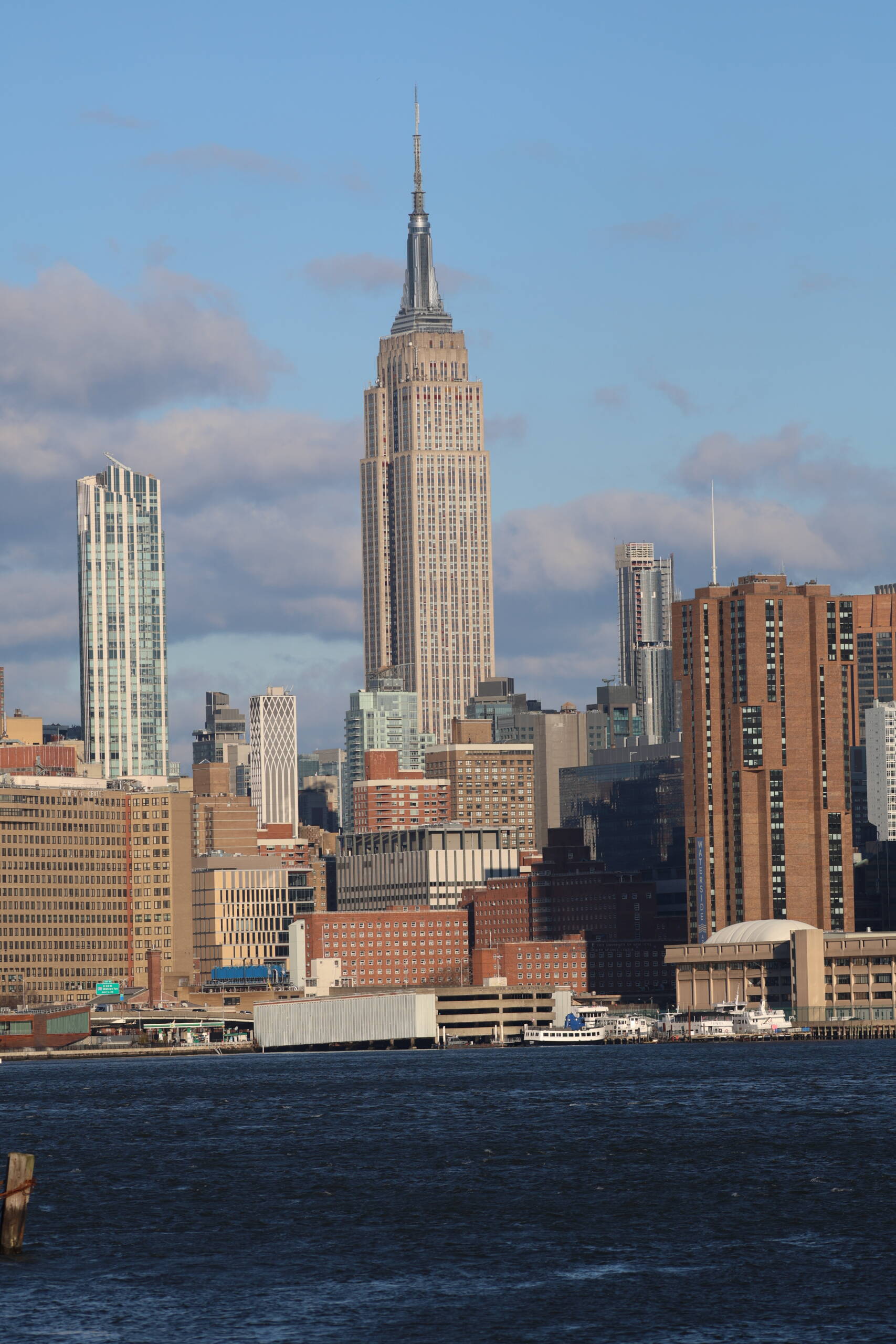
Empire State Framed from the Water
The frame settles on the Empire State Building rising cleanly through a soft blue sky, its limestone façade catching that late-afternoon light that flattens nothing and yet softens everything just a little. The perspective feels slightly compressed, almost certainly shot from across the water—likely the Hudson—where distance pulls the surrounding buildings closer together, stacking Midtown into a layered, almost model-like composition. The spire, thin and precise, cuts upward with that familiar confidence, but what stands out here isn’t just the tower itself, it’s how it sits inside the city rather than above it.
Down at the base, the skyline thickens into a dense patchwork of brick, glass, and concrete. Warmer tones dominate the mid-ground—those reddish-brown residential blocks and older commercial buildings—contrasting with the cooler, reflective surfaces of newer towers. Off to the left, a slimmer glass structure rises with a pale, almost mint tint, catching the sky differently, like it belongs to a slightly newer chapter of the city. On the right, bulkier buildings anchor the composition, their heavier façades adding weight and balance so the Empire State doesn’t feel isolated in the frame.
The foreground water is dark, textured, restless. Small ripples catch the light unevenly, breaking it into fragments, which gives the whole image a sense of movement even though everything above the shoreline is still. There’s a subtle narrative in that contrast—the permanence of the skyline versus the constant motion of the river. A few low-profile structures and what looks like a pier or ferry terminal edge into the bottom of the cityscape, almost easy to overlook, but they ground the image in real activity, not just postcard aesthetics.
Clouds drift in loosely behind the tower, not dramatic enough to steal attention, but present enough to give the sky depth. They soften the vertical dominance of the building, making the scene feel less rigid, more lived-in. And the light—this is the kind of light photographers chase without really saying it out loud—angled just enough to define edges, but not so harsh that it burns out detail.
It’s a classic subject, sure, but the angle gives it a slightly quieter tone than the usual Manhattan shots. No chaos, no crowded streets, no neon. Just distance, structure, and a city holding itself together in layers.
At the center of the seasonal rollout is a new butterfly-themed installation on the 86th Floor Observation Deck, where visitors can step into a larger-than-life spring photo setting against the Manhattan skyline. That kind of addition makes sense for a landmark that has spent the past several years repositioning itself as an immersive attraction rather than only a historic building with a view. The butterfly display gives guests a ready-made social media moment, which is obviously part of the point, but it also fits neatly with the seasonal mood the building is trying to create. For visitors arriving in New York during spring break or around Easter, the Empire State Building is making a fairly direct pitch: come for the skyline, leave with photos that look like the season itself.
Food is also being used as part of that experience layer. The 86th Floor will host special treat pop-ups beginning with Berry Stop, which will offer fresh strawberries covered in melted chocolate and topped, for this limited spring edition, with Cadbury eggs through April 9. After that, Ghirardelli will take over from April 10 through May 10 with hot chocolate and mini chocolate Easter bunnies. These are small touches, maybe even a bit touristy in the best way, but they matter because they help turn a standard observatory visit into something more time-specific and memorable. Limited seasonal offerings create urgency, and for an attraction that draws both tourists and repeat local visitors, that matters more than it used to.
Families are another clear target for the spring campaign. From April 1 through April 5, the Easter Bunny will appear daily from 1 p.m. to 3 p.m. at the Observatory Experience for meet-and-greets and photos. It is a simple addition, but effective. The Empire State Building has the advantage of being iconic enough that almost any themed event acquires extra appeal just by taking place there. A child meeting the Easter Bunny in a shopping mall is one thing; meeting the Easter Bunny inside one of the most famous skyscrapers in the world is a different kind of memory, and the building knows it.
The spring program also revives one of the more premium offerings in the building’s events calendar: the Starbucks Reserve Sunrise Experience. Held on Saturdays, this limited-capacity package gives guests access to the 86th Floor Observation Deck before public opening, timed to sunrise, and includes Starbucks Reserve coffee, pastries, and admission to the building’s immersive exhibits. Starting at $135, it is clearly positioned at the higher end of the experience economy, where exclusivity, timing, and atmosphere carry as much value as the attraction itself. For some visitors that price will feel steep, sure, but it is aligned with a broader trend across major urban attractions: selling access not just to place, but to a curated moment.
Another sign of how far the Empire State Building has expanded beyond traditional sightseeing is its new birthday celebration package. Available on select weekends with noon and 3 p.m. sessions, the package offers VIP Observation Deck access, a guided tour, and a private party room with décor, treats, and optional add-ons like face painting and balloon art. Starting at $90 per person for a two-hour event, it positions the building as a venue for family occasions rather than simply a stop on a New York itinerary. That is a smart move, actually. Landmark destinations that can tap into birthdays, seasonal outings, and premium private experiences are building more durable revenue streams than those that rely only on walk-up tourism.
The seasonal calendar will culminate visually on April 5, when the Empire State Building lights its tower in annual pastel fades to mark Easter 2026. The tower lighting tradition remains one of the building’s strongest symbolic assets, because it extends the attraction beyond ticket holders to the entire city skyline. Even people who never enter the building participate in the event, in a way, just by seeing it from afar. That public-facing element keeps the Empire State Building culturally visible in a city where attention is always contested, and where even famous landmarks have to keep refreshing their role in the daily visual life of New York.
At street level, the spring push continues with seasonal menu changes at STATE Grill and Bar, which is introducing new spring dishes built around fresh, locally sourced produce, along with an enhanced happy hour featuring half-priced small bites from 4 to 6 p.m. daily. It is another example of how the building is presenting itself as a fuller destination ecosystem. Observatory, restaurant, retail, event venue, seasonal activation platform — all of these pieces reinforce one another. None of them alone defines the Empire State Building in 2026, but together they make it easier to justify both a first visit and a repeat one.
All of this sits on top of the building’s much larger repositioning effort, especially after the $165 million reimagination of the Observatory Experience, which added a nine-gallery interactive museum, bespoke host uniforms, and the upgraded 102nd Floor deck. The strategy is pretty clear by now: preserve the icon, but program it like a modern attraction brand. That helps explain why the building keeps leaning into themed experiences and curated seasonal moments. A famous skyline view may be timeless, but in a competitive visitor economy, timeless alone is not always enough. Spring 2026 at the Empire State Building looks designed to prove that even the most familiar New York landmark can still find new ways to feel timely, festive, and just a little fresh.