• Skip to main content
  • Skip to secondary menu
  • Skip to footer

Travel Marketing

Travel and Tourism Trends

  • Sponsored Post
  • Travel Event Calendar
  • Travel Market
  • Travel Magazine
  • About
  • Contact

Wawel Hill, Kraków — Where Poland’s Story Rises in Brick and Gold

March 17, 2026 By admin Leave a Comment

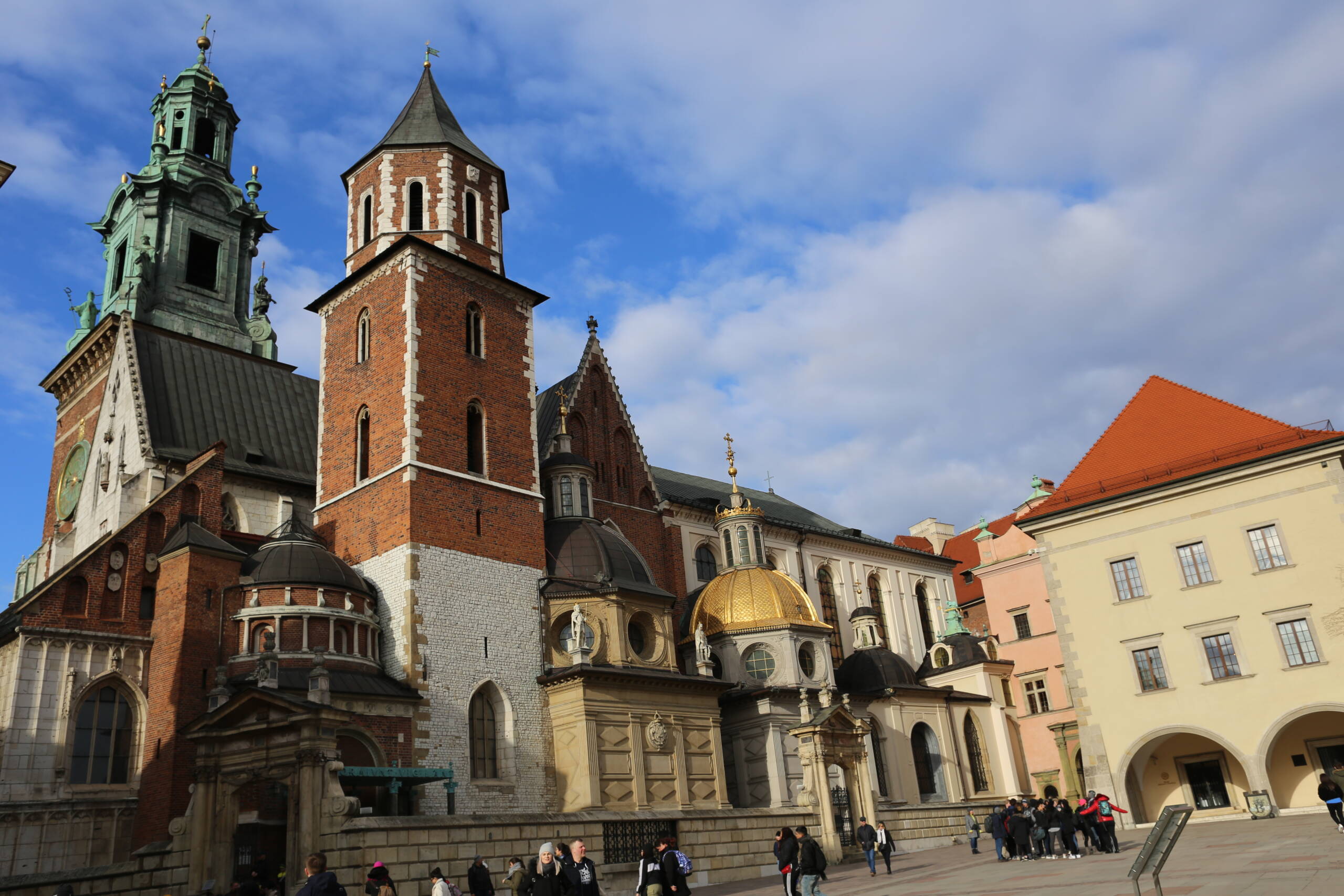
The scene unfolds with a kind of layered grandeur that feels almost accidental at first glance, as if centuries simply stacked themselves here without asking permission. The image captures the unmistakable silhouette of Wawel Cathedral, its red brick tower rising sharply into a sky that can’t quite decide between blue and drifting cloud. That central tower—tall, slightly austere—anchors the composition, while around it a cluster of domes, chapels, and architectural moods gathers like a conversation between eras. To the left, a green-patinated bell tower leans into the skyline, its oxidized copper hinting at age and endurance, while below it, smaller rounded chapels press outward, almost protective.
Wawel Hill, Kraków — Where Poland’s Story Rises in Brick and Gold
Street and Travel Photography with the Canon EF 28mm f/1.8 USM

Closer in, the golden dome of the Sigismund Chapel catches the light in a way that feels deliberate, almost theatrical. It’s not just reflective—it glows. That dome, one of the most iconic Renaissance elements in Poland, sits nestled against Gothic walls, creating a contrast that somehow works better in person than in theory. The stonework beneath it is dense with detail—arches, niches, carved figures—yet from a distance it resolves into something calm, almost orderly. You can see how Kraków built its identity here, not through uniformity but through accumulation.

At ground level, the scale shifts again. Visitors gather in small clusters, some pausing near informational plaques, others just standing and looking up, which seems to be the default behavior here. There’s a slight randomness to their movement—tour groups forming and dissolving, a couple drifting off toward the courtyard edge, someone pointing upward as if trying to explain history in a sentence or two. The open square gives the cathedral breathing room, framed by softer-toned buildings with red-tiled roofs that feel almost modest compared to the cathedral’s layered intensity.

This is the heart of Wawel Hill, and it carries that weight in a very physical way. Polish kings were crowned and buried here, national stories were shaped here, and even now, standing in the courtyard, there’s a subtle sense that this isn’t just a monument—it’s a reference point. Not loud, not overwhelming, just… present.

Traveling here isn’t about ticking off another cathedral, even if it might start that way. It’s more about noticing how the place resists simplification. Gothic meets Renaissance, stone meets gold, tourists meet something older than tourism itself. And somewhere in between, you find yourself lingering longer than planned, looking up again, trying to catch how the light hits that dome just right before it shifts.

Filed Under: News

Reader Interactions

Leave a Reply Cancel reply

Your email address will not be published. Required fields are marked *

Footer

Recent Posts

  • Château de Monbazillac, Dordogne: A difficult childhood. One château too many.
  • Fora Hits $1 Billion Valuation as AI Transforms the Future of Travel Planning
  • The Open Kitchen Experience: Dining Where You Can Watch the Cooking
  • Holland America Line Adds Flåm and Hellesylt to Five 2027 Norway Fjord Cruises
  • La Cité du Vin, Bordeaux: The Building That Looks Like Wine in a Glass
  • EU Border Delays: ETIAS Pre-Travel Authorization Pushed to Late 2026 as EES Chaos Continues
  • Toledo’s Old Town: A Mudéjar Watchtower Hiding an Antiques Shop
  • Piazza del Duomo, Catania: Where a Black Lava Elephant Guards Sicily’s Baroque Heart
  • Château de Fougères: Inside Europe’s Largest Medieval Fortress
  • Château de Vitré: The Medieval Fortress Guarding Brittany’s Eastern Gate

Media Partners

  • Virtual Travel Guide
  • Ancient Rome
Bilbao’s Quiet Renaissance: From Industrial Port to Design Destination
Lisbon’s Seven Hills: A Walking Guide That Tells You the Truth
New Orleans: An American City That Plays by Different Rules
Ha Long Bay Without the Cruise Brochure
Istanbul at the Threshold: A City That Has Always Been Two Things at Once
Iceland’s Ring Road: What the Drive Teaches You That No Photograph Can
Marrakech’s Medina: How to Read a City That Was Not Designed for You
Torres del Paine: What You Are Actually Getting Into
Kyoto in Autumn: What the City Looks Like When the Maples Turn
Disneyland Paris Rewrites Its Script With World of Frozen and Disney Adventure World
Water Across the Empire: Roman Aqueducts and the Hydraulic Logic of Conquest
The Oath of the Horatii: David's Roman Republic in Paint
Jean-Léon Gérôme: The Victorian Gaze on Rome
Ostia: The Port That Fed Rome
Roman Naval Warfare: The Sea They Called Their Own
The Roman Grain Ship: How Rome Fed Itself Across the Sea
Trajan's Column: Rome's Greatest Comic Strip
Caesarea Maritima: A Roman City Built from Nothing
Damnatio Memoriae: Rome's War on Memory
Faustina the Younger: The Woman Behind the Philosopher Emperor

Media Partners

The Immersive Experience in the Museum World
Japan, China, and Taiwan: A New Triangle of Risk — and a Window of Opportunity for Japan
Ghost Kitchens as Infrastructure: The Shift from Restaurants to Intelligent Food Networks
The Zoom Divide Nobody Saw Coming
The Perfect Budget Content-Creator Kit
Reimagining Prague’s Tourism Future Through Immersive Media and VR Museums
Israel’s Urban Paradox: Tel Aviv Moves, the Rest Stand Still
American Express Global Business Travel (GBTG): Understanding the Business and the Investment Case
Why the Canon R8 Paired With the New RF 45mm f/1.2 Lens Quietly Becomes the Content Creator’s Sweet-Spot
The Future of Travel: A $15.5 Trillion Industry

Copyright © 2026 Travel Marketing

Media Partners: Timey · Publishing House · Ancient Rome · Photography · Calendarial · Transportational