Toledo has a habit of making a short visit feel inadequate. It is close enough to Madrid to be sold as an easy excursion, yet the old city rewards the opposite approach: slowing down, looking up and allowing time for streets that do not lead anywhere in a straight line. The square outside Toledo Cathedral is a good place to understand why. Here, one of Spain’s great Gothic churches rises directly out of everyday city life, with visitors crossing the paving stones, small groups collecting at the edges and an extraordinary amount of carved stone competing for attention.
Seen from Plaza del Ayuntamiento, the Cathedral of Saint Mary of Toledo makes an unusually dramatic first impression. Its western façade does not have the neat symmetry people sometimes expect of a major cathedral. On the left, a tall Gothic bell tower climbs through successive levels of arches, buttresses and pinnacles before ending in a sharply drawn spire. On the right, a broad stone dome rises above the Mozarabic Chapel, creating a very different silhouette. Between them are the deep pointed entrance arches, rows of sculpted figures and an intricate upper façade. The contrast makes the building interesting even before a visitor steps inside.
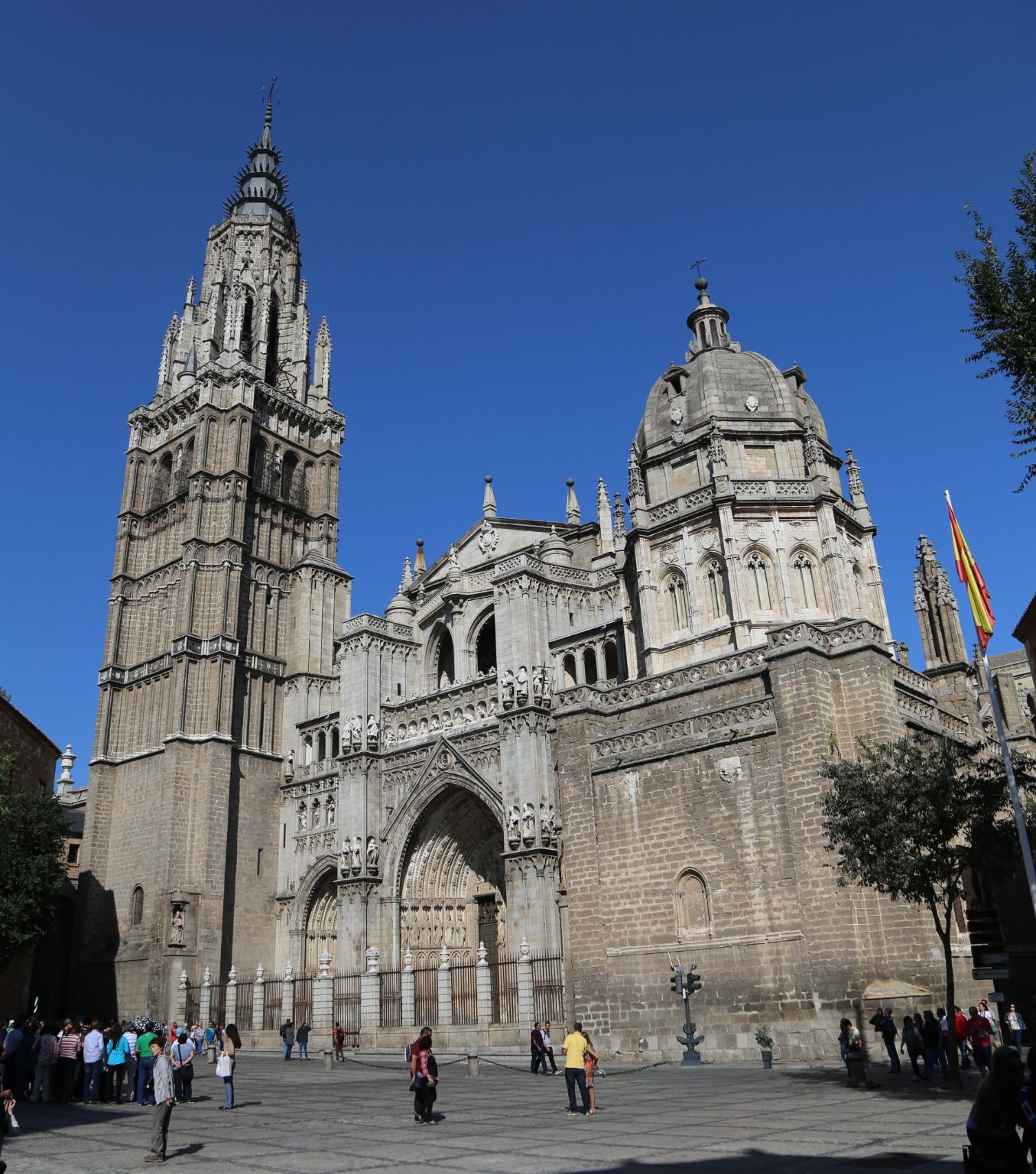
The bell tower reaches about 92 metres, but its impact is about more than height. In the strong Spanish daylight, nearly every projection throws a small shadow, picking out the stonework against a clear blue sky. Move your eyes down from the spire and the church becomes increasingly dense: narrow windows, carved niches, projecting saints and layers of decoration around the central portal. At ground level, people seem almost miniature against the façade. The photograph catches that contrast particularly well. It is a building made for an age in which architecture was expected to impress, instruct and endure.
The domed structure on the right tells another story. It belongs to the Mozarabic Chapel, associated with the preservation of an ancient Hispanic Christian liturgical tradition under Cardinal Cisneros. Its dome was rebuilt in the seventeenth century by Jorge Manuel Theotocópuli, the son of El Greco. It is a reminder that the cathedral was never one finished architectural statement. Generations added to it, restored it and changed how it looked. Toledo itself is much the same, a city where Christian, Jewish and Islamic histories remain embedded in the streets, buildings and local identity, although their coexistence was far from simple or always peaceful.
Inside, the scale changes again. The cathedral contains a richly decorated main chapel, a great carved choir, the dramatic sculptural and light-filled Transparente, and a sacristy with major works of art. Anyone interested in Spanish painting should make time for El Greco’s The Disrobing of Christ. These are not attractions to rush through on a timetable squeezed between lunch and the return train. A proper visit deserves time to stand still, to move between the chapels and to see how daylight changes the mood of the interior.
For the travel industry, Toledo illustrates the limitations of selling historic cities as quick checklist destinations. The fast connection from Madrid is a genuine advantage. It brings the city within easy reach of a much larger visitor market. But convenience can also encourage the kind of tourism that treats a place as a sequence of photographs. The cathedral façade is a spectacle, certainly, yet its real value becomes clearer when visitors spend longer in the surrounding streets, sit down for a meal, return to the square at another hour and discover other parts of Toledo beyond the main monuments.
That is the case for staying overnight, if the itinerary allows it. Arrive before the busiest groups or linger after many day visitors have left. Walk the medieval lanes without worrying about the next departure. Take another look at the cathedral when the angle of the light has changed. Toledo is famous for its skyline above the Tagus, but down at street level, this great building and the human-scale square in front of it offer something just as memorable. Sometimes the best reason to extend a visit is already standing right in front of you.