Paris has no shortage of memorable sights, but not every tourist spectacle deserves to be repeated. In the square outside Notre-Dame Cathedral, visitors sometimes become so absorbed in feeding pigeons that the cathedral itself seems almost incidental. Bread crumbs are offered, birds swoop down, children reach out excitedly, and adults compete for the perfect photograph of a pigeon landing on someone’s hand. It may look like harmless entertainment, but it is a poor way to experience one of Europe’s great public spaces.
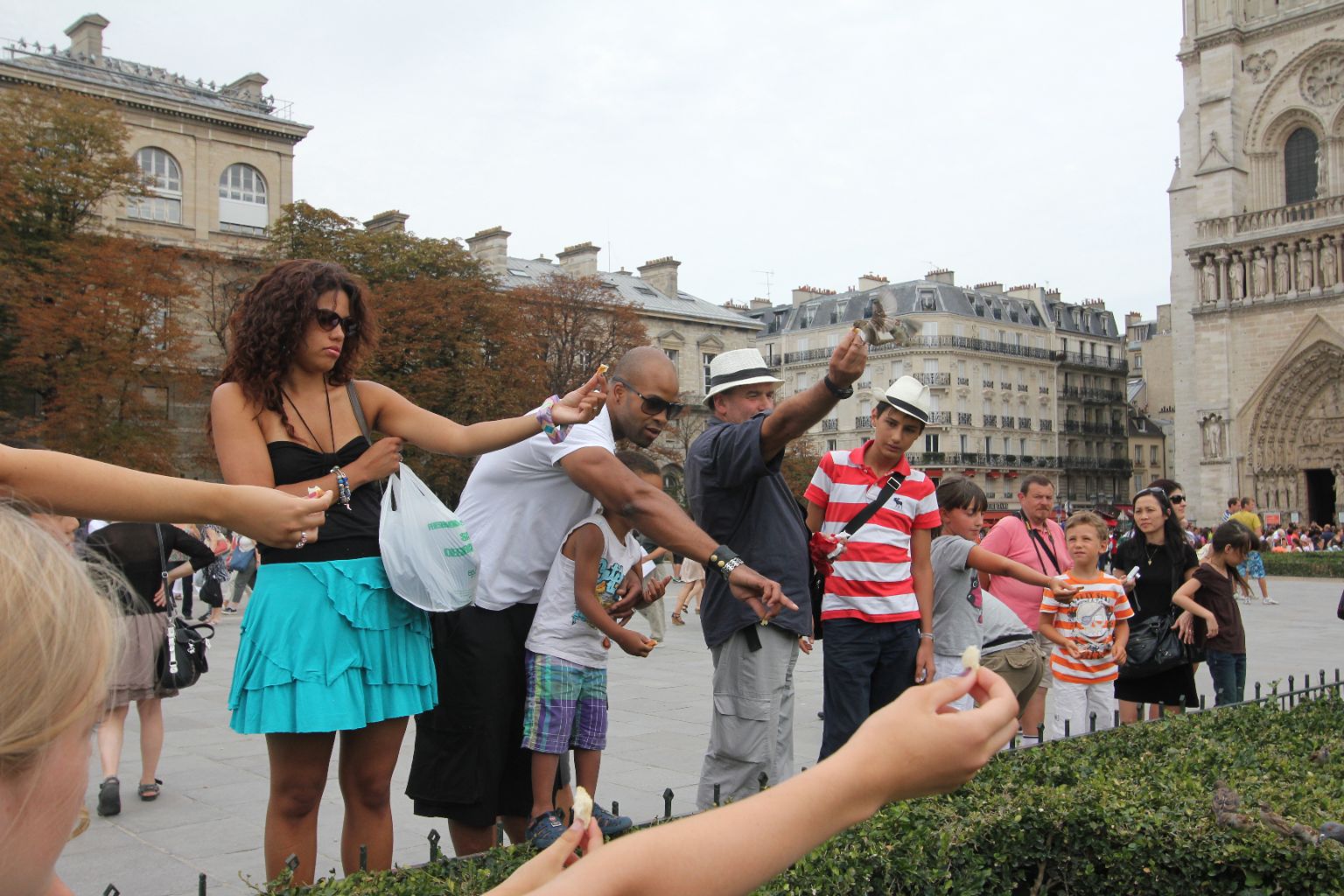
The photograph captures this little drama beautifully, and rather mercilessly. A man in a white hat holds his arm high as a pigeon approaches his hand, while another visitor leans forward with his arm extended. A woman in sunglasses and a bright turquoise skirt stretches her hand toward the birds, and children and adults gather around with bits of food. Arms cross the foreground from several directions, creating a chaotic arrangement of hands, people, and birds. Behind them stand elegant Parisian buildings and the richly carved stone façade of Notre-Dame, almost pushed into the background by the commotion. The contrast is striking: centuries of architecture on one side, a spontaneous pigeon-feeding performance on the other.
There are good reasons not to participate. Feeding pigeons encourages them to congregate in large numbers, contributes to droppings and maintenance problems, and can interfere with the birds’ natural feeding behavior. Bread and other human snacks are not an appropriate balanced diet for wild birds. Food scraps can also attract rats and other unwanted animals. Parisian public-health rules restrict feeding wildlife in public spaces.
But beyond hygiene and wildlife management, there is something about the behavior that deserves a little reflection. Travel should make us more attentive to the places we visit, not less. Notre-Dame is not simply a picturesque backdrop for a photograph with a bird. Its sculptures, towers, portals, and extraordinary history reward even a few minutes of careful observation. The surrounding square is also a place to appreciate the changing life of Paris, its residents, visitors, architecture, and urban rhythms.
Of course, children are fascinated by pigeons, and adults are hardly immune to the pleasure of seeing a wild bird approach their hands. The temptation is understandable. Yet there is a difference between enjoying the presence of birds in a historic square and deliberately turning that square into a feeding ground. You can photograph pigeons, watch them move among the crowds, or capture the amusing interactions they create without offering them food.
The photograph also reveals something interesting about tourism itself. Everyone is looking in a different direction, responding to a different bird or another person’s gesture. The famous cathedral is right there, yet the immediate attraction is a common city pigeon. It is an almost comic illustration of how easily visitors can become distracted from the very places they have traveled hundreds or thousands of kilometers to see.
So when you visit Notre-Dame, enjoy the square, take your photographs, admire the architecture, and watch the pigeons if you like. Just leave the bread in your bag. Paris offers plenty of wonderful ways to interact with its streets and public spaces without feeding the wildlife.
And really, the pigeons have been managing Parisian life for generations without needing another tourist to provide lunch.