Just a short journey uphill from Palermo, Monreale offers a different perspective on Sicily. The crowded streets, noisy markets and restless traffic of the island’s capital give way to a compact historic town where medieval architecture, palm-lined squares and residential neighborhoods share the same dramatic hillside setting. Monreale is internationally famous for the extraordinary Byzantine mosaics of its Norman cathedral, but there is considerably more to the town than its celebrated monument.
The photograph captures this other side of Monreale particularly well. Taken from an elevated viewpoint near the cathedral, it looks across a lively square with a landscaped garden, a circular fountain, tall palm trees and cafés sheltered beneath pale awnings. Beyond the square, rows of cream, ochre and terracotta buildings climb toward the surrounding hills. Modern apartment blocks mingle with older houses, balconies overlook narrow streets, and patches of woodland interrupt the urban landscape. Above everything stretches a remarkably open Sicilian sky, with large clouds casting changing shadows across the mountains.
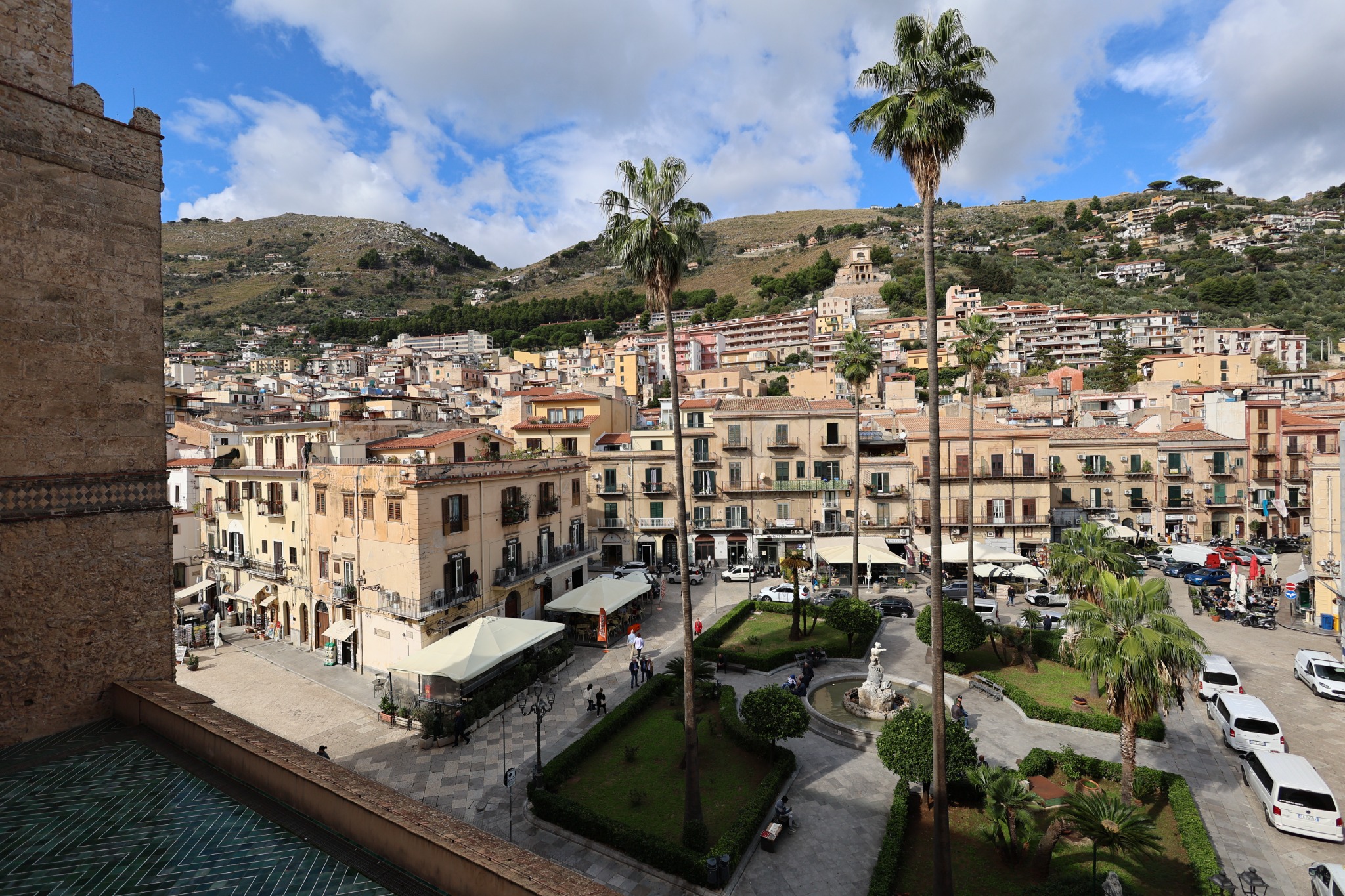
What makes the scene interesting is the contrast between the monumental and the ordinary. The massive weathered stone structure at the left edge of the photograph recalls Monreale’s medieval heritage, while the square below is unmistakably a place of contemporary everyday life. People walk between cafés, vehicles circulate around the garden, and residents go about their routines against a backdrop that visitors might consider spectacular. For them, of course, it is simply home.
The cathedral remains the principal reason to visit. Built under the Norman king William II in the twelfth century, it is celebrated for its vast mosaic cycle, which brings biblical narratives to life in shimmering gold. The adjoining cloister, with its intricately carved paired columns, rewards a slower visit. Yet concentrating exclusively on these treasures means missing the character of the town around them.
Step beyond the cathedral precinct and Monreale becomes a place to explore without a strict itinerary. Its streets offer glimpses of the Conca d’Oro, the broad basin surrounding Palermo, while local cafés and small shops provide opportunities to observe the rhythm of daily life. The slopes explain much of the town’s visual appeal: buildings appear stacked one above another, and a short walk can change the entire composition of a view.
For travelers interested in photography, Monreale is especially rewarding because its scenes contain multiple layers. A palm tree may frame a rooftop, a church tower rises against a green hillside, and a bright patch of sunlight briefly illuminates a building while the rest of the neighborhood remains under cloud. A wide-angle view captures the relationship between the square and the mountains; a longer lens isolates balconies, terraces and architectural details.
Monreale is easy to combine with a stay in Palermo, but it deserves more than a hurried stop to see the cathedral mosaics. Spend time in the square, walk the surrounding streets and look back toward the hills. Sicily’s appeal is not confined to its famous interiors and archaeological landmarks. Sometimes it is most evident in the ordinary urban landscape, where centuries of history coexist with the unremarkable business of a modern afternoon.