A policy shift that once felt almost unthinkable is now being discussed in earnest: charging foreign tourists to enter England’s leading museums. For more than two decades, institutions like the British Museum and the National Gallery have operated under a simple premise—free access for anyone who walks through the door. No ticket barrier, no pricing tiers, no hesitation at the entrance. Just culture, open and immediate.
That model is now under pressure, and the debate around it is less about ideology than it is about arithmetic.
On one side sits a pragmatic argument that’s hard to ignore. Museums are expensive to run—climate control for fragile artifacts, security, conservation labs, rotating exhibitions, staffing, digital infrastructure. Public funding, once sufficient, has not kept pace with inflation or rising expectations. Meanwhile, visitor numbers have surged, especially from international tourism. The logic emerging in policy circles is almost blunt: if millions of overseas visitors benefit from these institutions, why shouldn’t they contribute directly to sustaining them?
Seen this way, charging tourists isn’t a retreat from the principle of free culture, but a recalibration of who pays for it. UK residents, through taxation, would retain free access. Visitors—who often already pay for flights, hotels, and experiences—would encounter a modest fee, broadly aligned with global norms. Walk into the Louvre Museum or the Metropolitan Museum of Art and you’re already conditioned to expect it.
There’s also a subtle economic argument here. Pricing can act as a filter—not necessarily reducing demand, but smoothing it. Anyone who has stood shoulder-to-shoulder in a packed gallery knows that “free” sometimes comes with a hidden cost: overcrowding. A fee, even a modest one, could reshape visitor flow, potentially improving the experience itself. Not a popular point, but one that tends to surface in internal discussions.
And yet, the counterargument carries a different kind of weight—less about budgets, more about identity.
Free access to national museums was never just a financial decision. It became part of the UK’s cultural philosophy, almost a statement about what public institutions are meant to be. You don’t “buy” your way into history, science, or art. You encounter it because it belongs, in some sense, to everyone.
Introducing a price—even selectively—risks shifting that perception. The moment a ticket is required, the museum begins to resemble an attraction rather than a civic space. Subtle, but meaningful. It reframes the relationship between visitor and institution.
There’s also the question of fairness, and it’s messier than it first appears. A two-tier system—free for residents, paid for foreigners—may make fiscal sense, but it introduces a boundary that didn’t exist before. Culture becomes conditional. And practically speaking, enforcing that distinction isn’t trivial. Do you check passports at the door? Use digital verification? Accept self-declaration? Each option carries friction, and friction changes behavior.
Then there’s the broader economic loop. Free museums have long functioned as anchors of tourism, encouraging longer stays and repeat visits. They’re not just cost centers; they’re demand generators. A visitor who doesn’t pay for entry may still spend on accommodation, food, transport, and retail. If even a small percentage of tourists reconsider their plans because of cumulative fees, the downstream impact could outweigh the direct revenue gains.
And beneath all of this sits a quieter, almost philosophical tension.
Museums hold objects that often originate far beyond national borders. The British Museum, in particular, has long been at the center of debates about global heritage and ownership. Charging international visitors to see artifacts from their own regions—well, it adds another layer to an already complex conversation. Not necessarily decisive, but hard to ignore.
So what emerges is not a clear right or wrong, but a trade-off between sustainability and principle.
Charging tourists could stabilize funding, align the UK with international practice, and preserve free access for residents. At the same time, it risks eroding a distinctive cultural stance, complicating access, and subtly transforming how museums are perceived.
If the policy moves forward, the real test won’t be the price point. It will be whether the experience still feels open—whether walking into a museum in London retains that sense of immediacy, that absence of transaction, even when, somewhere in the process, a transaction has been introduced.
Because once that feeling changes, even slightly, something more than revenue has shifted.
Visit While It’s Free: Trajan’s Column Casts at the Victoria and Albert Museum
This image shows full-scale plaster casts of Trajan’s Column, displayed inside the Victoria and Albert Museum. The original column, known as Trajan’s Column, stands in Rome and was completed in 113 AD to commemorate the victories of Emperor Trajan in the Dacian Wars. Because the original is extremely tall—about 30 meters—the museum presents it in two vertical sections indoors, allowing visitors to see the detailed reliefs up close.
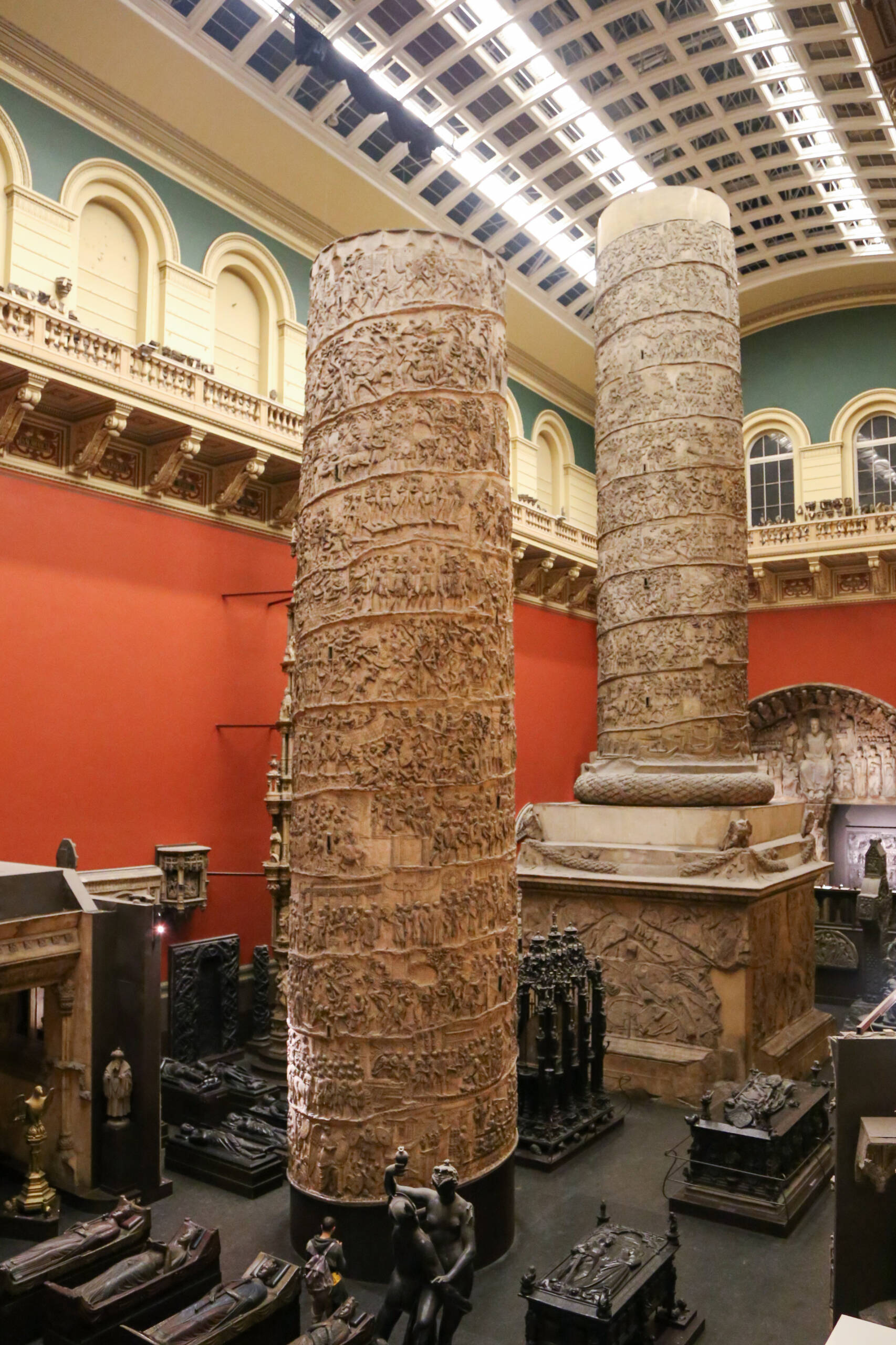
The columns are covered in a continuous spiral frieze that wraps around the shaft from bottom to top. This frieze contains more than 2,500 carved figures, depicting scenes of military campaigns, engineering works, river crossings, battles, and daily life in the Roman army. The carvings function almost like a visual narrative, a stone record of imperial power and organization. The level of detail is extraordinary—individual gestures, armor, and even expressions are rendered, though from a distance they blend into textured bands.
The setting itself is the museum’s Cast Courts, a large 19th-century gallery specifically designed to house reproductions of major European monuments. The architecture reflects that purpose: a high, vaulted glass ceiling floods the space with natural light, while the surrounding walls—painted in deep red and green—frame the pale columns and emphasize their scale. The room is arranged to accommodate objects that would otherwise be impossible to display indoors in their original form.
Around the base of the columns, the gallery contains additional sculptures and casts—tombs, statues, and architectural fragments—mostly in darker materials. These create a visual contrast with the pale columns and help anchor the scene. Some of the sculptures are recumbent effigies, others are freestanding figures, contributing to the sense that this is not just a display but a curated landscape of historical forms.
One unexpected detail is the aircraft suspended beneath the ceiling. This reflects the broader scope of the museum, which spans art, design, and engineering across periods. Its presence adds a subtle contrast between ancient craftsmanship and modern technological achievement.
The image captures a space where scale, narrative, and preservation intersect. The columns themselves are not originals, but their replication allows for a closer, more complete reading of one of the most important visual records of ancient Rome.
Leave a Reply