The first impression isn’t subtle. Two spires cut sharply into the sky, impossibly tall, almost needle-like, pulling your gaze upward before you even have time to process the rest. This is Wrocław Cathedral, standing at the heart of Ostrów Tumski, and it doesn’t really ease you into its presence—it just rises, decisively.
The red brick façade feels dense, almost textured like fabric when seen up close, layered with Gothic details that reward attention but don’t demand it. You can take it in all at once, or you can let your eyes wander—arched windows, delicate stonework, the clock set slightly off-center, and that entrance portal, intricately carved, where people gather almost instinctively. A small group stands there in the frame, bundled in coats, forming a kind of human scale reference that quietly emphasizes just how massive the structure really is.
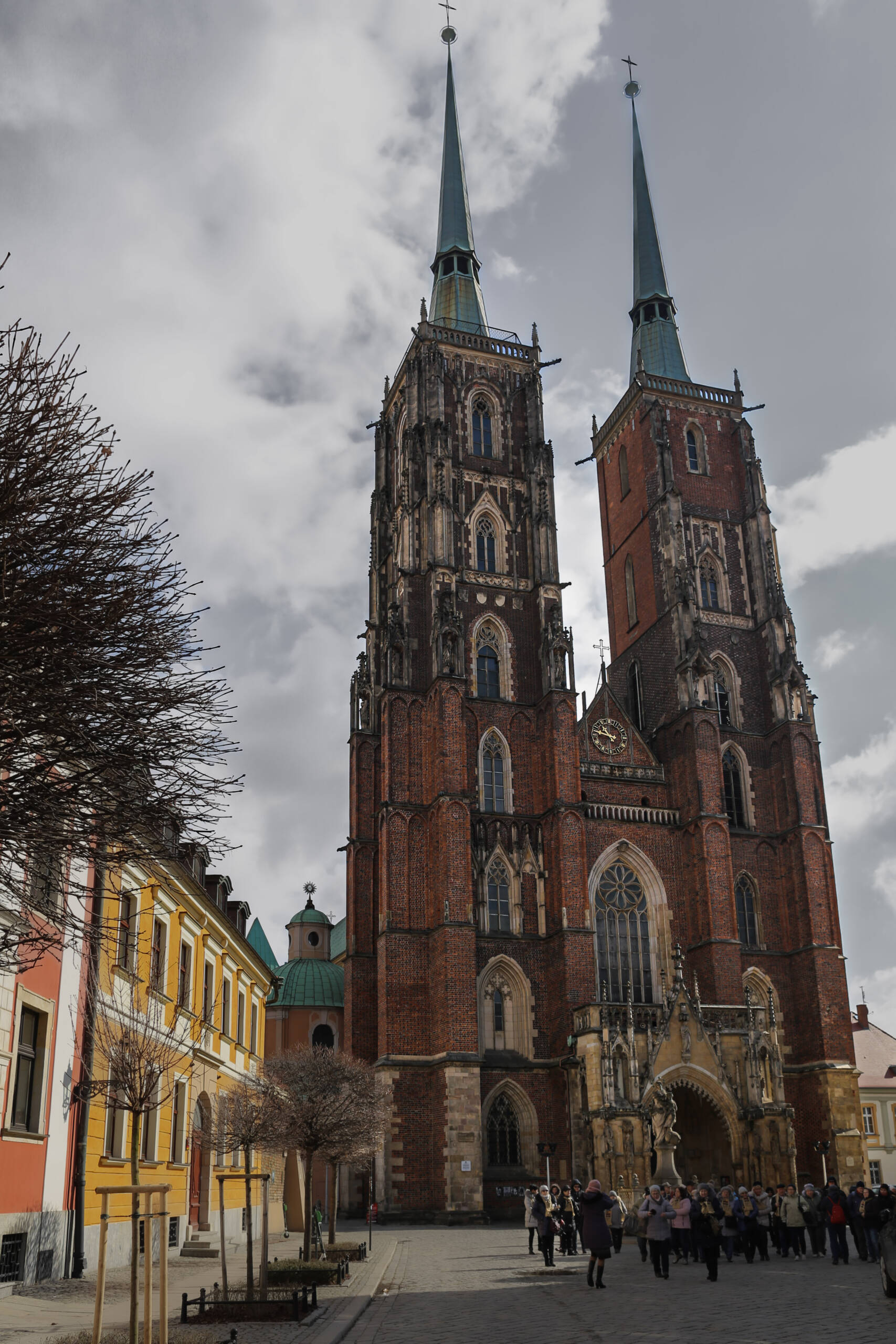
Those twin towers, though, dominate everything. One slightly darker, one catching a bit more light, both capped with greenish spires that taper into fine points against a shifting sky. There’s a faint asymmetry between them—not enough to disrupt the balance, just enough to make it feel real. The crosses at the top seem almost distant, like they belong to the clouds more than the building itself.
To the left, a row of pastel-colored buildings—soft yellows and warm tones—adds an unexpected contrast. They’re lower, friendlier, almost domestic, and they soften the cathedral’s intensity. Behind them, a rounded green dome peeks out, hinting at yet another layer of history tucked just out of view. It’s that layering again—Wrocław doesn’t present itself in clean, isolated monuments. Everything overlaps, slightly.
But the story here runs much deeper than the architecture you see. Ostrów Tumski is the oldest part of the city, originally an island on the Oder River, and it was here in the 10th century that the first Piast rulers established one of the early centers of Polish statehood. The earliest cathedral on this site dates back to around 1000 AD, when the Diocese of Wrocław was founded under the rule of Bolesław I the Brave. That early structure didn’t survive long—fires, invasions, and rebuilding cycles reshaped the site again and again.
The current cathedral, largely Gothic in form, began taking shape in the 13th century after Mongol invasions devastated earlier buildings. Over time, it evolved—chapels were added, towers extended, details refined—reflecting not just architectural trends but the shifting political reality of the region. Wrocław itself moved between Polish, Bohemian, Austrian, Prussian, and German control over the centuries, and the cathedral stood through all of it, absorbing influences without losing its core identity.
The most dramatic chapter came much later, during World War II. In 1945, as the city—then known as Breslau—was declared a fortress and besieged, the cathedral suffered heavy damage. Much of what you see today is the result of careful post-war reconstruction, carried out when the city became part of Poland again. The rebuilding wasn’t just technical—it was symbolic, restoring a landmark that had witnessed nearly a thousand years of upheaval.
The light here does something interesting. The sky is partly clouded, diffusing the sunlight just enough to flatten harsh shadows while still allowing highlights to catch on edges and textures. The brick absorbs some of that light, deepening its color, while the stone details reflect it back, creating a subtle interplay that changes as you move, even slightly.
Walking through this part of Wrocław feels different from the main square. It’s quieter, more contained, almost like the city steps back a little and lets history take the foreground. Ostrów Tumski isn’t just old—it’s foundational. You’re not just visiting a district; you’re standing where the city, in many ways, began.
And then there’s that moment—standing in front of the cathedral, looking up, realizing that no photo quite captures the vertical pull of it. Even this one, framed carefully, grounded by the street and the people, can’t fully translate how your perspective shifts when you’re there. You don’t just look at the cathedral. You adjust to it.