At first glance the object looks almost playful, like something lifted from a fairytale shelf, but the longer you look, the more unsettling it becomes, and that slow shift is exactly the point. Behind the glass at the Metropolitan Museum of Art sits a brightly glazed ceramic group: a yellow tiger with black stripes, mouth open, teeth sunk into the neck of a man dressed in an 18th-century red coat, his body limp, one arm dangling as if he has already accepted the outcome. The base beneath them, delicately decorated with flowers and raised on small feet like a piece of furniture, carries the inscription “THE DEATH OF MUNROW,” making sure no one misses the story being told. The colors are cheerful, almost naive—lemon yellow, grassy green, clean white glaze—but the scene itself is brutal, frozen violence turned into ornament.
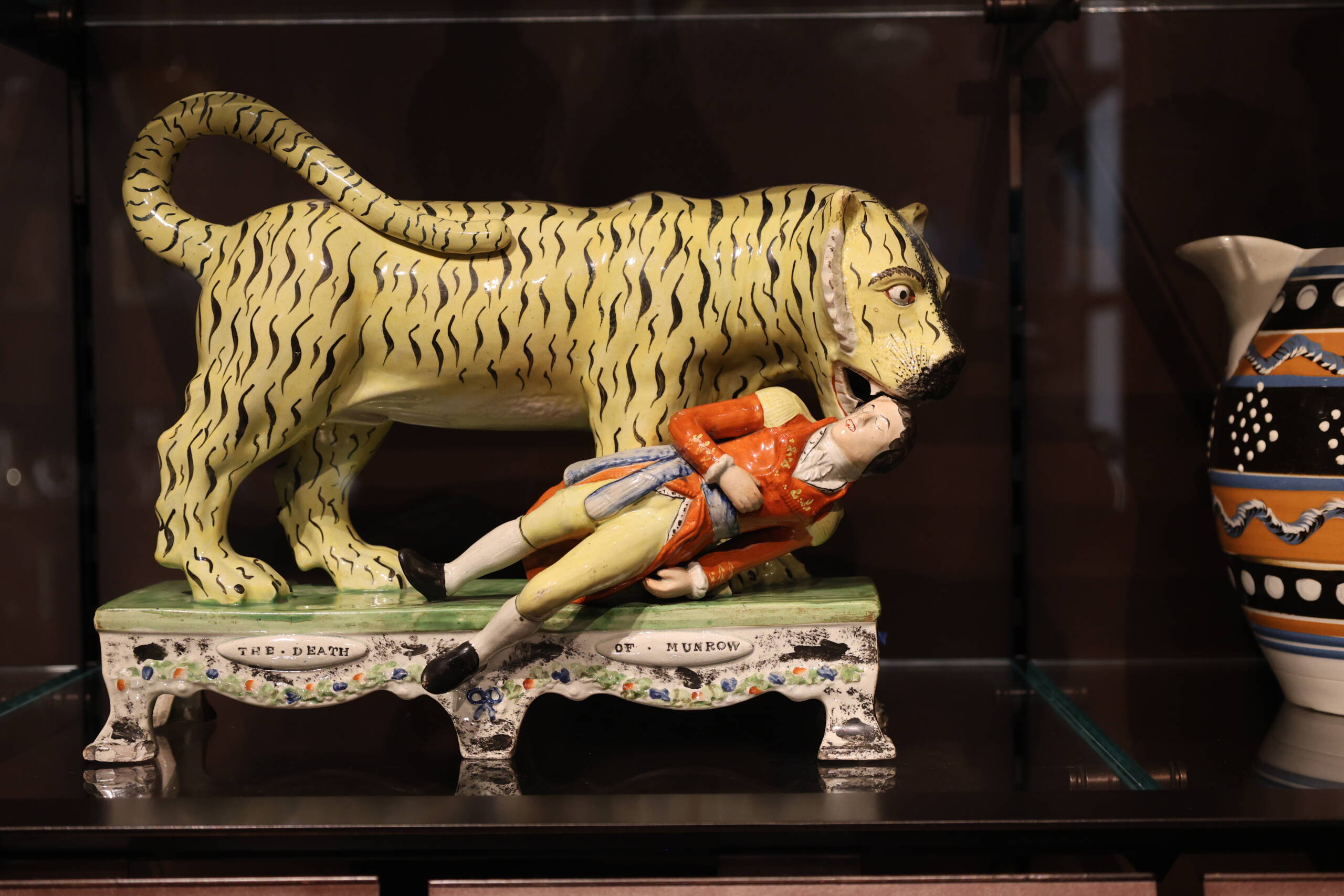
This piece comes from Staffordshire, England, a region famous in the 18th century for producing popular ceramic figures that told stories: news events, crimes, executions, miracles, moral lessons. They were the tabloids of their time, but in porcelain. The Munrow here is almost certainly Captain Thomas Munro (often spelled Munrow in contemporary sources), a British officer killed by a tiger in India in 1792. His death became a sensation back home, retold in newspapers, engravings, and eventually in objects like this one. For people in England who would never see India, never see a tiger, never see colonial violence firsthand, this ceramic became a way to touch the empire, to bring distant danger into the living room, safely miniaturized and glazed.
What’s fascinating—and a little disturbing—is how calmly the scene is staged. The tiger stands almost politely, tail curling in a decorative loop, body balanced like a toy. Munrow’s face is not twisted in terror; it’s serene, nearly asleep. This isn’t realism, it’s symbolic storytelling. The tiger becomes the exotic, uncontrollable “other,” while Munrow, dressed in European finery, represents order being momentarily overturned. On a shelf in an English home, this would have read as both thrilling and reassuring: yes, the empire is dangerous, but we can frame it, domesticate it, and place it neatly on a mantle.
Seeing it at the Met, in New York, behind museum glass, the layers pile up. It’s not just a ceramic curiosity anymore. It’s a fragment of colonial imagination, a reminder of how violence was aestheticized and sold as decoration, how death became collectible. And the craftsmanship—slightly uneven, hand-painted stripes, the glaze pooling in creases—keeps reminding you this was made by human hands, not a factory line, by someone who may never have left England, shaping a tiger they had only imagined. You stand there, looking at this frozen moment, and it feels oddly modern, like an early version of viral content: shocking, visual, simplified, and designed to be talked about. The glass case reflects your face faintly as you look, and for a second, you’re part of the display too, another viewer pulled into a story that’s been circulating for more than two centuries and somehow still hasn’t finished telling itself.
Leave a Reply