Every metre of Italian beach below the high-water mark belongs to the state. It’s demanio marittimo, public property, and the law says you can walk to the sea and swim in it without paying anyone. Then you arrive in August and find a turnstile.
The gap between those two sentences is where the money is.
The rent nobody collects
Start with what the state charges for the sand. The Court of Auditors put revenue from maritime concession fees at €84.4 million in 2024. Older figures from the competition authority ran to €115 million. Take whichever number you prefer; against a sector whose direct value added is estimated at €2 billion a year, and around €15 billion once the surrounding tourist spend is counted, the ratio lands somewhere near four percent. In luxury resorts the fee can work out at barely over one percent of what the operator takes in. The Court of Auditors has said in plain language that the fees aren’t proportionate to what concession holders earn from public assets, and that those assets are therefore not being properly valued.
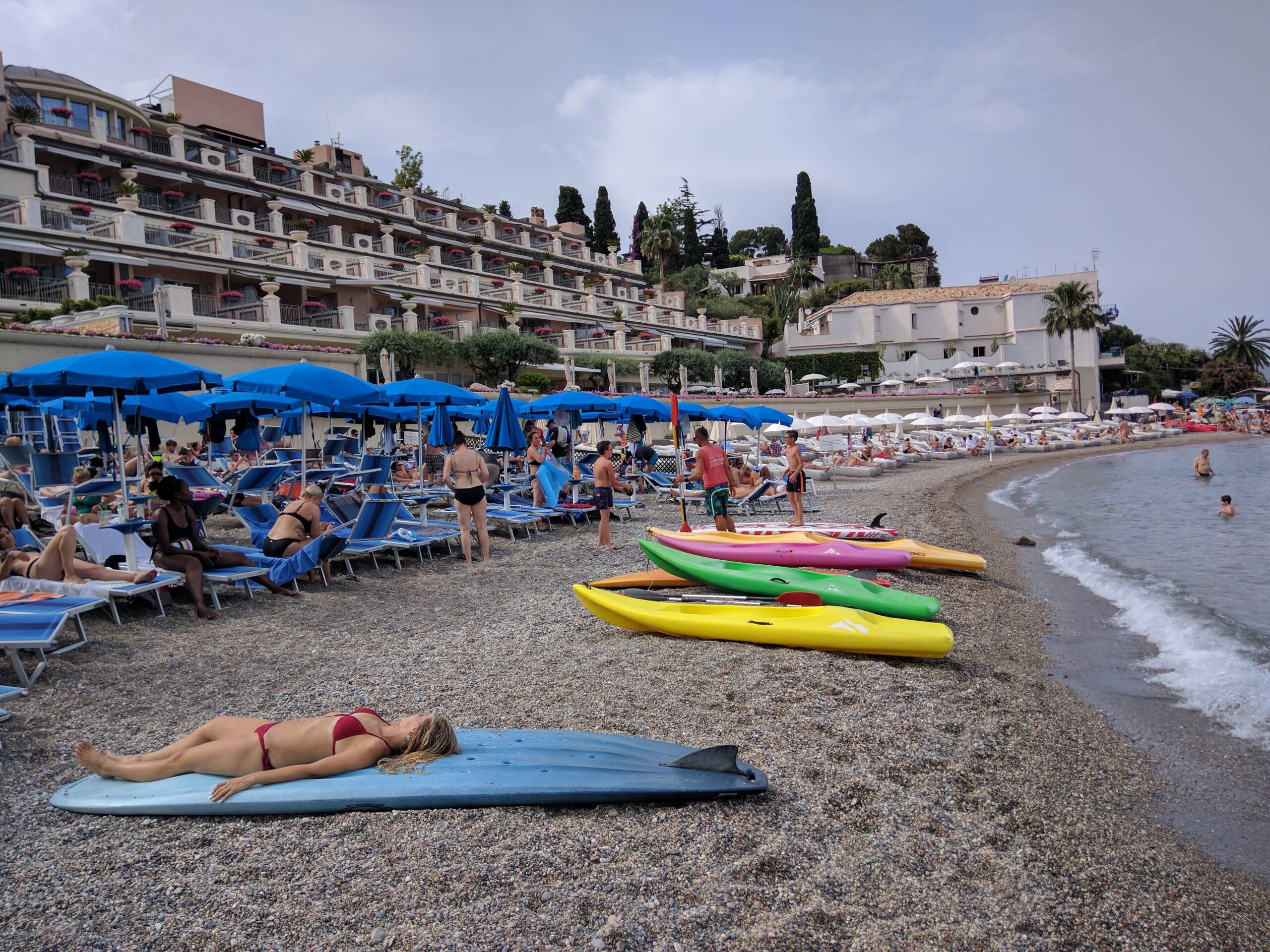
Then there’s the part that’s owed and never arrives. Roughly €235 million in unpaid concession fees from the years between 2007 and 2020 was still sitting uncollected.
The operators have a case worth hearing. A minimum annual fee of €2,500 was introduced in 2021, so the widely quoted stories about people renting a beach for a few hundred euros are out of date. Confcommercio puts average seasonal revenue at around €159,000 per business, which is a living rather than a fortune, and the sector supports something like 300,000 seasonal workers. Regional and municipal taxes push the actual fee anywhere from 30 to 100 percent above the base figure. All true. None of it explains why the public landlord is the only party in this arrangement that doesn’t seem to know what its property is worth.
The underlying data is a mess, which is itself revealing. The ministry’s system logs 103,620 maritime concessions, of which around 15,414 are tourist and recreational. Other official counts put total concessions nearer 30,000 with about 7,200 actual beach clubs. Legambiente counted 12,166. Nobody has to agree on the numbers, because nobody has ever been made to.
The turnstile
Mondello is Palermo’s city beach, managed along a long stretch by a company that has been there more than a century. Its establishments have physical turnstiles at the entrance. Sicilian regional law obliges concession holders to allow free passage to the water. After a video went viral last summer, the harbourmaster’s office and the Guardia di Finanza inspected and found seven public corridors from the pavement to the shoreline, 70 to 80 metres apart, unstaffed and signposted. No sanction followed. The legal question they flagged was narrow: whether those corridors sit inside the concession or outside it, which determines whether a turnstile next to them is an administrative detail or an illegitimate obstruction.
The company’s answer is that the gates have been there for a decade, that they organise staff and protect paying bathers, and that nobody is stopped from reaching the sea. The counter-argument is that the free corridors are scarce, badly marked and easy to miss by design, and that the result on Ferragosto is half-empty paying beaches beside a strip of free sand where people are stacked on top of each other. Federconsumatori’s line was blunter: the shore is public, a family that can’t afford a lido still has a right to the water, and a law requiring a public access point every 200 metres means nothing if the municipality draws it on a map and then lets it grow over.
Livorno had its own version this summer. At the historic Bagni Pancaldi Acquaviva, turnstiles and a €7.50 entry ticket that doesn’t include an umbrella or a lounger drew a protest and nearly a brawl. The operator’s defence was more revealing than the complaint: since 2015, it said, two or three people in total had used the free passage. That is either proof that nobody wants it or proof that nobody can find it. The municipality wrote to every concession in the city reminding them of the difference between walking to the sea and renting a sunbed.
Where the word racket stops being a metaphor
The word “balneari” appears repeatedly in the reports of Italy’s anti-mafia investigative directorate. Beach clubs are low-cost, cash-heavy, seasonal and tied to a public asset handed out by a small municipal office. Camorra, ‘ndrangheta and Cosa Nostra have all shown an interest.
Ostia, Rome’s seafront, is the textbook case. Investigations established two competing mafia associations on a sixteen-kilometre stretch, fighting over beach management among other things, with establishments run through front men and at least one seized outright. When the municipality was dissolved for mafia infiltration, inspectors found building violations at 71 of the 73 beach establishments, and roughly thirty arson attacks and violent incidents against local businesses in a four-year span. This year’s season opened with 35 lots put out to tender, 24 signed only after illegal structures came down, and around fifteen establishments staying shut, about ten of them under judicial seizure.
At Scilla in Calabria, a prefect’s report described a clan influencing the award of beach concessions through threats to competitors and contacts inside the town hall, keeping the lots with the people who had always held them. The council was dissolved. At Nettuno, a concession company was seized by the courts because it traced back to a man with convictions including mafia association and extortion.
This is what a low fee, a long automatic renewal and a weak checking regime produce over thirty years. It isn’t a coincidence, and it isn’t limited to the south.
Twenty years of “not yet”
The EU services directive passed in 2006. Italy has been avoiding its application to beach concessions ever since, most memorably by extending existing concessions to 2034 in the 2019 budget law. Courts kept striking the extensions down. The Consiglio di Stato has now held that years of operation and money invested create no permanent right to the concession, and that losing it triggers no automatic compensation, only a claim where investments remain genuinely unamortised. The infringement-avoidance decree sets 2027 as the point by which tenders must be concluded. The model tender document that municipalities need in order to run those tenders has still not appeared.
Meanwhile Italy has no national minimum share of free beach. Liguria wrote a 40 percent rule and then kept waiving it, most recently until 30 September 2027, which lets towns award new concessions without ever having reached the legal floor. Genoa decided to apply the rule this year against a current figure of 18.78 percent, of which only 3.61 percent is genuinely free rather than “free but equipped”. Altroconsumo found prices up 6 percent this summer and 24 percent over five years, reaching 16 percent in some resorts, and its reform petition has passed 91,000 signatures.
For scale, an OpenStreetMap-based count puts 4,577 beach establishments against 5,646 mapped beaches in Italy. The same measure gives Greece 15 percent, Portugal and Croatia 5, Spain 2.
Greece got angry faster
Greece had the same problem in a hotter form. Operators laid sunbeds far beyond their leased plots, in some cases covering entire beaches, put up fences, staffed them like doormen and charged €60 for an umbrella and two loungers, or €120 for a front row rebranded as VIP. Campaigners on Paros documented businesses occupying many times the area they had actually leased, and blocking public car parks as well.
In July 2023, three hundred people walked onto Santa Maria beach on Paros and laid their towels down in front of the loungers. The press called it the towel revolt. It spread to Naxos and beyond, prosecutors opened files, and within eight months parliament passed a new coastal use law: proper demarcation of the shoreline, concessions awarded through a central electronic tender, technology-based enforcement and heavier penalties. Loungers have to stay four metres back from the water. The state launched MyCoast, an app that lets anyone check whether a business is licensed for the spot it occupies and report it on the spot, backed by drones and satellite imagery.
The enforcement was real. Fines in the first days of one July run reached €350,000, mostly for taking up more beach than allowed, and a single unlicensed operator south of Athens was hit for €220,000. Complaints through the app passed three thousand in a season. Separately, the environment ministry’s list of beaches where sunbeds, parasols and temporary structures are banned outright has grown from 198 in 2024 to 238 in 2025 and 251 this year.
Greece hasn’t solved it. Enforcement still depends on someone standing on the sand with a phone. But it took a public occupation of one beach and eight months to produce a law with teeth, which is roughly one twenty-fifth of the time Italy has spent explaining why the rules can’t apply yet.
Spain wrote the law first and still has the problem
Spain abolished the private beach in 1982 and codified public access in the Ley de Costas of 1988. The shore is state property, reaching it is a right, and the same OpenStreetMap measure that gives Italy 81 percent gives Spain 2. On paper it’s the model everyone else should copy.
Walk the coast and the framework leaks. Ecologistas en Accion surveys all 8,000 kilometres every year, and its recent audit counted thirteen bathing areas effectively closed to the public by hotels, housing developments and tourist infrastructure. In Andalusia the chiringuito has drifted from a temporary shack into a permanent building that annexes the sand around it, and anyone who isn’t buying gets treated accordingly. Malaga province has eleven marinas along 175 kilometres of coast, several less than a kilometre apart, which in places physically cut off bathing areas to anyone who isn’t a resident or a member. The Ley de Costas says that’s illegal. It happens anyway.
Spain is also on the same European hook as Italy, just further along it. In 2023 the Commission opened an infringement procedure over coastal concessions handed out directly, with no transparent competitive process, and over renewals that can run as long as 75 years. Madrid is now redrafting the coastal regulation to push permanent beachfront businesses through public tender. The reflex was identical to Italy’s. The reaction time wasn’t.
Formentera shows what enforcement costs politically. Applying the Balearic occupation rules for 2026 to 2029, including a ten-metre setback from the waterline, the coastal directorate struck 681 loungers and 339 parasols off what the island council had requested, authorising 1,169 and 589 instead. Ses Illetes, the island’s most photographed beach, gets none at all. The overall cut runs past a third, and it landed in May with the season already open. The small-business association called it enormous damage to the concession holders and the jobs behind them. Both things are true at the same time: the sand is more public than it was last year, and somebody’s season was rearranged by a letter arriving three weeks late.
The actual transaction
Strip out the sunshine and the arrangement is simple. The state owns an asset, rents it out for a fraction of what it yields, doesn’t collect all of even that, doesn’t retender it, doesn’t check who’s behind the company, and leaves the holder to decide in practice who gets to walk down to the water.
Greece and Spain show that the repair isn’t exotic. Measure the shoreline, tender the plots openly, set a setback from the water, and give somebody the power to fine. That is the racket. The umbrella is just what it looks like from the beach.