A woman tourist stands in Piazza della Signoria with her arm raised, pretending to hold the David’s testicles for an Instagram photo. Her friend takes the picture from the one spot where the angle works. Nobody else in the square is watching. Behind her there are maybe two hundred people, and a fair share of them are lining up the same joke thirty meters away, out of frame.
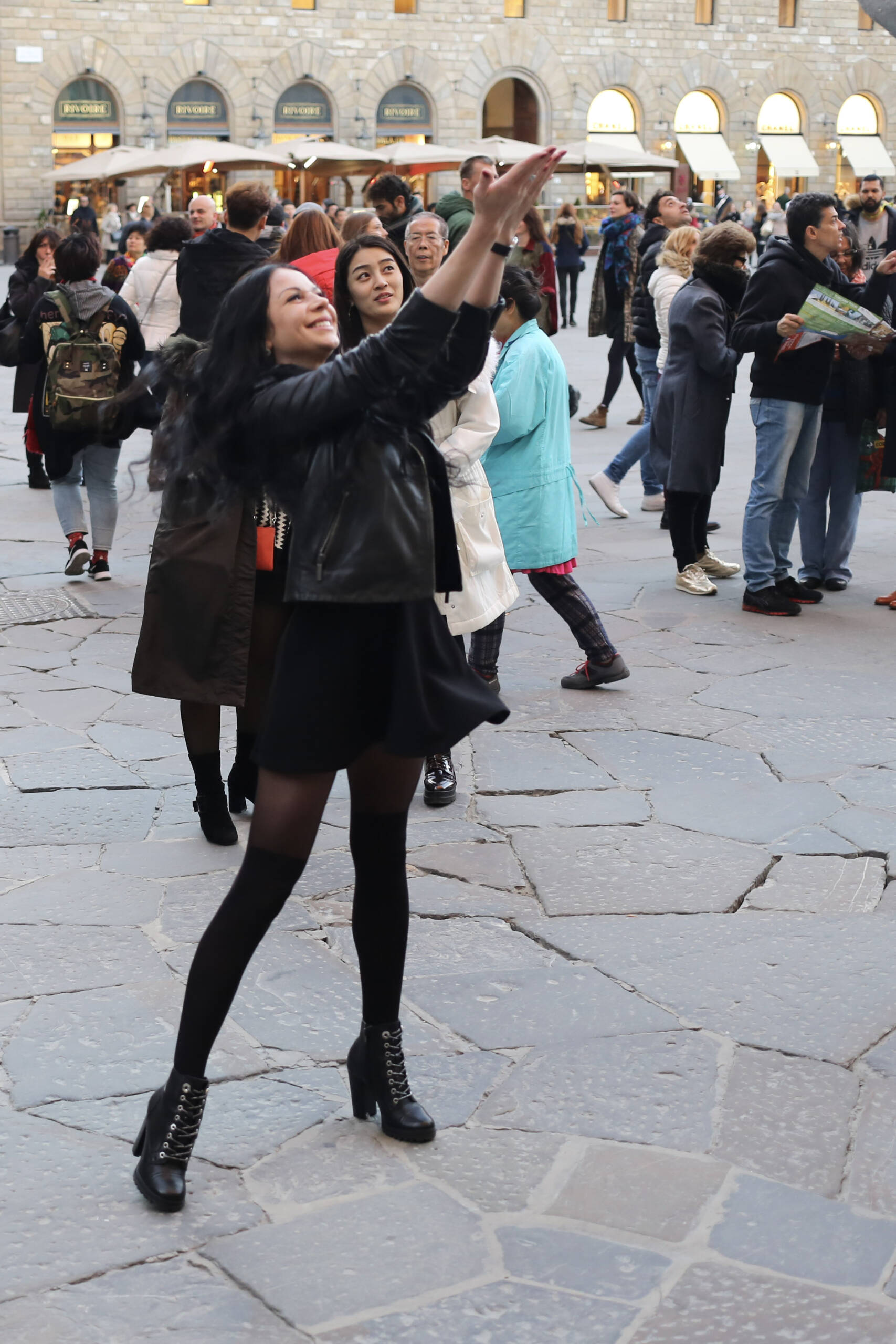
Rivoire’s awnings on one side, Chanel’s windows on the other, and between them a slow crowd of people who came to Florence and are now standing in it, arranging themselves.
The gag is older than the platform
Start with the obvious objection. This is not an Instagram invention. People have been pretending to hold up the tower at Pisa since the invention of the snapshot, and they’ve been grabbing at the David from twenty feet away since long before anyone had a phone in their pocket. Forced perspective is folk humor. It needs no algorithm. Neither does the joke underneath it, which is just that Michelangelo carved a naked man four meters tall and put him in the middle of the civic square. When the Victoria and Albert took delivery of a plaster cast of the thing, somebody had a detachable fig leaf made to hang over the crotch whenever Queen Victoria came through. That part of that statue has been the story for a very long time.
Two details make the Florence version instructive anyway. The first is that what she’s reaching for is a copy, installed in 1910 after the original went indoors in 1873. Almost nobody in that square is bothered by this and almost nobody checks. The frame works, so the frame is enough. The second is that the joke has a fixed address. It only reads from one spot, which means the shot doesn’t distribute people across a piazza. It gathers them onto a tile.
So what changed isn’t the impulse. It’s the volume and the loop. Her photo runs back through the same machine that sent her there in the first place, and someone watching it decides where to go next.
Discovery moved to the feed
A survey published this month by TUI Musement put hard edges on something the industry has described anecdotally for years. Among Gen Z travelers, TikTok is now the leading source of travel inspiration at 48 percent, ahead of recommendations from family and friends at 43 percent. That’s the flip. For most of the history of this business the strongest signal in travel was somebody you actually knew telling you where they’d been. It isn’t anymore.
And the feed converts. More than four in ten travelers said a viral post or video led them to book a trip or an activity, rising to about half among millennials and Gen Z. More than a quarter said they changed their destination outright because a creator recommended it. Not added a stop. Changed where they were going.
What the frame does once you arrive
The more useful numbers are about behavior on the ground. Nearly four in ten travelers said they’d visited a hotspot mainly to take a photo or record a video. Roughly the same share said they’d sometimes rather go to an Insta-famous place than a destination’s quieter alternative. And 37 percent admitted feeling pressure to make their trips look more exciting than they were, climbing to 45 percent among Gen Z.
Put those together and you get a demand pattern nobody designed and almost no destination can steer. Visitors don’t spread across a city. They converge on a small number of frames. One bridge, one staircase, one marble crotch, one bar with the right light at the right hour. A city can have four hundred worthwhile things to look at and still find that its problem is a queue at three of them.
That compression is the real mechanism behind a lot of what gets filed under overtourism. It isn’t only that more people are coming. It’s that they’re trying to stand in the same square meter, increasingly at the same hour, because the light in the reference video was golden.
Cities are now managing image supply
Watch what the policy responses have in common. Venice ran its day-tripper access fee again this year across sixty dates between early April and late July, five euros booked ahead, ten for late arrivals, checked by QR code at seven entry points between 8:30 and 16:00. It cleared more than five million euros. Portofino designated its most photogenic corners as no-waiting zones with fines attached, which is a rule about lingering rather than about visiting. In the Dolomites, ahead of the Milan-Cortina games, authorities have been actively discouraging geotagging of the peaks that keep going viral.
Different instruments, same target. These are attempts to govern where the camera points and how long it stays there. Some destinations have gone further and built the alternative outright, purpose-made photo sets that hand people the shot without putting them on a cliff edge or in a resident’s doorway. Sounds cynical until you price the alternative. Florence solved its version of the problem by accident in 1873, when it moved the real David indoors and left a copy out in the weather for tourists to pretend to grab.
What reels changed that photos didn’t
A still frame needs a viewpoint. Video needs a reveal. That’s a bigger shift for operators than it looks. A static overlook was enough to sell a place in 2016. Short-form video wants motion, a turn of the corner, a door opening, a plate arriving, sound. It rewards sequence, which rewards the walk-in, the tasting, the boat pulling away from the dock. Products that read as one image are getting harder to sell. Products with a beat and a payoff are getting easier. The forced-perspective gag survives the transition, incidentally, because it has a reveal built in. The hand moves, the alignment snaps, the friend behind the camera laughs.
The practical version for anyone selling travel: the frame is the product now, and the frame you promote should probably be your second-best one. Push the shot you can serve at scale, at an hour you can absorb, in a place that can take the footfall. Sell the timed slot rather than the queue. Assume your visitor arrived with a reference image and will be measuring you against it.
One last figure from that survey, and it’s the one that sticks. Nearly one in five respondents said an obsession with photos and social media would be a red flag in a travel companion. So people know. They just can’t put the phone down, because the trip has to be legible to people who weren’t there.
She’s still got her arm up. Nobody’s looking.