The frame opens wide, almost exaggeratedly so, like the lens itself wanted to capture more than just a square and ended up bending the edges of reality a little. The cobblestones stretch outward in a gentle curve, darkened by recent rain, each stone reflecting fragments of the pale sky above. At the heart of it all stands the ornate façade of Wrocław Town Hall, a structure that feels less like a single building and more like a composition—Gothic ambition layered with decorative excess, spires rising unevenly, details accumulating rather than aligning.
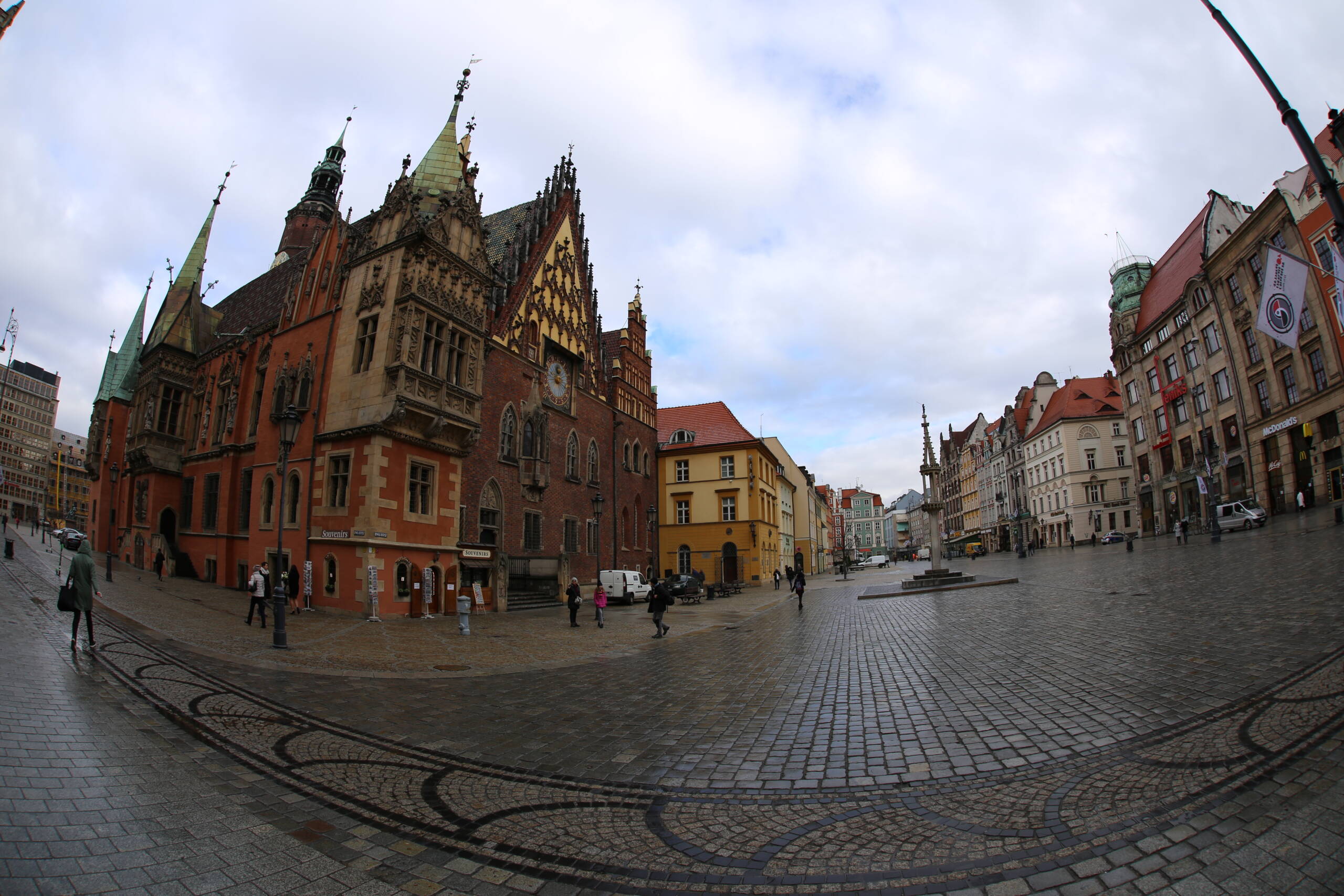
The Town Hall’s clock face sits embedded in a richly textured wall, surrounded by patterns that seem almost too intricate to process at once. Its steep roofline, dotted with greenish spires and copper elements aged into that familiar patina, leans into the sky with a kind of medieval confidence. There’s something slightly asymmetrical about it, and that imperfection gives it life. You can almost imagine craftsmen adding elements over decades, maybe arguing about proportions, maybe not caring too much as long as it looked impressive enough.
Around it, the square of Rynek opens generously, unusually spacious, almost theatrical in scale. The buildings lining the edges—painted in soft yellows, muted greens, pale reds—form a pastel perimeter that contrasts with the darker, heavier presence of the Town Hall. Their façades are more restrained, but still detailed, each one carrying a slightly different rhythm of windows and rooflines, like a row of personalities standing side by side.
People move through the scene in small, unhurried paths. A few figures cross the square, their reflections briefly visible in the wet stone before dissolving. Someone pauses near the base of the building, maybe checking a phone, maybe just taking in the view. The openness of the space creates this odd calm—despite being a central square, it doesn’t feel crowded, just… expansive. The kind of place where footsteps echo a bit more than expected.
The wide-angle perspective exaggerates the distance between elements, pulling the viewer slightly into the scene. The curve of the cobblestones in the foreground feels almost like a visual guide, leading inward toward the Town Hall, then outward again toward the surrounding streets. It’s not just a photograph of Wrocław, it’s a sense of spatial memory—the way the square feels when you stand in it, not just how it looks.
And maybe that’s what stays with you. Not a single architectural detail, not even the Town Hall itself, but the way the space holds everything together—the damp air, the softened light, the quiet movement of people across centuries-old stone.
Leave a Reply