Looking at this image, New York still feels endless. The city stretches like a textured carpet of brick, glass, and steel, stitched together by straight avenues that fade into the distance, with the Empire State Building still standing like a punctuation mark in the middle of the sentence. From above, Manhattan looks dense, confident, almost defiant, as if scale itself were part of the architecture. Yet this view is deceptive. It shows intensity, not expansion. New York is tall, tight, and vertical, but it is no longer massive in the way megacities are now measured. While Asian urban regions have dissolved their boundaries and absorbed surrounding cities into single living organisms, New York remains an island mentality city, even when it isn’t an island at all.
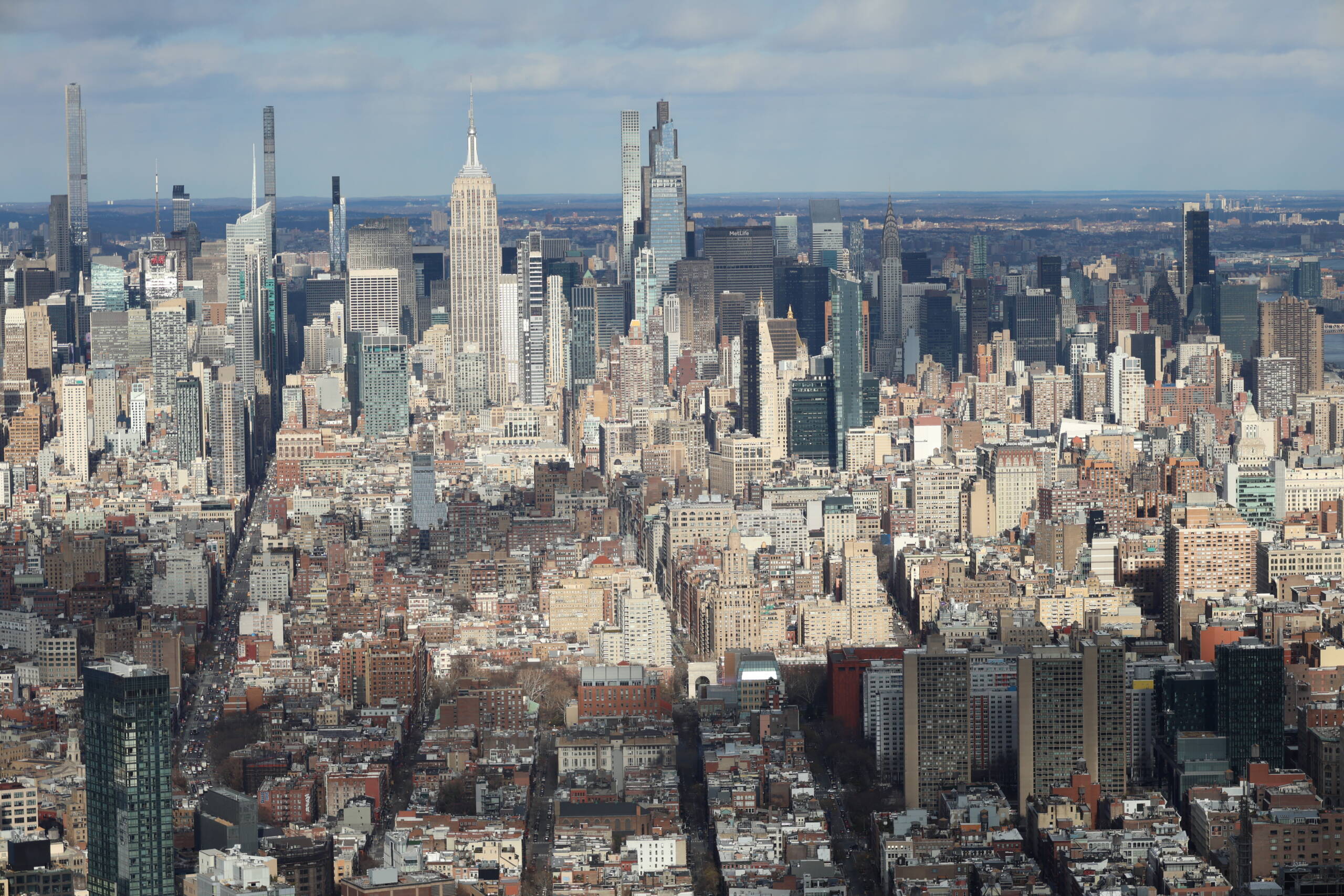
For most of the twentieth century, New York represented the ultimate urban achievement: density without collapse, diversity without fragmentation, power without sprawl. It grew by stacking itself upward rather than outward, compressing millions into a narrow geography and building infrastructure that made that compression livable. That model worked brilliantly in an industrial and financial age where proximity mattered more than space. Factories, offices, ports, exchanges, and media all needed to be close, and New York became the machine that made that closeness profitable. The skyline in the photo still tells that story, layer upon layer of ambition rising from a tight grid that never relaxed.
But the world’s definition of a megacity has quietly changed, and New York did not follow. Jakarta, Dhaka, Delhi, Shanghai, even Tokyo now operate as vast urban fields rather than cities in the traditional sense. They sprawl, merge, blur, and absorb. Commuting zones stretch for hours, not minutes. Housing spills outward in every direction. Administrative borders have become irrelevant to how people actually live. By contrast, New York’s growth stalled not because of decline, but because of limits it chose to keep: zoning rigidity, protected neighborhoods, political fragmentation between states and counties, and an infrastructure system that was never rebuilt for true regional integration. The New York metropolitan area exists, but it does not function as a single organism in the way Asian megacities do. It is more like a federation of uneasy neighbors sharing a train system that groans under the weight of its own age.
This image captures that paradox beautifully. You see density pushed to its absolute limit, every block filled, every rooftop used, every vertical inch negotiated. Yet beyond that density, the city simply stops. There is no endless urban tide rolling outward, no seamless continuation into a larger metropolitan mass. New York is complete, finished, almost sealed. Its power now comes from concentration rather than scale. It remains one of the world’s most influential cities, but it is no longer one of the world’s largest, and those two things are no longer the same.
New York didn’t lose the megacity race; it opted out of it. While Asia built cities for population, New York became a city for capital, culture, and signal. The skyline still broadcasts authority, but the numbers tell a different story. In a century defined by urban expansion, New York stands as a monument to an older idea of the city: bounded, vertical, and intensely human in scale, even when viewed from the sky. That may not win statistical rankings anymore, but it explains why the city still feels, stubbornly, like the center of something.
Leave a Reply