The photograph captures it well enough: a broad urban square, the kind that French cities do better than anywhere else on earth, ringed by cream-stone Haussmann-era facades, a baroque fountain at its center, a Gothic spire cutting the sky above. It could almost be Paris. It is not Paris, and that is precisely the point. This is Place Royale in Nantes, and it stands as an introduction to a city that the international travel market has chronically undervalued relative to what it actually offers and, more importantly, relative to where it sits.
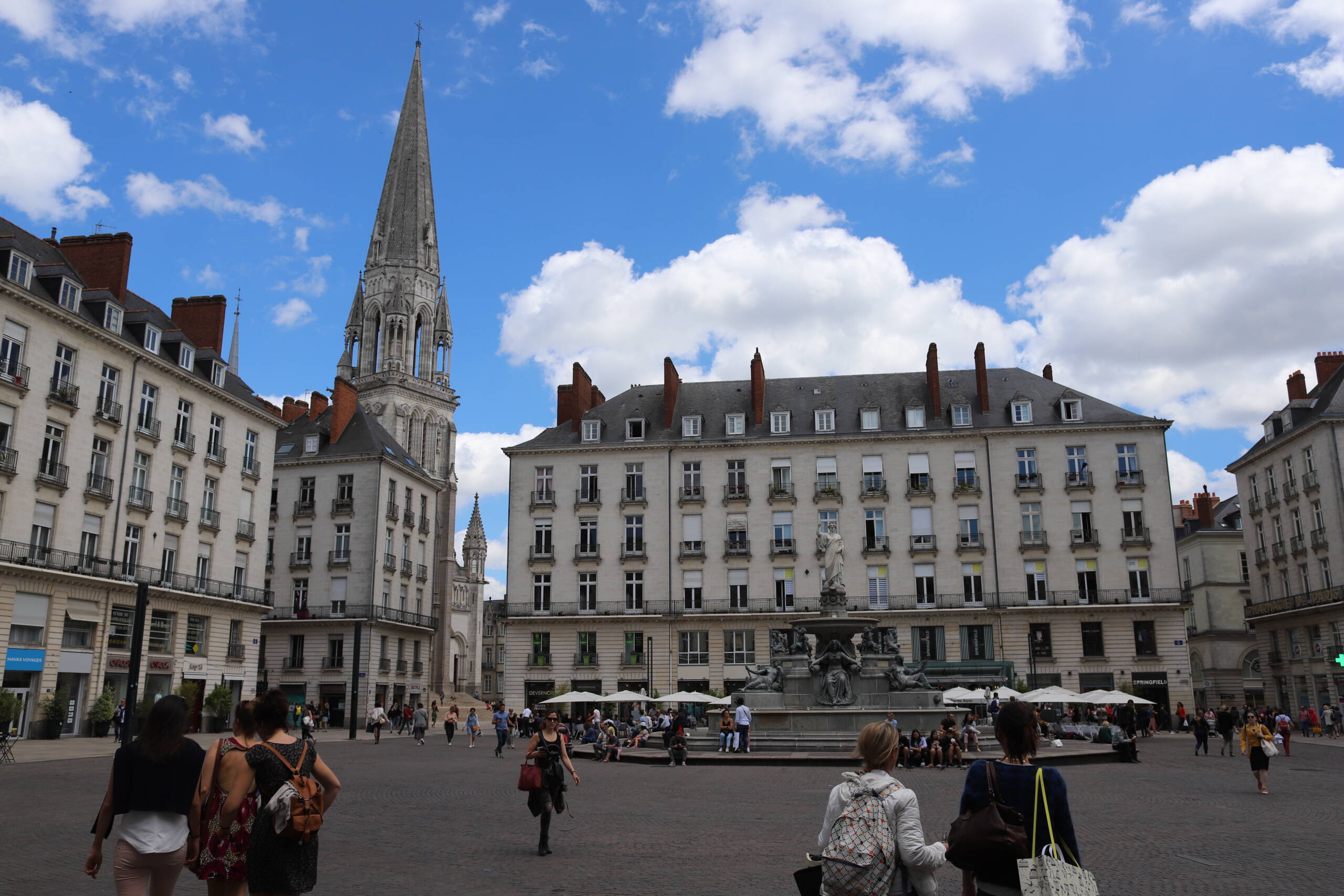
Nantes is located at the confluence of the Loire and the Erdre, roughly an hour by TGV from Paris, two hours from Bordeaux, and positioned at the western terminus of the Loire Valley. That last fact alone should make it a standard-issue stop on any serious France itinerary, and yet it remains largely a city that French travelers know and international travelers discover accidentally. The accident is a gift.
As a base of operations, Nantes is close to structurally ideal. The TGV connection to Paris is fast enough that the capital is a day trip rather than a commitment. The Loire Valley châteaux — Chambord, Chenonceau, Villandry, Amboise — are accessible by train and car without the logistical complexity that comes with staging them from Tours, which is deeper into the valley but offers a narrower range of departure options. To the south, the Atlantic coast opens within forty minutes. The Vendée, Saint-Gilles-Croix-de-Vie, the Île de Noirmoutier reachable at low tide across the Passage du Gois — these are coastal France experiences that most international itineraries skip entirely because no one told the story of how easy they are to reach from a city with Nantes’s connectivity.
To the north, Brittany begins almost immediately. Rennes is forty-five minutes by train. Saint-Malo, the walled corsair city above a tidal bay, is under two hours. The Gulf of Morbihan, one of the most unusual coastal environments in Western Europe — an inland sea studded with islands, tidal patterns that produce water colors that shift from grey to green to blue across the day — is reachable in under ninety minutes by car. Travelers who stage Brittany from Paris are doing it on hard mode. Travelers who use Nantes as the pivot point cover more territory with less friction.
The city itself rewards the time between excursions. Nantes was the capital of the Duchy of Brittany before its annexation by France, a slave-trade port of considerable historical importance whose reckoning with that history is now embedded in the Mémorial de l’Abolition de l’Esclavage on the quai de la Fosse — one of the more thoughtfully designed memorial installations in Europe. The Château des Ducs de Bretagne anchors the old city with a structure that is genuinely impressive in scale and condition. The Passage Pommeraye, a three-level nineteenth-century shopping arcade of theatrical grandeur, photographs like a set piece. The contemporary art scene, anchored by the Machines de l’Île — monumental mechanical animals operating inside the old shipyard buildings on the Île de Nantes — gives the city a creative identity that is specific to itself and not derivative of Paris.
The food positioning deserves attention. Nantes sits at the intersection of Loire Valley wine country, Atlantic seafood supply, and the butter-intensive traditions of western French cooking. The muscadet produced in the vineyards immediately south and east of the city is among the most food-versatile white wines in France and one of the least expensive for its quality. Beurre blanc, the sauce that defines the regional kitchen, originated on the banks of the Loire near Nantes. The covered market at Talensac is the functional center of local food culture, operating at a scale and quality level that most French cities of comparable size cannot match.
For the travel marketer, Nantes presents a specific kind of case: a destination that is not unknown but is underframed. The problem is not awareness — the city has a solid domestic reputation — but positioning. Nantes is rarely presented as what it actually is: one of the best-located cities in France for a traveler who wants to use a single urban base to move efficiently through three or four distinct regions in a single trip. Selling Nantes as a destination sells one city. Selling Nantes as a hub sells the Loire Valley, the Atlantic coast, Lower Brittany, and the city simultaneously, which is a materially stronger proposition for the traveler and a materially larger revenue opportunity for the operators and airlines willing to build around it.
The TGV corridor from Paris to Nantes is already served. The story just needs to catch up.