Amsterdam’s Dam Square is one of those places where the entire city seems to gather in a single frame. The National Monument rises above the cobblestones, the Grand Hotel Krasnapolsky overlooks the square, and visitors cross in every direction with cameras, shopping bags and sightseeing plans. In this original photograph, a woman in a white jacket stands amid a flock of pigeons, with birds perched on her hands and head and another caught in mid-flight. People nearby stop to watch and take pictures. It is a lively, unmistakably Amsterdam street scene, but it also illustrates a kind of tourism the city has good reason to discourage.
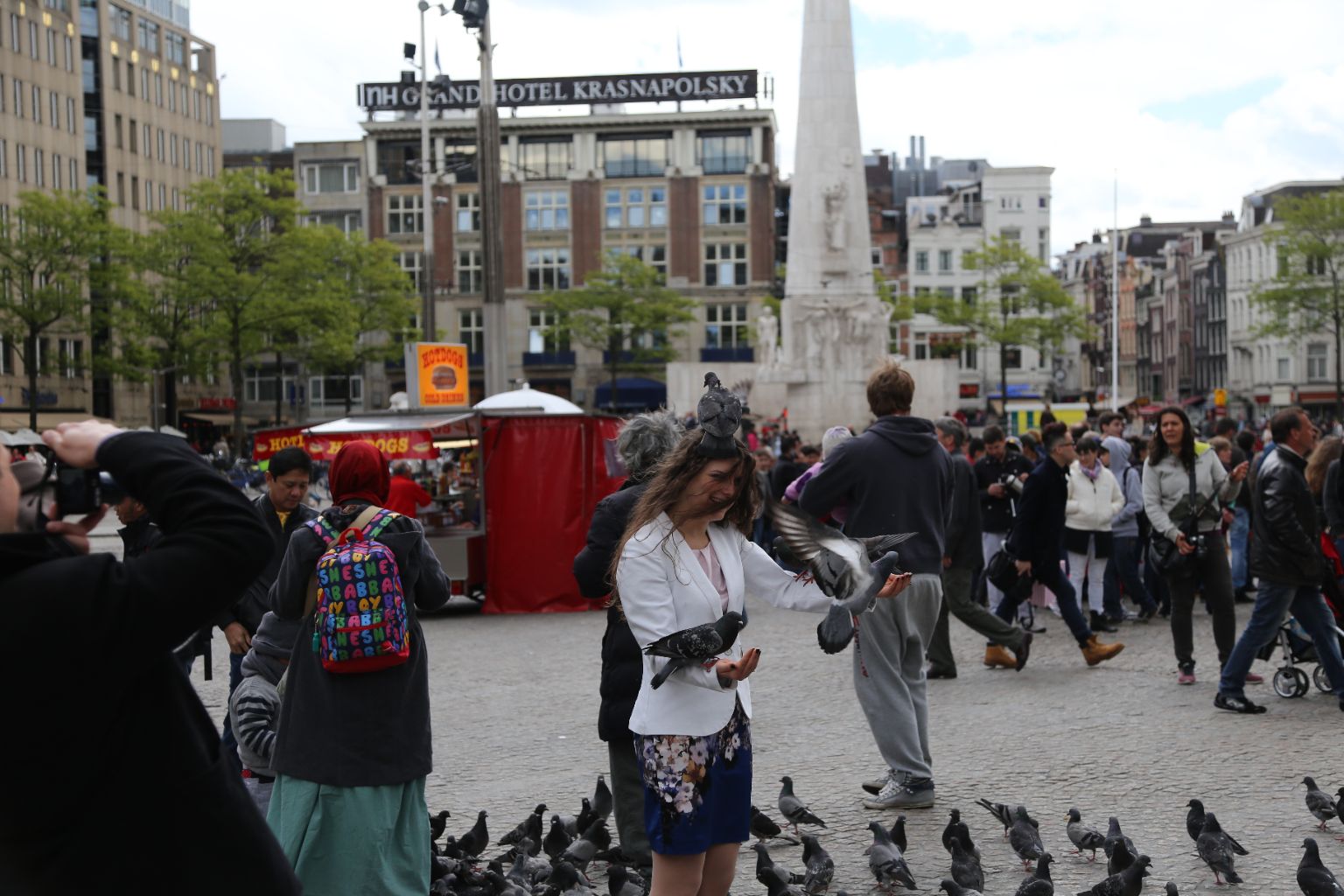
The temptation is easy to understand. A bird lands on an outstretched hand, another flutters toward the camera, and suddenly an ordinary stop in a public square turns into a personal wildlife performance. The resulting photograph may be amusing, perhaps even charming. But a city square is not a petting zoo, and a flock encouraged to gather around visitors does not simply disappear when the photographs are taken. Food scraps and concentrated bird activity create problems for sanitation, other pedestrians and the people who have to maintain the square long after the tourists leave.
More importantly, Amsterdam actually has a rule about this. Since April 2022, the city has prohibited feeding animals in public spaces, including pigeons and other birds. The municipal public health service explains that the ban is intended to reduce rat nuisance and that feeding animals can result in a fine. That makes this more than an argument over taste or etiquette. However photogenic the pigeons may seem, feeding them in the street is against local rules. A visitor does not get an exemption because the moment would make a good Instagram picture.
And pigeons are only one part of the problem. Amsterdam is a functioning city, not a stage set constructed for weekend visitors. Its narrow streets, bridges, bicycle lanes, public transport and residential neighborhoods have to work for the people who live there. Tourists who drift into cycling lanes without looking, block entrances while arranging group photographs, leave rubbish behind or treat quiet streets as an extension of the nightlife district are not adding to the city’s appeal. They are making everyday life more difficult. Even in busy Dam Square, where crowds are part of the atmosphere, a little awareness goes a long way.
There is a better way to experience Amsterdam, and it does not require becoming a humorless traveler. Take photographs of the grand buildings, the changing light and the strange little moments that unfold naturally. Watch the pigeons without trying to assemble them into a spectacle. Step aside before stopping for a picture, give cyclists room, dispose of rubbish properly and remember that the people around you may be on their way to work rather than on holiday. If you have time, wander beyond the most crowded central streets, where Amsterdam’s canals, neighborhood shops and ordinary daily rhythms often reveal far more than the familiar tourist performances.
For the travel industry, this is also a marketing lesson. A destination can welcome visitors without encouraging every behavior that generates clicks. Responsible tourism is not just about choosing a greener hotel or buying a train ticket; it is also about what travelers do once they arrive. The most memorable city experiences rarely require turning public spaces and animals into props. Enjoy Dam Square, photograph it, and take home a story worth telling. Just don’t be that tourist.