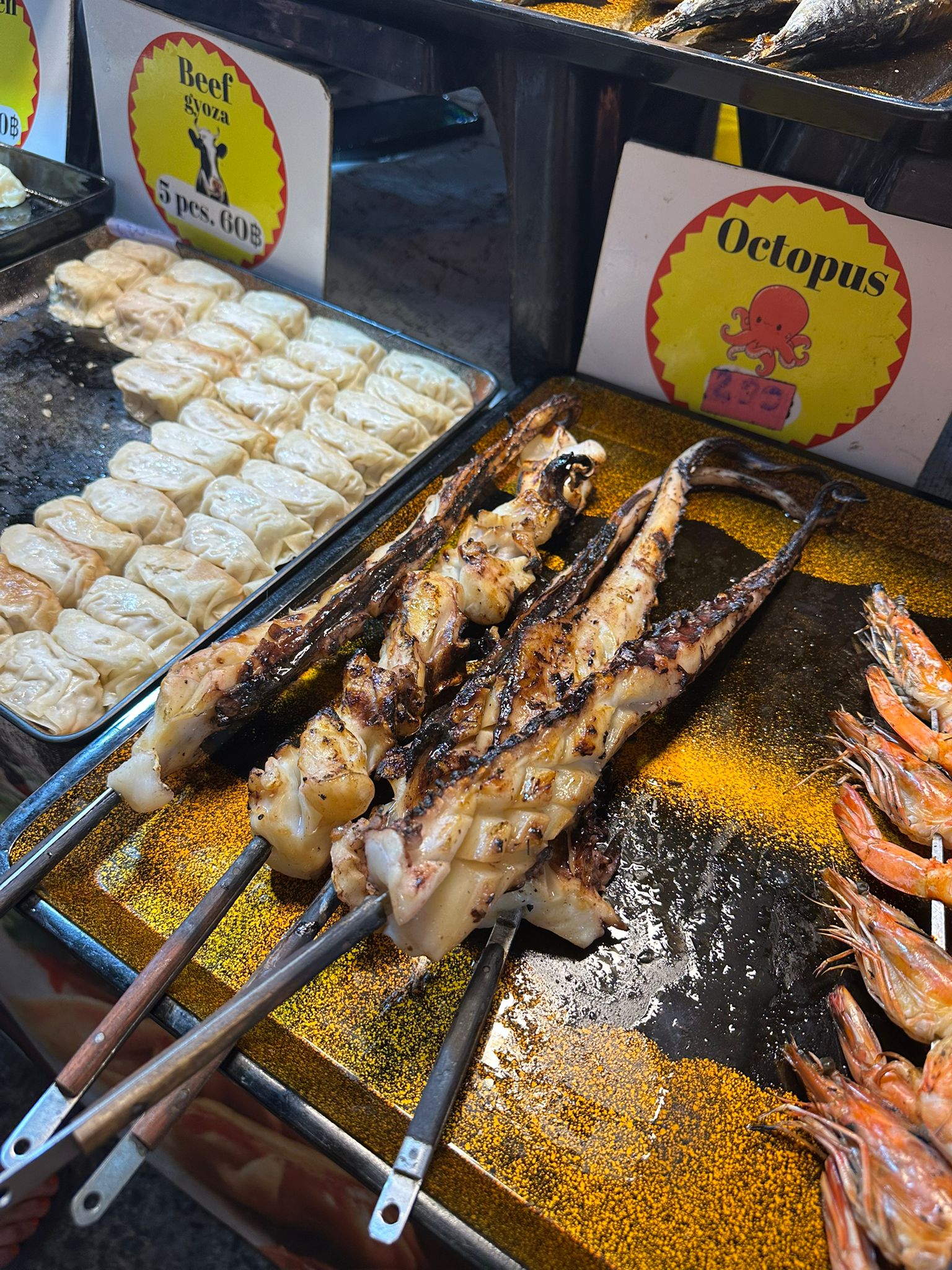
There’s something hypnotic about standing in front of a stall like this, watching octopus tentacles curl slightly over the heat, the char lines catching that glistening sheen that only comes from a hot grill and a vendor who has done this every single evening for years. The table is dotted with spice powder that seems to have a life of its own, the prawns on the right side lined like little soldiers, and a batch of beef gyoza quietly steaming in the corner. It’s noisy around, humid, people bumping, somebody shouting orders in two languages at once. And somehow, this is where some of the best food of your life tends to happen.
Naturally, the question comes up: is it safe?
The honest answer is that most hawker markets are generally safe if the stall is busy and the food is cooked hot to order. Heat is your friend here. What you’re looking at in the photo is textbook “good sign” street food. The grill is scorching, smoke rising, nothing sitting around long enough to grow questionable bacteria colonies. The ingredients look like they’re being handled actively, not languishing untouched. And the vendor is clearly moving product quickly. In places like Thailand, Vietnam, Malaysia, Singapore, Hong Kong, the entire culture of hawker food relies on freshness through speed: sell everything fast, cook everything fast, serve it immediately. It’s the opposite of some forgotten hotel buffet tray under a heat lamp.
Of course, there are little rules travelers pick up after a few markets. You stick to the stalls where locals are queueing, because locals don’t tolerate bad or unsafe food. You avoid raw things unless you are absolutely sure about the cleanliness. You don’t drink water with ice from a random bucket. You trust your senses more than a TripAdvisor review. And sometimes, if your gut says hmm maybe not today, you just smile, walk three steps, and there’s another stall right there, because street food economies are competitive ecosystems and the weak don’t survive long.
Standing there, the sound of sizzling octopus and the cloud of chili salt dusting your shirt, you realize that hawker markets are not just about eating. They’re about being in the middle of life as it happens: late-night laughter, a kid chasing bubbles, scooters threading between plastic stools, a grandmother with the fastest knife hands in Southeast Asia. There’s a certain trust in the whole thing. A shared, unspoken agreement that food is culture and community, not just fuel.
So how safe are hawker food markets? Safe enough that millions of people eat from them daily, generations have grown up on these flavors, and entire cities have been defined by them. Safe enough — if you choose well, watch how the food is handled, and respect the wisdom of the crowd. And also, safe enough that if your stomach does complain once in a while, it’s usually more of a minor grumble than a tragedy. A rite of passage, almost. Not that we aim for that, but, well, life happens.
The truth is: some of the most memorable meals don’t happen in Michelin restaurants. They happen right here, under a tarp roof, surrounded by smoke, neon, chatter, and skewers the length of your forearm. And maybe that’s part of what makes them taste so good.
Why We Call Them “Hawker” Markets
The name goes back to something very simple and very human: people calling out to sell things. The word hawker comes from the old English idea of someone who hawks their goods, meaning they move around and call out to attract attention. Think of a voice weaving through a crowded street: “Fresh fish! Hot soup! Grilled octopus!” It’s almost like a song. Long before there were permanent food stalls or organized markets, vendors walked from village to village with baskets, carts, or makeshift stands, literally hawking what they had. Over time, especially in places like Southeast Asia, these sellers became more rooted, gathering in busy areas where people naturally met — bus stops, ferry docks, train stations, temple gates. Eventually, the wandering voices settled into clusters, and those clusters became what we now call hawker markets.
In Singapore, Malaysia, Thailand, Hong Kong — the term stuck because the spirit stayed the same. Even if the stalls today are neatly arranged in big open halls, each vendor still has that energy. They compete, they charm, they grill, they stir, they shout a bit, they smile a bit — always trying to win your attention in a moving crowd. The name hawker carries that memory of food as something lively, communal, and personal. Not a silent restaurant menu, but a place where you feel the transaction happening in real time: eye contact, aroma, flame, choice, plate, bite.
So the word doesn’t just describe the market — it describes the people. The ones who cook right there in front of you, who feed travelers and office workers and families at long shared tables. And maybe that’s why hawker markets feel different from “street food” in the generic sense. They carry a lineage of hands, voices, and faces, a tradition of calling out to you across a crowd, asking you to come taste what they made.