Walking through the Whitney feels less like ticking off masterpieces and more like drifting through a series of conversations that never quite settle. The building itself stays politely out of the way—white walls, pale wood floors, generous breathing room—so your attention keeps snapping back to the art and, just as much, to the people standing in front of it. In one gallery, a woman in a heavy dark coat stands with her arms folded, leaning slightly forward, studying a framed painting that feels almost out of time. The work shows a lone figure caught mid-motion, skin and fabric rendered with painterly tension, the background slipping into something murky and psychological. The viewer’s posture mirrors the subject’s strain, as if concentration itself has weight. Nothing dramatic is happening in the room, yet it feels charged, like a held breath. That’s a familiar Whitney sensation: the sense that looking carefully is an act, not a passive habit.

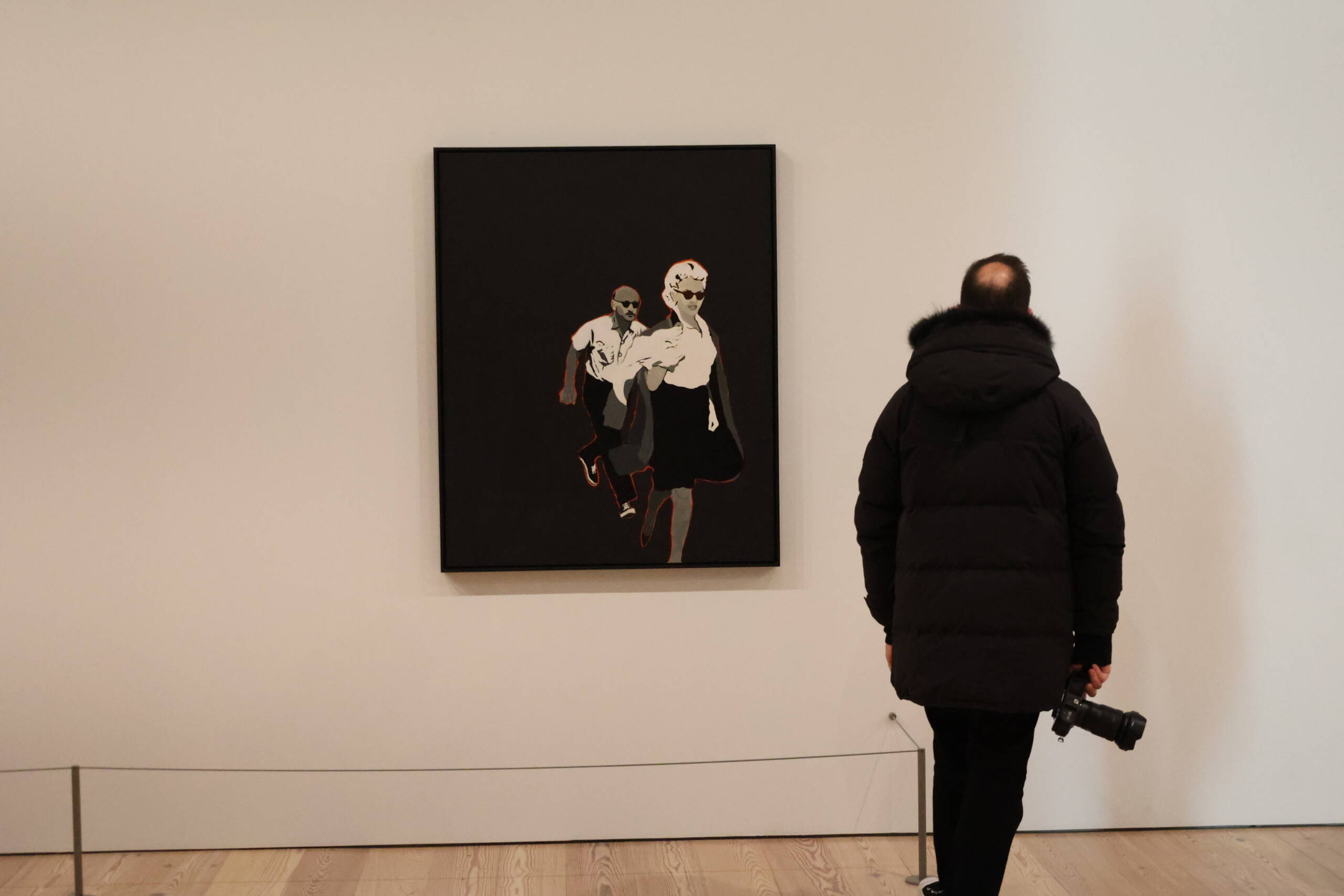
A few rooms later, the mood snaps into something sharper and more contemporary. A stark black canvas hangs alone, its figures reduced to graphic silhouettes edged with faint color, frozen in what could be motion or escape or confrontation—it’s not entirely clear, and that ambiguity is part of the pull. A man in a thick black jacket stands directly in front of it, camera dangling from his hand, clearly resisting the urge to photograph before fully understanding what he’s seeing. The painting’s minimalism makes the gallery feel quieter, even though it’s not. The emptiness around the work amplifies it, turning negative space into a kind of echo chamber. You start noticing how the Whitney uses restraint not as absence, but as emphasis.
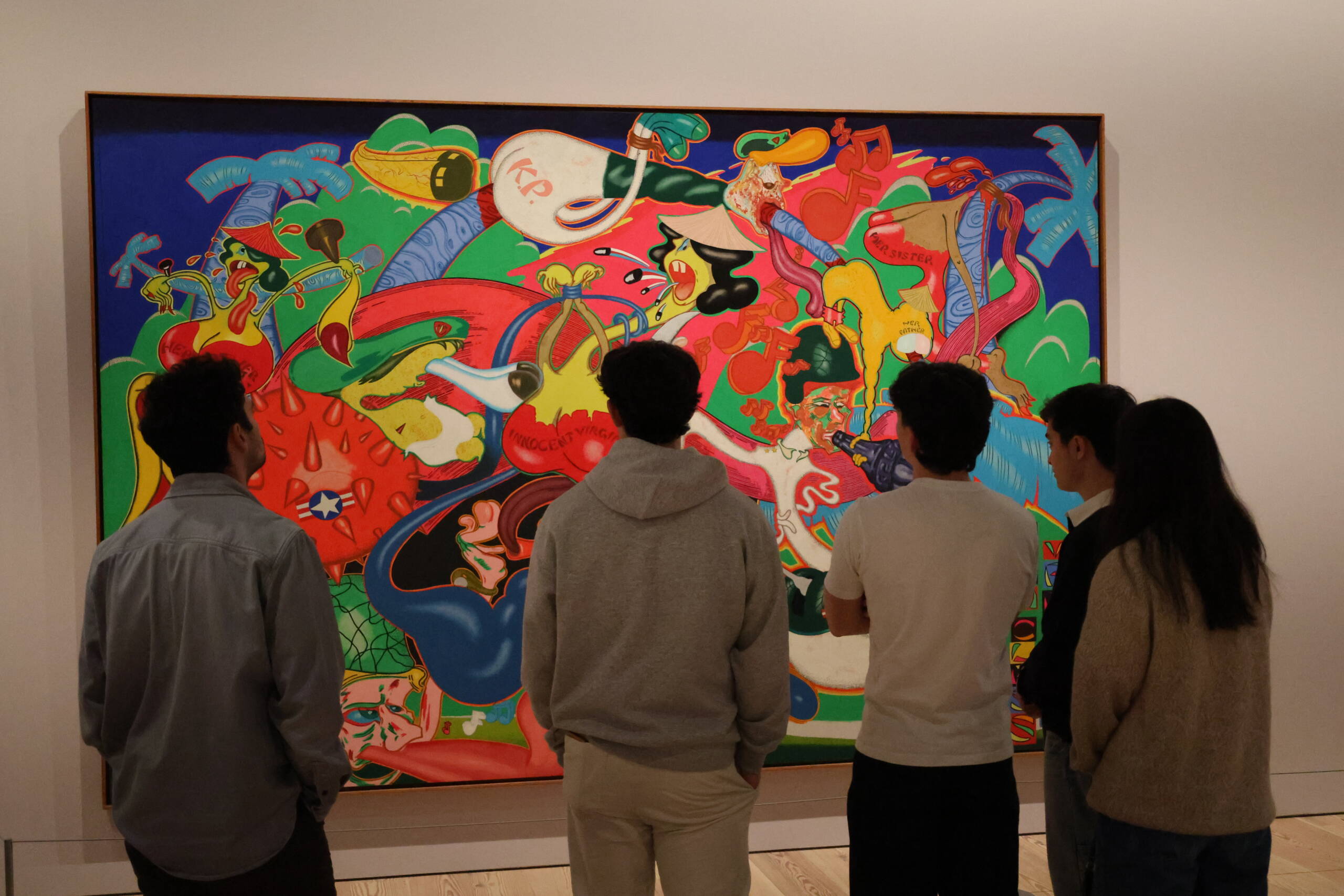
Then comes the inevitable rupture of color. A large, explosive canvas pulls in a small crowd, five people lined up shoulder to shoulder, all facing the same riot of reds, greens, blues, and cartoonish forms colliding across the surface. The painting is loud without making noise, chaotic yet strangely organized, full of symbols that feel half-familiar and slightly unsettling. You can almost trace different viewing strategies in the group: one person scanning left to right, another stepping back to take in the whole, someone else leaning in to decode a single detail. The Whitney excels at this kind of collective looking, where the artwork becomes a temporary meeting point for strangers, each bringing their own internal footnotes. It’s less about agreement and more about shared curiosity.
What makes the Whitney Museum of American Art distinctive isn’t just its focus on American art, but how insistently it frames that art as unfinished business. Styles clash, narratives overlap, and nothing pretends to be definitive. You move from introspective figuration to graphic urgency to exuberant excess in the span of a few steps, and somehow it all holds together. Maybe that’s the quiet achievement here: the museum doesn’t tell you what American art is, it shows you how often it argues with itself. You leave slightly overstimulated, a little unsure, and oddly energized—like stepping back onto the streets of New York after being indoors too long, carrying images that keep replaying in your head whether you invite them or not.
Leave a Reply