Spring has a way of announcing itself in cities not through temperature alone but through color, and in San Francisco the signal arrives in spectacular fashion when Union Square fills with tens of thousands of tulips. On Saturday, March 21, the heart of downtown will temporarily transform into a vivid urban garden as the Union Square Alliance hosts its annual Tulip Day Presented by JPMorganChase, a public celebration that turns one of the city’s most recognizable plazas into a sea of flowers. For a few hours, the granite square normally surrounded by luxury storefronts and hotels becomes something closer to a Dutch spring field—only this one sits between cable car lines and high-rise façades.
The event brings together an astonishing 80,000 tulips, grown in the United States from bulbs originally sourced in the Netherlands. Arranged in carefully planted beds across the square, the flowers create an almost painterly scene: bands of deep red, bright yellow, violet, and soft pink stretching across the plaza, framed by palm trees and historic buildings. Visitors wander through the garden paths before the ceremonial moment when the field opens for picking. At that point, thousands of people step forward and select their own bouquet—eight tulips per person—cutting stems from the temporary garden and carrying them away as a small symbol of spring.
City leaders see the event as more than just a photogenic spectacle. Mayor Daniel Lurie described Tulip Day as one of the gatherings that helps bring energy back to the city center, drawing both residents and visitors into the downtown core. In recent years Union Square has been working to rebuild foot traffic and revive its role as a social hub, and large public events—especially visually striking ones like this—have become an important part of that strategy. A plaza filled with flowers, families, cameras, and street-level activity sends a message that the district is alive again.
Tulip Day also serves as the opening moment of Union Square in Bloom, a seasonal initiative where businesses across the district embrace floral themes throughout spring and summer. Storefronts decorate their windows with botanical installations, restaurants introduce flower-inspired cocktails or seasonal menus, and public programming spreads outward from the square itself. The whole area begins to take on a subtle garden aesthetic for several months, blending retail, hospitality, and urban culture with the symbolism of the season.
The tradition behind the event reaches back nearly a century. Tulip festivals in the United States trace their roots to the first Tulip Festival held in Holland, Michigan, in 1929—an idea inspired by the Netherlands’ deep cultural connection to the flower. San Francisco’s version brings that heritage to the West Coast, combining Dutch horticultural history with California’s own flair for public festivals. The bulbs may originate in the Netherlands, but the blooms themselves are grown domestically, making the display a collaboration across continents.
Community participation remains a key part of the day. Among the organizations involved in the festivities is the Chinatown Community Development Center, whose youth group will take part in the event. The nonprofit primarily serves San Francisco’s Chinatown neighborhood while also supporting nearby communities such as North Beach and the Tenderloin, and its presence adds a local dimension to what might otherwise feel like a purely symbolic festival.
By the time the afternoon winds down, the garden that once filled Union Square will mostly be gone—transformed into thousands of bouquets carried through city streets, onto buses and cable cars, and back into homes across the Bay Area. That brief, almost fleeting transformation is part of the charm. For a morning and early afternoon, the plaza becomes a field of spring color. Then the flowers disperse, spreading that color across the city in the hands of the people who came to gather them. 🌷🌷🌷
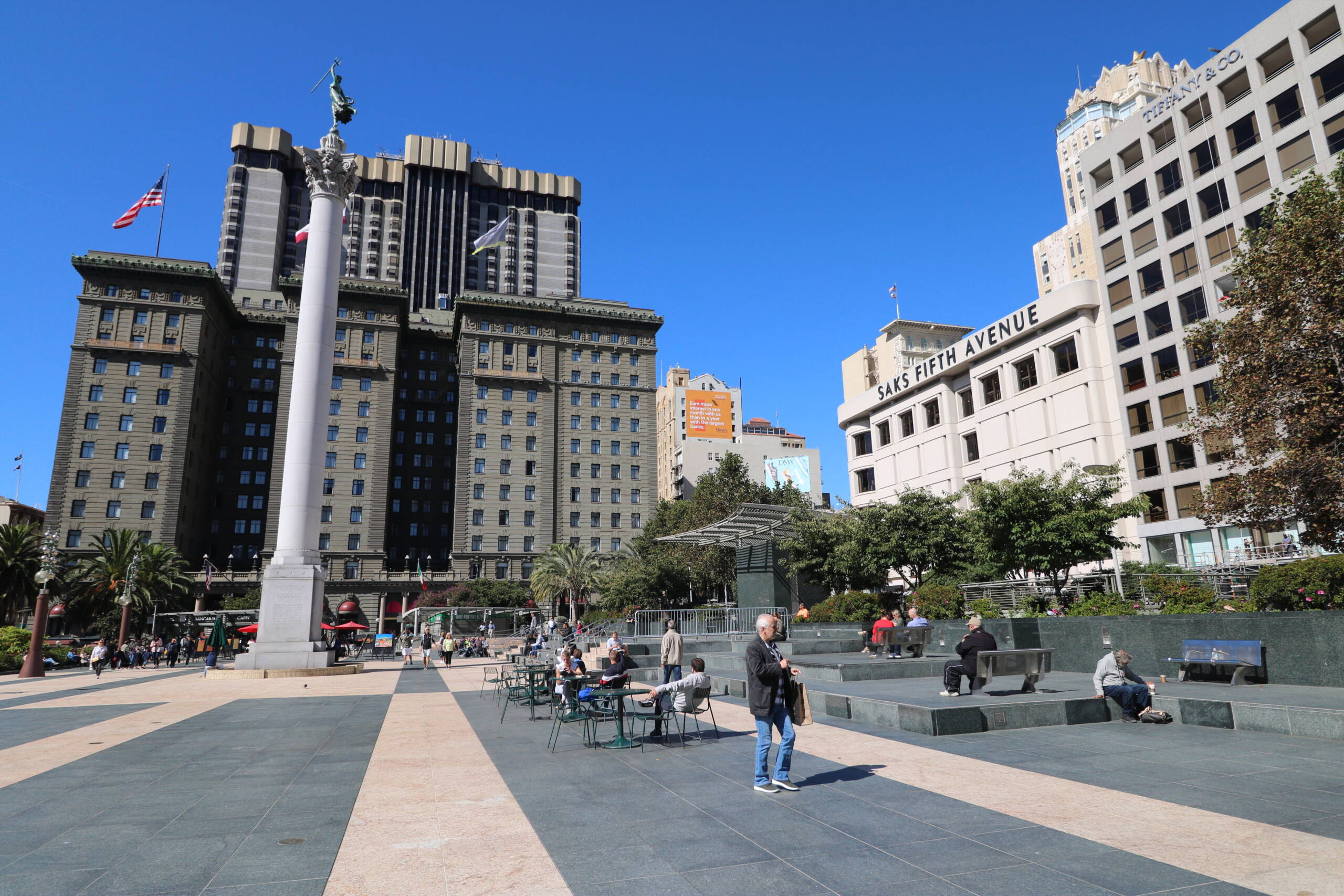
Union Square, San Francisco. Image credits: Pho.tography.org, photo taken with Canon R100 and Canon RF-S 10–18mm F4.5–6.3 IS STM Combo
The photograph captures Union Square in one of those moments when the space feels wide, almost stage-like, waiting for the next act of city life to unfold. The sky above San Francisco is a deep, uninterrupted blue, the kind of crisp Pacific clarity that makes the architecture look sharply cut against the horizon. At the center of the composition rises the tall white column of the Dewey Monument, its Corinthian capital supporting the bronze figure of Victory poised high above the square. The statue leans forward slightly, holding a trident and wreath, as if surveying the city below with a calm, triumphant posture.
Behind the column stands the stately façade of the Westin St. Francis hotel, a historic presence that has anchored Union Square for over a century. Its pale stone exterior and rows of evenly spaced windows give the building a quiet gravity, though it’s partially framed by a darker, more modern tower rising behind it. The American flag flutters on the left side of the hotel roofline, catching the light and adding a small movement against the otherwise still skyline.
To the right, the bright cream-colored building of Saks Fifth Avenue curves slightly toward the plaza, its large black lettering stretching across the upper façade in unmistakable department-store confidence. Further back, the top of the Tiffany & Co. building peeks into view, its name etched near the crown of the structure, reminding you that this square has long been the commercial heart of San Francisco’s shopping district.
The foreground tells a quieter story. The plaza itself is paved in wide geometric bands of gray and beige stone, forming long stripes that lead the eye naturally toward the monument. A scattering of café tables and green metal chairs sits near the center, where several people linger—some talking, some just watching the day drift by. A man in the foreground walks across the open plaza holding a small paper bag, his shadow stretching sharply across the stone in the midday sun.
To the right side of the square, the stepped seating terraces hold clusters of people resting, chatting, or checking their phones. A few individuals sit alone on benches, leaning back casually, while others gather in small pairs. Trees line the edge of the plaza, their green canopies softening the hard geometry of the buildings behind them.
Palm trees appear near the base of the St. Francis, adding a faint California signature to the scene. Beneath them, red awnings mark the hotel entrances and cafés that spill slightly toward the square. Pedestrians move along the edges of the plaza, weaving between storefronts and the open public space.
What makes the image especially interesting in the context of the upcoming Tulip Day is how empty the center of the square feels. The broad expanse of stone—clean, sunlit, almost minimalist—will soon be replaced by a temporary garden of 80,000 tulips. Where people now walk across open pavement, dense rows of red, yellow, pink, and purple flowers will appear, transforming the plaza into something that resembles a Dutch spring field placed right in the middle of downtown San Francisco.
Looking at the photograph now, the square feels calm, structured, almost architectural in its simplicity. In a few weeks, though, that same space will become something entirely different: a burst of color, crowds with bouquets in their hands, cameras everywhere, and the unmistakable signal that spring has finally arrived in the city. 🌷