• Skip to main content
  • Skip to secondary menu
  • Skip to footer

Travel Marketing

Travel and Tourism Trends

  • Sponsored Post
  • Travel Event Calendar
  • Travel Market
  • Travel Magazine
  • About
  • Contact

Whitney Museum of American Art, New York City

January 10, 2026 By admin Leave a Comment

Walking through the Whitney feels less like ticking off masterpieces and more like drifting through a series of conversations that never quite settle. The building itself stays politely out of the way—white walls, pale wood floors, generous breathing room—so your attention keeps snapping back to the art and, just as much, to the people standing in front of it. In one gallery, a woman in a heavy dark coat stands with her arms folded, leaning slightly forward, studying a framed painting that feels almost out of time. The work shows a lone figure caught mid-motion, skin and fabric rendered with painterly tension, the background slipping into something murky and psychological. The viewer’s posture mirrors the subject’s strain, as if concentration itself has weight. Nothing dramatic is happening in the room, yet it feels charged, like a held breath. That’s a familiar Whitney sensation: the sense that looking carefully is an act, not a passive habit.

Whitney Museum of American Art, New York City

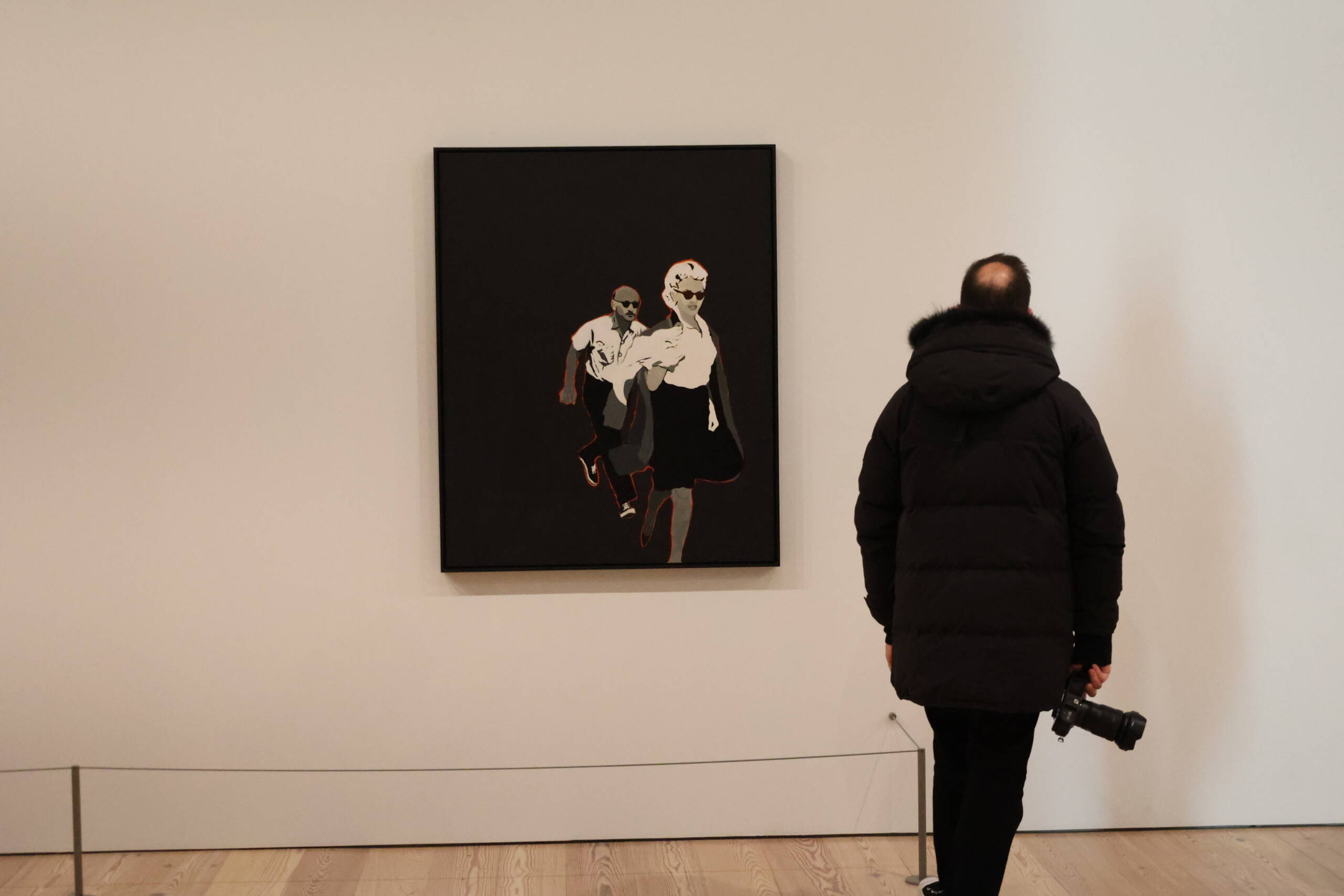
A few rooms later, the mood snaps into something sharper and more contemporary. A stark black canvas hangs alone, its figures reduced to graphic silhouettes edged with faint color, frozen in what could be motion or escape or confrontation—it’s not entirely clear, and that ambiguity is part of the pull. A man in a thick black jacket stands directly in front of it, camera dangling from his hand, clearly resisting the urge to photograph before fully understanding what he’s seeing. The painting’s minimalism makes the gallery feel quieter, even though it’s not. The emptiness around the work amplifies it, turning negative space into a kind of echo chamber. You start noticing how the Whitney uses restraint not as absence, but as emphasis.
Whitney Museum of American Art, New York City

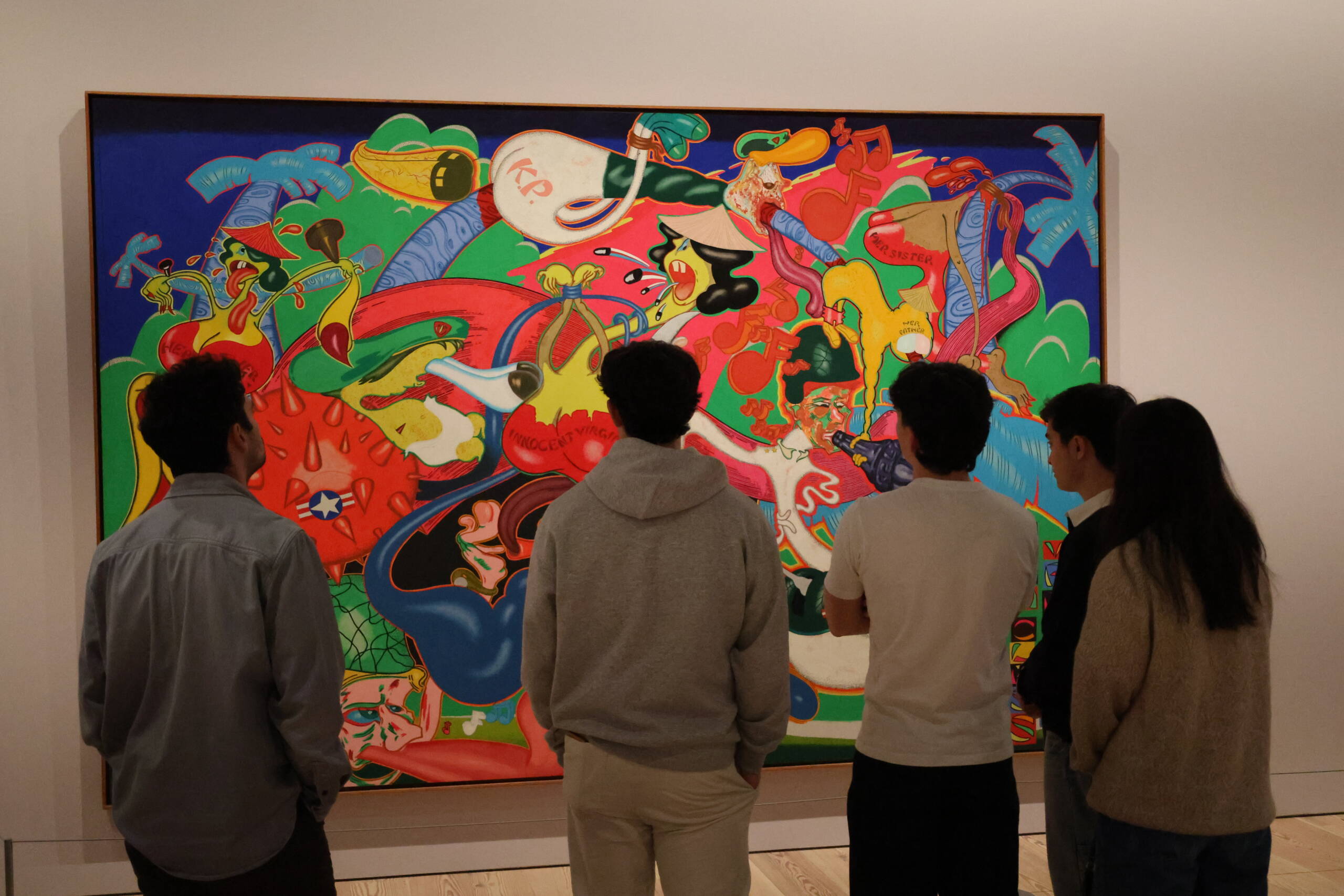
Then comes the inevitable rupture of color. A large, explosive canvas pulls in a small crowd, five people lined up shoulder to shoulder, all facing the same riot of reds, greens, blues, and cartoonish forms colliding across the surface. The painting is loud without making noise, chaotic yet strangely organized, full of symbols that feel half-familiar and slightly unsettling. You can almost trace different viewing strategies in the group: one person scanning left to right, another stepping back to take in the whole, someone else leaning in to decode a single detail. The Whitney excels at this kind of collective looking, where the artwork becomes a temporary meeting point for strangers, each bringing their own internal footnotes. It’s less about agreement and more about shared curiosity.
Whitney Museum of American Art, New York City

What makes the Whitney Museum of American Art distinctive isn’t just its focus on American art, but how insistently it frames that art as unfinished business. Styles clash, narratives overlap, and nothing pretends to be definitive. You move from introspective figuration to graphic urgency to exuberant excess in the span of a few steps, and somehow it all holds together. Maybe that’s the quiet achievement here: the museum doesn’t tell you what American art is, it shows you how often it argues with itself. You leave slightly overstimulated, a little unsure, and oddly energized—like stepping back onto the streets of New York after being indoors too long, carrying images that keep replaying in your head whether you invite them or not.

Filed Under: News

Reader Interactions

Leave a Reply Cancel reply

Your email address will not be published. Required fields are marked *

Footer

Recent Posts

  • Fora Hits $1 Billion Valuation as AI Transforms the Future of Travel Planning
  • The Open Kitchen Experience: Dining Where You Can Watch the Cooking
  • Holland America Line Adds Flåm and Hellesylt to Five 2027 Norway Fjord Cruises
  • La Cité du Vin, Bordeaux: The Building That Looks Like Wine in a Glass
  • EU Border Delays: ETIAS Pre-Travel Authorization Pushed to Late 2026 as EES Chaos Continues
  • Toledo’s Old Town: A Mudéjar Watchtower Hiding an Antiques Shop
  • Piazza del Duomo, Catania: Where a Black Lava Elephant Guards Sicily’s Baroque Heart
  • Château de Fougères: Inside Europe’s Largest Medieval Fortress
  • Château de Vitré: The Medieval Fortress Guarding Brittany’s Eastern Gate
  • Miroir d’eau at Blue Hour: Bordeaux’s Water Mirror Comes Alive

Media Partners

  • Virtual Travel Guide
  • Ancient Rome
Lisbon’s Seven Hills: A Walking Guide That Tells You the Truth
New Orleans: An American City That Plays by Different Rules
Ha Long Bay Without the Cruise Brochure
Istanbul at the Threshold: A City That Has Always Been Two Things at Once
Iceland’s Ring Road: What the Drive Teaches You That No Photograph Can
Marrakech’s Medina: How to Read a City That Was Not Designed for You
Torres del Paine: What You Are Actually Getting Into
Kyoto in Autumn: What the City Looks Like When the Maples Turn
Disneyland Paris Rewrites Its Script With World of Frozen and Disney Adventure World
Wallace Fountain: Carrying Water, Carrying Values
Water Across the Empire: Roman Aqueducts and the Hydraulic Logic of Conquest
The Oath of the Horatii: David's Roman Republic in Paint
Jean-Léon Gérôme: The Victorian Gaze on Rome
Ostia: The Port That Fed Rome
Roman Naval Warfare: The Sea They Called Their Own
The Roman Grain Ship: How Rome Fed Itself Across the Sea
Trajan's Column: Rome's Greatest Comic Strip
Caesarea Maritima: A Roman City Built from Nothing
Damnatio Memoriae: Rome's War on Memory
Faustina the Younger: The Woman Behind the Philosopher Emperor

Media Partners

The Immersive Experience in the Museum World
Japan, China, and Taiwan: A New Triangle of Risk — and a Window of Opportunity for Japan
Ghost Kitchens as Infrastructure: The Shift from Restaurants to Intelligent Food Networks
The Zoom Divide Nobody Saw Coming
The Perfect Budget Content-Creator Kit
Reimagining Prague’s Tourism Future Through Immersive Media and VR Museums
Israel’s Urban Paradox: Tel Aviv Moves, the Rest Stand Still
American Express Global Business Travel (GBTG): Understanding the Business and the Investment Case
Why the Canon R8 Paired With the New RF 45mm f/1.2 Lens Quietly Becomes the Content Creator’s Sweet-Spot
The Future of Travel: A $15.5 Trillion Industry

Copyright © 2026 Travel Marketing

Media Partners: Timey · Publishing House · Ancient Rome · Photography · Calendarial · Transportational