Summer 2026 is shaping up as one of the most expensive and logistically complicated travel seasons in recent memory. Two forces — unrelated in origin but convergent in effect — are compressing the options available to international travelers: a structural spike in aviation fuel costs driven by the conflict in the Middle East, and the full rollout of the EU’s Entry/Exit System (EES), which became mandatory at Schengen borders on April 10. Neither factor is fatal to travel plans, but both require adjustment that most travelers haven’t made yet.
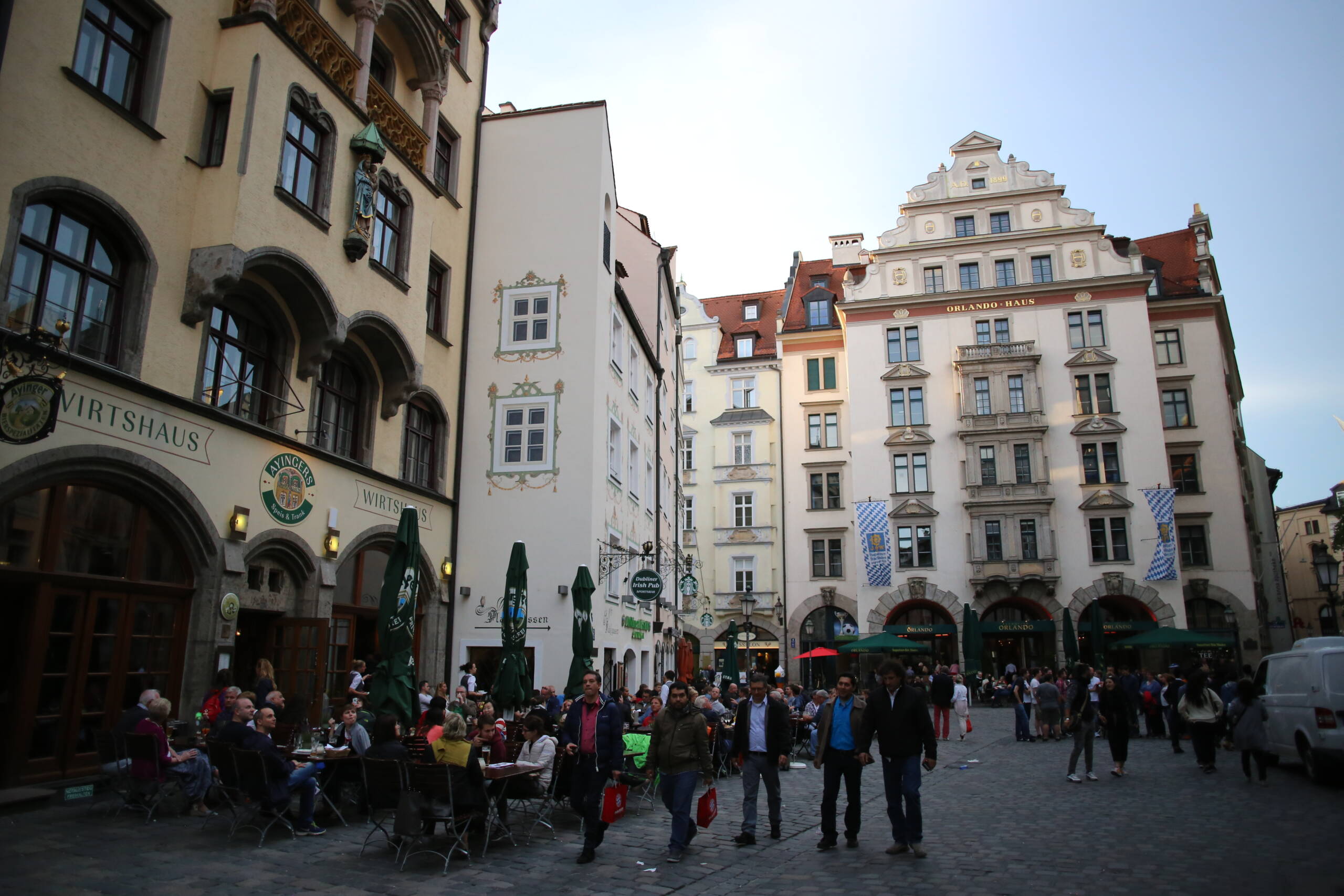
Munich’s Platzl on a warm evening — one of the great street-level arguments for European travel, where centuries-old civic architecture and the chaotic pleasure of an outdoor crowd occupy the same cobblestones without apparent contradiction. This summer, getting here costs more than it did last year, and arriving at the German border takes longer than it did six months ago. Jet fuel prices have roughly doubled since February, pushing airfares up across the board and forcing carriers to cut the off-peak routes that budget travelers depend on. Simultaneously, the EU’s Entry/Exit System is now fully live: biometric registration at Schengen borders, mandatory for every non-EU national on a short stay. The scene in this frame — relaxed, densely populated, lit by the last of the daylight — is still entirely achievable. It just requires more planning, earlier booking, and wider connection buffers than the summer before it.
The Fuel Problem Is Already Baked In
Oil markets were already under pressure heading into spring. After a brief period of relative stability, the Iran conflict sent crude prices above $100 per barrel — up sharply from around $70 before hostilities began in late February. Jet fuel spot prices tracked the same trajectory, roughly doubling in three weeks to approach $4.69 per gallon. The knock-on for consumers is direct: aircraft fuel accounts for close to 30 percent of airline operating costs industry-wide, and that cost is getting passed through.
United Airlines was the first major U.S. carrier to make structural changes, announcing cuts of approximately five percent of planned routes for Q2 and Q3 — including off-peak midweek and red-eye flights that have historically been the cheapest options in the market. Delta, United, and JetBlue have each raised checked baggage fees, with Delta’s first-bag fee climbing to $45. Air France-KLM implemented a blanket €50 round-trip surcharge on new bookings. These aren’t speculative — they’re already in effect.
The compounding dynamic is that cutting off-peak capacity reduces overall supply while demand, though potentially softening under economic uncertainty, has not collapsed. Airlines are not discounting into weakness; they’re managing the revenue yield of a shrunken schedule. That means travelers who wait are paying into a smaller pool of seats with the same or stronger demand competing for each one.
There is one structural window. August — historically a shoulder month for summer travel as American school calendars push families to travel earlier — remains relatively cheaper. The cheapest booking windows point to early-to-mid August, when demand typically drops while capacity hasn’t fully recovered. Travelers with flexibility to avoid June and July are looking at a materially different cost environment.
EES: Now Fully Live, Poorly Understood
The EU’s Entry/Exit System is not a future consideration — it is the operational reality at Schengen borders right now. After a phased launch beginning October 2025, the system became mandatory on April 10, 2026. It applies to all non-EU, non-Schengen nationals on short stays: American, British, Canadian, Australian, and other visa-exempt travelers are all in scope.
What it replaces is the passport stamp. What it adds is a biometric registration requirement on first entry: four fingerprints and a facial image, collected at dedicated kiosks. Subsequent entries use the stored biometric for faster verification. The system digitally enforces the 90/180-day Schengen rule — automatically, without margin for ambiguity.
The operational picture heading into summer is uneven. Major hubs including Paris CDG, Frankfurt, and Amsterdam have dedicated infrastructure. But implementation has not been consistent across smaller airports and land borders, and reported processing times at some locations rose by as much as 70 percent during the 2025 holiday season rollout. Lisbon suspended the system at its airport in December 2025 due to chronic backlogs. France’s Parafe e-gates were not compatible with US or UK passports until late March.
The EU built a buffer into the legal framework for exactly this reason. Member states can partially suspend EES checks for up to 90 days post-launch, with a 60-day extension possible — meaning flexibility runs through September 2026 if invoked. Some borders will effectively operate in hybrid mode: technically live but inconsistently enforced depending on congestion levels. That is not a reason to assume easy passage; it means the experience will vary unpredictably by port.
The practical correction is simple: add 30 to 60 minutes to any border crossing estimate at major European hubs this summer. First-time EES registrants should expect a longer initial processing interaction. The EU’s “Travel to Europe” app allows pre-registration at some borders and is worth using where supported.
One important clarification: ETIAS — the pre-travel authorization system for visa-exempt travelers, comparable to the US ESTA — is a separate upcoming system expected in Q4 2026. It is not yet required and will not affect this summer’s travel. Fraudulent ETIAS application sites are already circulating; the system is not yet accepting applications.
The Combined Effect
The interaction between higher costs and border friction doesn’t just inconvenience travelers — it restructures the economics of European summer tourism. Higher fares will price some travelers out of June and July while compressing demand into a narrower August window. EES friction will disproportionately affect travelers arriving via land borders, budget carriers at secondary airports, and anyone with a tight connection schedule that doesn’t account for expanded processing time.
The asymmetry favors those who move now, book August where possible, allow connection buffers of at least two hours at large Schengen airports, and arrive at border crossings with biometric expectations already calibrated.