There is a paradox sitting at the center of modern travel marketing. The industry has spent decades perfecting the art of selling the same forty destinations to the same demographic cohorts, and the result is a kind of successful failure. Venice is sinking under the weight of its own appeal. The Amalfi Coast is gridlocked every July. Machu Picchu issues timed tickets. Santorini has experimented with visitor caps. The destinations that travel marketing made famous are now destinations that travel marketing is quietly helping to destroy, and the industry knows it.
Meanwhile, hundreds of destinations with genuine depth, authentic culture, extraordinary landscapes, and functional infrastructure sit largely unvisited, their tourism boards underfunded, their stories untold, their hotels half-empty outside a narrow local season. The undertourism problem is not a supply problem. It is a marketing problem, and that reframing matters enormously for anyone in this business.
Undertourism is not simply the absence of visitors. It is the presence of everything a destination needs to succeed, without the narrative apparatus to convert awareness into arrivals. The opportunity, for travel marketers willing to work harder and think differently, is substantial.
This is what an undertouristed European city looks like at street level, and it is worth pausing on the image because it communicates something that statistics and destination rankings cannot.
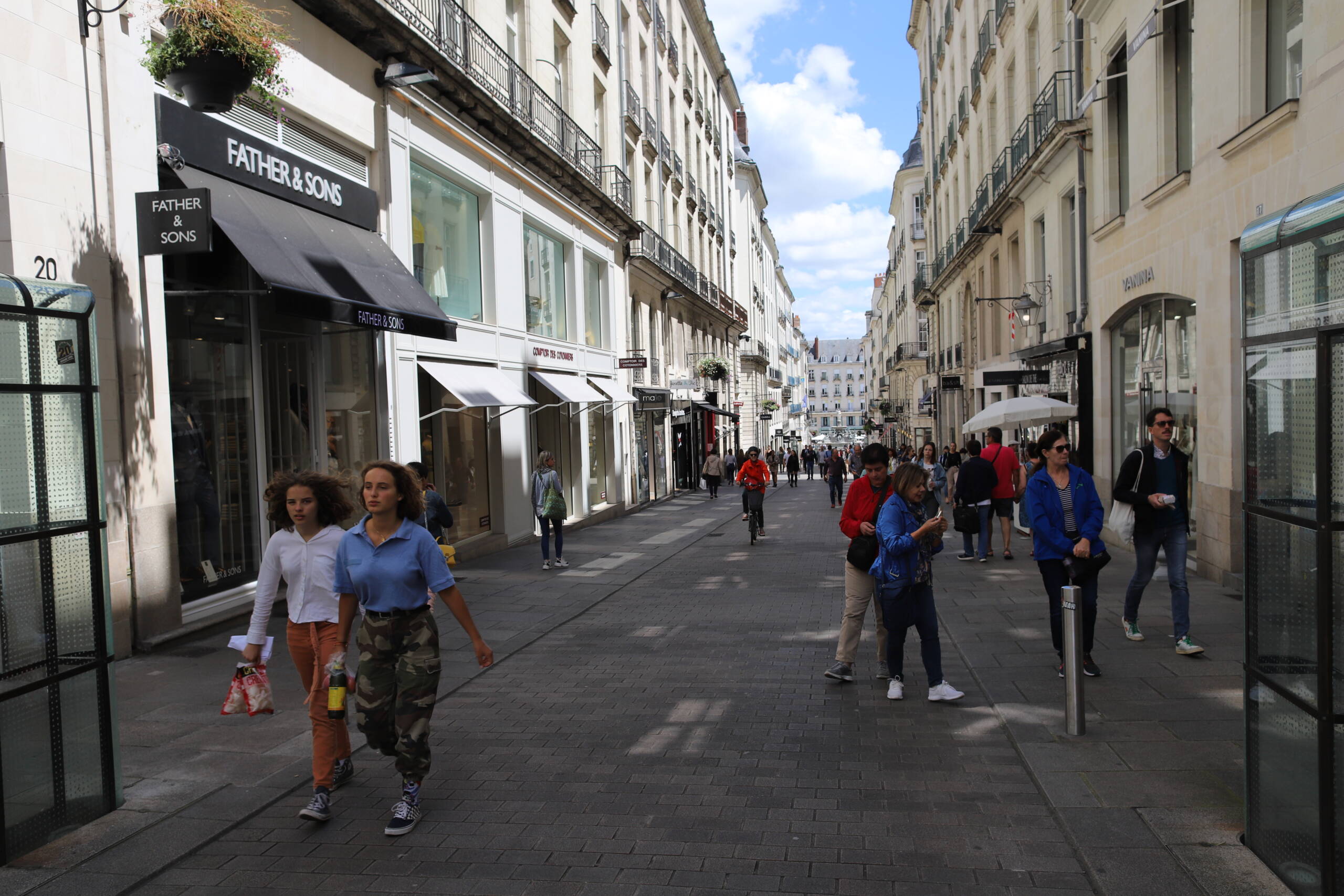
A pedestrianized shopping street in central Nantes on what appears to be a mild afternoon. The stonework is immaculate. The architecture is confident, classical, the kind of built environment that takes centuries to accumulate and cannot be replicated. The shops are open, the street is animated, people are moving with the unhurried ease of people who are not fighting for pavement. A cyclist passes without incident. There is space. There is light. There are no selfie sticks extended into other people’s faces, no tour group trailing a raised umbrella, no queue forming around a corner and disappearing out of frame.
This is what European urban travel looked like before the aggregation of tourist flows into a handful of saturated nodes made the experience of walking through a continental city center feel like navigating a theme park at peak season. The pedestrians in this frame are predominantly locals — you can read it in their posture, their bags, their direction of travel. They are not performing the city for a camera. They are just in it, living in it, and the traveler who wanders into this street is a participant in that rather than an external observer pressing against glass.
The cruel irony is that this image, precisely because it looks like this — calm, proportioned, genuinely European — is more aspirationally compelling than a photograph of the same street type in Paris or Rome packed shoulder to shoulder with visitors. The fantasy of European travel that most people carry is closer to what this photograph shows than to what the overtouristed version actually delivers. Undertourism, in this sense, is not the consolation prize. It is the original product.
What Undertourism Actually Looks Like
The term gets applied loosely, so it is worth being precise. An undertouristed destination is not one that lacks appeal. It is one where the ratio between appeal and visitor volume is dramatically out of balance, usually because of historical neglect, geopolitical stigma, proximity to a more famous neighbor, or simple failure of imagination on the part of the travel press and the brands that follow it.
Albania is a textbook case. It shares a coastline with Greece, a mountainous interior that rivals Montenegro, and a cultural history layered with Byzantine, Ottoman, and communist-era chapters that no other European country can replicate. Its capital Tirana has undergone a genuine urban renaissance over the past fifteen years. Its food culture is unsung but serious. Hotel infrastructure in Tirana and along the Riviera south of Vlorë has improved markedly. Visitor numbers have climbed, but remain a fraction of what comparable destinations attract. The narrative infrastructure — the magazine features, the influencer presence, the booking platform prominence, the airline route investment — has not caught up. That gap is the opportunity.
Kosovo is more extreme. It is one of the least visited countries in Europe by pure tourist arrivals, and almost nothing about the destination itself justifies that status. Pristina has a young, energetic population, a café culture that rivals Sarajevo’s, and the Rugova Canyon, which would be a regional draw of the first order if it existed in Austria or Slovenia. The country carries geopolitical baggage in some markets, but the facts on the ground tell a different story than the headlines suggest. Travelers who go there return converted.
Oman has made meaningful strides, and its luxury positioning has helped, but outside of Muscat and the Wahiba Sands it remains dramatically underexplored. The Hajar Mountains contain driving routes and wadis that would be booked solid for months if they were in Provence. The frankincense coast along Dhofar is among the most atmospheric landscapes in the Arab world. The country is safe, infrastructure-positive, and actively welcoming. What it lacks is saturation-level storytelling.
In Latin America, the Guianas — Guyana, Suriname, and French Guiana — represent one of the great undertourism cases. The biodiversity is extraordinary. The cultural layering is unlike anywhere else in the hemisphere, combining Amerindian, African, South Asian, Dutch, French, and British influences in a configuration that produces genuinely novel food, music, architecture, and social life. Suriname’s capital Paramaribo is a UNESCO World Heritage Site. Guyana’s Kaieteur Falls is four times the height of Niagara. The marketing infrastructure around these destinations is close to nonexistent in most major source markets.
Japan beyond Kyoto and Tokyo belongs on this list, not because it is truly unknown, but because the distribution of visitors is so lopsided that entire regions of profound cultural richness operate at a fraction of their potential. The Chugoku region, the Tohoku coast, the Kii Peninsula, the Noto Peninsula before the 2024 earthquake — these are places Japanese people value deeply that foreign tourism has barely touched.
Why the Industry Defaults to the Obvious
Understanding why undertourism persists is a precondition for doing anything about it. The structural forces that concentrate tourist flows are not irrational. They are the product of rational decisions made at each link in the distribution chain, and they compound.
Airlines allocate routes to proven demand. Proven demand is circular — it derives from existing visitor patterns, which derive from existing routes. An undertouristed destination often lacks the direct connectivity that would make it easily bookable, and that absence becomes a self-reinforcing barrier. The destination appears inconvenient. It takes two connections to get there. Travelers with limited vacation time select against it before they have even thought about whether they want to go.
Online travel agencies optimize for conversion. Pages for Paris or Bali or Cancún are rich with content — user reviews, professional photography, detailed neighborhood guides, curated hotel selections across every price point. Pages for Niamey or Berat or Georgetown, Guyana are thin. The content gap translates directly to confidence gaps in the consumer. People book what they can research, and they can research what has been written about. Travel media chases the same destinations because those are the trips editors can get funded by advertising partners who are spending in proven markets. The cycle is tight and largely self-sealing.
Tour operators build product around destinations where ground handlers are established, where guides are trained and licensed, where liability is manageable, and where itineraries have been tested enough that failure modes are understood. Pioneering product in an undertouristed destination costs more and carries more operational risk. Only the most entrepreneurial operators absorb that cost willingly.
The result is a system that efficiently produces more visitors for Florence and fewer for Plovdiv, regardless of what the underlying quality of experience might be.
The Marketing Case for Undertourism Investment
Here is the argument that should be made more forcefully inside travel marketing organizations and DMO boardrooms: undertourised destinations offer a structural pricing and positioning advantage that is becoming increasingly rare in the industry.
Overcrowded destinations are experience-degraded. That degradation is now measurable. The traveler who spends four days in Barcelona in August navigating crowd-controlled lines at the Sagrada Familia, paying forty euros for a paella that was produced at industrial scale, and sharing their hotel district with ten thousand other tourists on the same package is not having the experience that the brochure sold. Satisfaction scores at overtouristed destinations have been declining in proportion to their visitor numbers. The product is getting worse as the marketing gets better, and eventually that gap catches up with you.
An undertouristed destination offers the opposite dynamic. The experience overdelivers against expectation. There are no lines. The restaurant owner has time to talk to you. The landscape is not littered. The hotel is happy to see you. The guide is not bored. These are not small things — they are the core components of travel memory formation, and they disproportionately drive the word-of-mouth and organic social content that constitutes the most valuable marketing signal in the industry.
The traveler who goes to Shkodër in northern Albania and discovers the Accursed Mountains — the Prokletije range — and spends two days hiking trails that are genuinely empty and eating lamb cooked over open fire in a traditional guesthouse does not return home neutral. They return evangelical. They post. They tell their friends. They become a distribution node. The conversion economics on that organic advocacy are far superior to paid placement in a congested market.
There is also a first-mover dynamic that applies directly to destinations, operators, and media properties that move early. The Albanian Riviera of 2024 is not the Albanian Riviera of 2019. The brands and operators that established presence there early are now the credentialed authorities as the destination scales. The same trajectory applied to Croatia two decades ago, to Iceland a decade ago, to Colombia and Georgia in the years after their respective political stabilizations. Whoever told that story first built equity that later entrants paid premium prices to acquire.
How Marketing Actually Moves the Needle
The mechanism by which travel marketing opens undertourised destinations is understood well enough to be replicated deliberately. It is not mysterious. It is a sequenced effort involving narrative, distribution, and product development, and the order matters.
Narrative comes first. A destination without a story cannot be booked at scale, because the anxiety of the unknown — where will I stay, what will I do, is it safe, will I be the only one there — is not resolved. The story does not need to be comprehensive. It needs to be specific and credible. The single most effective format remains the long-form travel feature, whether in print or digital, written by a writer who was actually there and found something specific to love. Generalized praise is discounted. Particular detail — the name of the restaurant, the description of the drive, the actual quality of the hotel bed — is believed. DMOs underinvest in funding this kind of journalism because the attribution is indirect. The investment logic is correct, and the attribution problem is real but tractable with modern tracking.
Influencer deployment is effective in undertourism contexts only when the influencer has genuine authority and takes genuine risk. The luxury travel influencer who arrives in a destination on a hosted press trip and produces aspirational content from a five-star hotel is not opening a destination — they are demonstrating that the destination can be visited in a familiar mode. What actually moves undertourism markets is influencers who go off-template and document the experience of figuring it out. That content resolves anxiety by showing anxiety being resolved. It is more honest and more useful.
Booking infrastructure matters in ways that are easy to underestimate from the marketing side. If a destination has great storytelling and terrible booking infrastructure, the conversion fails at the final step. The destination needs not just inspiration content but decision content — the specific hotel name, the specific tour operator, the specific entry requirement, the specific packing recommendation. The gap between inspiration and booking is where most undertourism marketing investment is lost, and closing that gap requires a level of operational specificity that destination marketing organizations are not always equipped to provide but urgently need to develop.
Airline connectivity advocacy is often outside the scope of a DMO’s mandate but needs to be inside its strategy. The practical trigger for destination scaling is almost always a new direct route or the expansion of a low-cost carrier’s service. When Ryanair opened routes to Albania, visitor numbers moved. When Norwegian added Iceland routes from the U.S. East Coast, Iceland moved. The DMO that has cultivated relationships with network planning departments at the relevant carriers and built the demand data to make the route business case is doing its job at the level that actually produces results.
Specific Destinations Worth Building For
For travel marketing professionals looking at where to invest attention and resources in the coming three to five years, a handful of undertouristed destinations stand out as particularly ripe for the kind of narrative investment described above.
Uzbekistan has been opening steadily since the reform period that followed Islam Karimov’s death in 2016. The Silk Road cities — Samarkand, Bukhara, Khiva — are among the most architecturally extraordinary urban environments in the world. The tiled domes of the Registan in Samarkand photograph like almost nothing else on earth. Visa liberalization has made access genuinely easy for most Western travelers. The government is actively courting tourism investment. The window before mass market discovery closes is probably five to eight years at current trajectory, and the brands and operators who build product and presence there now will define how the destination is sold when it scales.
The Azores, while not unknown, remain dramatically undersold outside a niche adventure travel segment. The islands collectively offer whale watching of a caliber that rivals any cold-water destination, volcanic calderas of genuine grandeur, thermal pools, dramatic surf coastlines, and some of the best walking trails in the Atlantic. São Miguel is the most developed and still uncrowded by Madeira standards. The outer islands — Flores, Corvo, São Jorge — are frontier-level in terms of visitor density. The destination is four hours from the U.S. East Coast and two hours from Lisbon. The infrastructure is solid. The story is underwritten.
Kyrgyzstan offers the best nomadic culture experience accessible to travelers without extraordinary physical or logistical tolerance. The Son-Kul lake plateau, reachable in summer by jeep and horse, places travelers inside a yurt-based pastoral economy that is still functionally operating rather than staged for tourism. The Tian Shan range, shared with China and Kazakhstan, is one of the great mountain systems of Central Asia. The country has community-based tourism infrastructure developed over the past two decades that is genuinely good and genuinely authentic. The marketing vocabulary for this destination barely exists in most Western source markets. There is almost no competitive clutter for any brand willing to write the story.
Mozambique’s northern coast, particularly the Quirimbas Archipelago, is among the most pristine marine environments in the Indian Ocean. The diving is world-class by any technical measure. The island architecture in Ibo carries layers of Portuguese, Arab, and Swahili history that are visible in the physical fabric of the buildings. Access is not trivial, but it is not as hard as most travelers assume. The destination has been held back partly by proximity to Tanzania’s more famous Zanzibar and partly by legitimate security concerns in the central and northern provinces that have been miscommunicated as applying to the coast. Careful positioning — honest about access, honest about the geography of security — would open a market for which there is real latent demand among high-value travelers who are genuinely looking for somewhere they have not already been.
The Faroe Islands, positioned here not because they are unknown but because the quality of the marketing investment opportunity is extraordinary, represent a case study in destination character building done right. The Faroese tourism authority has operated with a clarity of brand identity and a restraint of volume that has kept the destination perpetually at the frontier of aspirational travel. The Closed for Maintenance campaign, which recruited foreign volunteers to help with physical infrastructure maintenance in exchange for exclusive access, was one of the most genuinely clever destination marketing executions of the past decade. The lesson is exportable: scarcity and selectivity are marketing tools, not constraints.
The Responsibility Dimension
It would be dishonest to discuss undertourism opportunity without addressing the dynamic by which travel marketing converts undertouristed destinations into overtouristed ones. The industry has watched this happen enough times that the trajectory is predictable. Dubrovnik. Hallstatt. The Scottish Highlands. Lisbon’s Alfama. These places were promoted enthusiastically, visitor numbers grew faster than infrastructure and community capacity, and the experience degraded while the community experience of tourism shifted from positive to negative.
The marketing community has some agency over this trajectory, even if it has not always exercised it. Distributing demand across seasons is a function of messaging. Distributing demand across a region rather than concentrating it in a single photogenic node is a function of what stories get told and what images get promoted. Qualifying the audience — communicating that a destination rewards travelers who are patient, physically capable, culturally curious, and willing to engage on its own terms — reduces the mismatch between what a place is and who arrives expecting something it cannot provide.
This is not idealism. It is product quality management. A destination that attracts the right travelers has better reviews, fewer resident complaints, more sustainable economics, and longer appeal. Travel marketing that builds for fit rather than pure volume serves the industry’s long-term interest in having viable destinations to sell.
The undertourism conversation, properly understood, is not about charity toward neglected destinations. It is about a structurally superior opportunity sitting beside an increasingly compromised one. The famous destinations are not going away, but the value proposition they offer travelers — and the margins they offer marketers — are under pressure. The destinations that have not yet been told right are the ones where the upside is real, the competition is thin, and the experience, for now, still overdelivers. That is a good position to be in, for anyone willing to do the work of getting there first.
Leave a Reply