On a weekday afternoon in a Bavarian pedestrian zone, a small procession appears without announcement. Men in lederhosen and flower-crowned hats. A woman in dirndl carrying a saxophone. A clarinet player wearing more buttons and badges than a NATO general. They move through the street with the unhurried confidence of people who have done this before, surrounded by shoppers and tourists who step aside not out of deference but mild surprise.
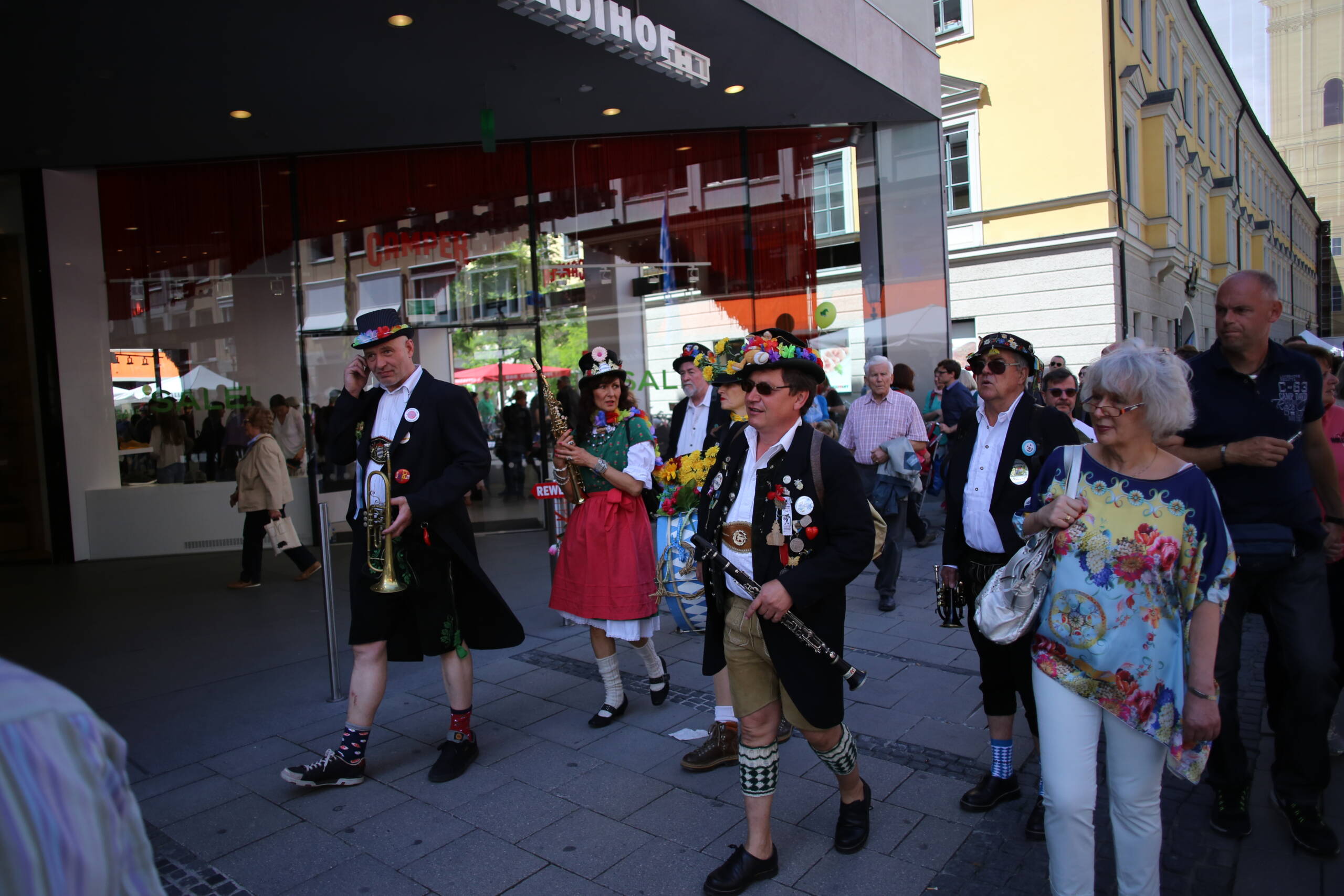
No one organized this for you. There is no tourism board backdrop, no ticketed event. This is simply what Bavarian civic music culture looks like when it happens in the open — informal, proud, slightly absurd in the best possible sense.
What You’re Actually Looking At
The costumes are Tracht, the regional dress of the Alpine south — Bavaria, Tyrol, Salzburg, parts of Switzerland. The hats decorated with flowers and feathers signal membership in a Schützenverein or music association, groups that have existed in continuous form for centuries. The badges and pins on the jackets are a vernacular biography: festivals attended, competitions placed, decades of membership marked in enamel.
This is not performance for outsiders. It predates tourism, and it will outlast whatever the current tourism moment is.
Europe’s Living Archive Problem
Travel writing about Europe tends to flatten into one of two modes: the elegiac (everything authentic is disappearing) or the boosterist (everything traditional is available for purchase). Neither maps cleanly onto what you actually see on a Bavarian street.
The Tracht tradition is simultaneously genuinely old, commercially exploited, politically contested, and stubbornly alive. Munich retailers sell dirndl to tourists at significant markup. The same dirndl is worn without irony by third-generation Munich families at the same events their grandparents attended. Both things are true. The culture does not require your adjudication to continue.
This is, in a compressed form, the condition of European identity broadly: layered, contested, and entirely indifferent to outside interpretation.
Why It Travels Well as a Subject
Street scenes like this one reward a particular kind of travel attention — not the monument-checklist mode, but something more patient. The architectural backdrop here is postwar commercial Europe: glass storefronts, standardized paving, chain retail. The Tracht procession walks through it without contradiction, which is the point.
European cities contain this vertical compression constantly: Roman foundations under medieval streets under modernist rebuilds under current commercial overlay. The folk musicians moving past the REWE supermarket are not an anomaly. They are the visible layer of something that runs much deeper than the shopfronts.
If you travel to find authenticity, Bavaria will frustrate and reward you in equal measure. If you travel to look at what people actually do — how they maintain continuity, how tradition gets carried in bodies and instruments and embroidered hats through a contemporary pedestrian zone — it becomes one of the more interesting places in Europe to watch.
The man in the center of the frame is carrying a clarinet and walking like he owns the street. He does not own the street. But he has been playing on it, in one form or another, for a long time.
That counts for something.