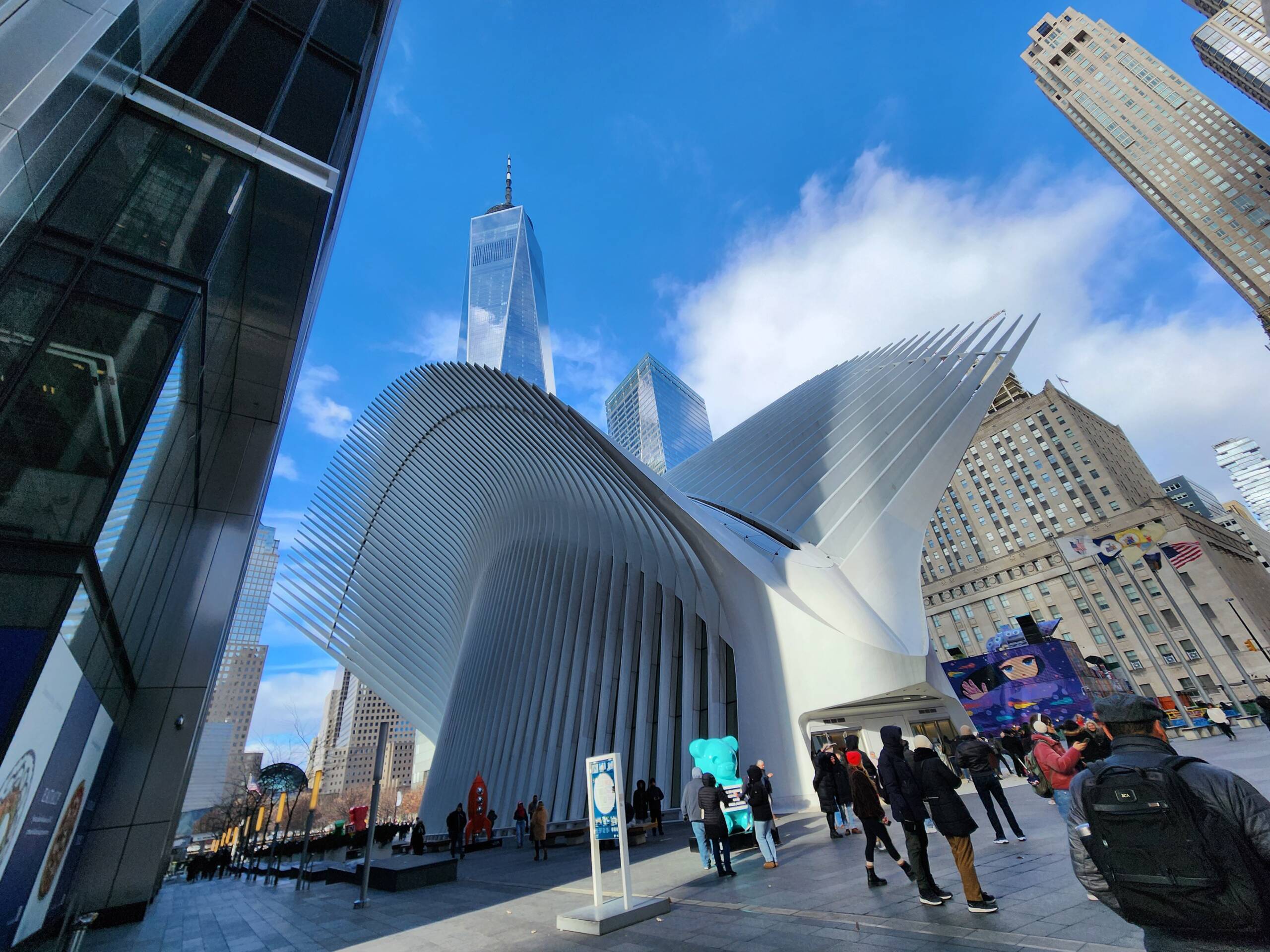
Lower Manhattan has a way of stacking symbols on top of each other until they almost start arguing, and standing here you can feel that tension humming quietly under your feet. Outside, the first image pulls you into a dramatic upward gaze: the white ribs of the Oculus flare outward like a frozen wingbeat, sharp and aerodynamic, cutting into a crisp blue sky. Behind it, One World Trade Center rises with a calm, almost indifferent confidence, its glass surface mirroring clouds that seem to drift far slower than the city itself. The contrast is striking—Santiago Calatrava’s sculptural exuberance pressed against the clean, rectilinear language of the surrounding towers. People drift across the plaza bundled in winter coats, some pausing to look up, others marching straight through with headphones on, late for something important. It feels very New York that way: a monument designed to inspire awe, immediately normalized by daily routine.
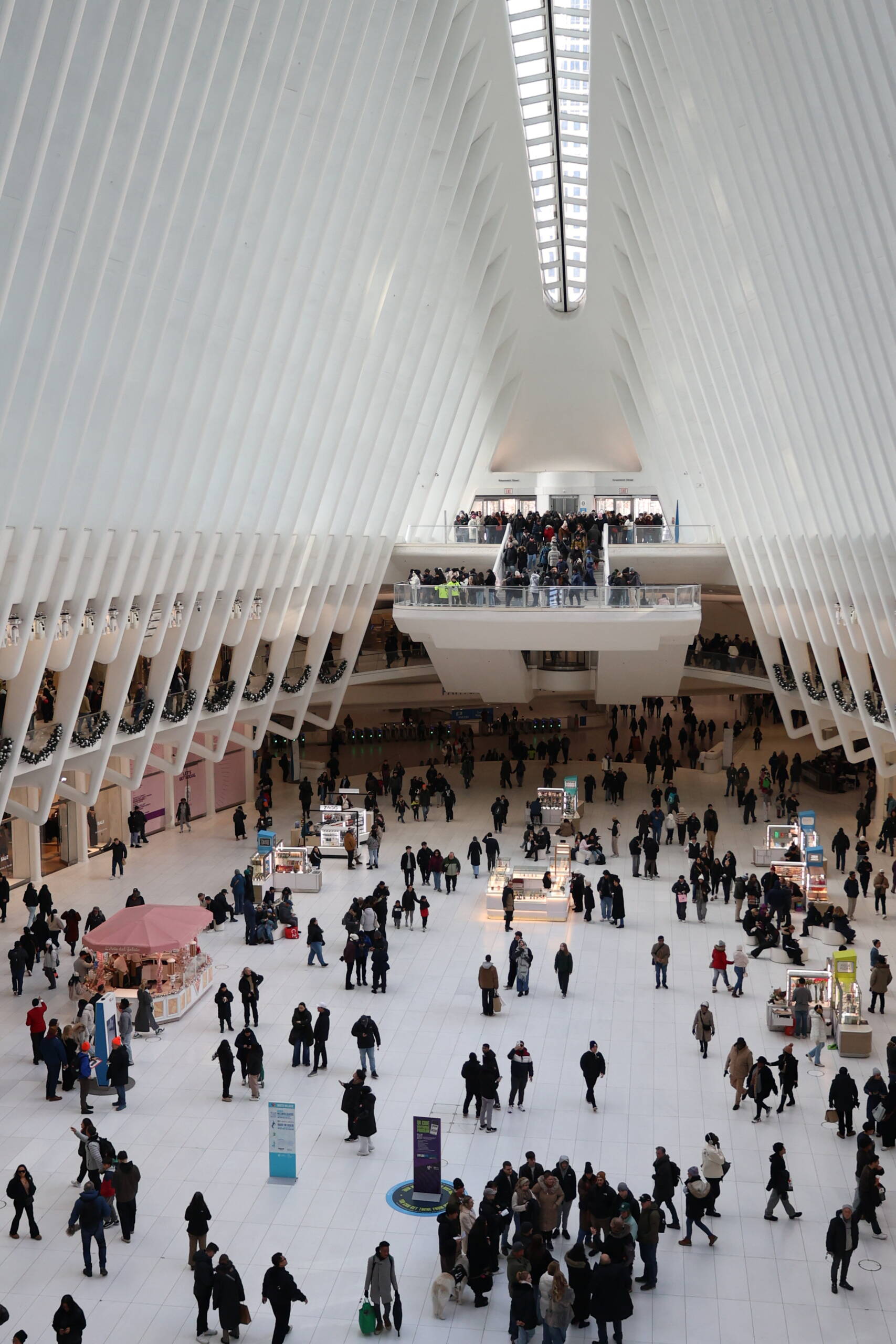
Step inside and the mood shifts, not quietly but all at once. The second image opens into a vast, cathedral-like interior where light pours down from the narrow skylight above, slicing the space symmetrically and washing everything in soft white. The repeating ribs curve inward, creating a sense of movement even though the building stands perfectly still. Below, the main floor spreads out like a minimalist stage, dotted with small retail islands that feel almost temporary compared to the scale of the architecture. People move in loose currents—commuters crossing diagonally, tourists stopping dead center to take photos straight up, families clustering near the edges as if instinctively respecting the geometry. The echo of footsteps, distant voices, and rolling suitcases blends into a low urban murmur, not silence, but something close enough to feel intentional.
What makes this place work as a travel moment isn’t just the design, or the history it quietly carries, but the way it stitches together memory, motion, and commerce without fully resolving the contradictions. You’re standing inside a transit hub, a shopping space, a memorial-adjacent landmark, and a piece of architectural theater all at once. It’s not cozy, and it’s not trying to be. Instead, it gives you scale—of the city, of the crowds, of time passing through—and asks you to find your own pace within it. Maybe you rush through to catch a train, maybe you linger and look up longer than planned. Either way, you leave slightly recalibrated, which, honestly, feels like the real souvenir here.
Leave a Reply