A wide sunlit square unfolds beneath an almost impossibly clear turquoise sky, the kind of sky that feels slightly stylized, almost as if it belongs to a postcard from another decade. The cobblestones stretch across the foreground in warm, uneven textures, catching the light and giving the scene that unmistakable old-Europe surface that photographers love. Rising around the square are the ornate facades of Brussels’ historic guild houses and civic buildings, their pale stone and gilded accents glowing softly in the afternoon light. Tall windows, decorative columns, sculpted pediments, and statues perched along rooflines create a rhythm of architectural detail that pulls the eye upward again and again. One building, especially elaborate, carries a central statue above its entrance while intricate carvings decorate nearly every level, making the whole façade look like a carefully composed stage set rather than simply a building.
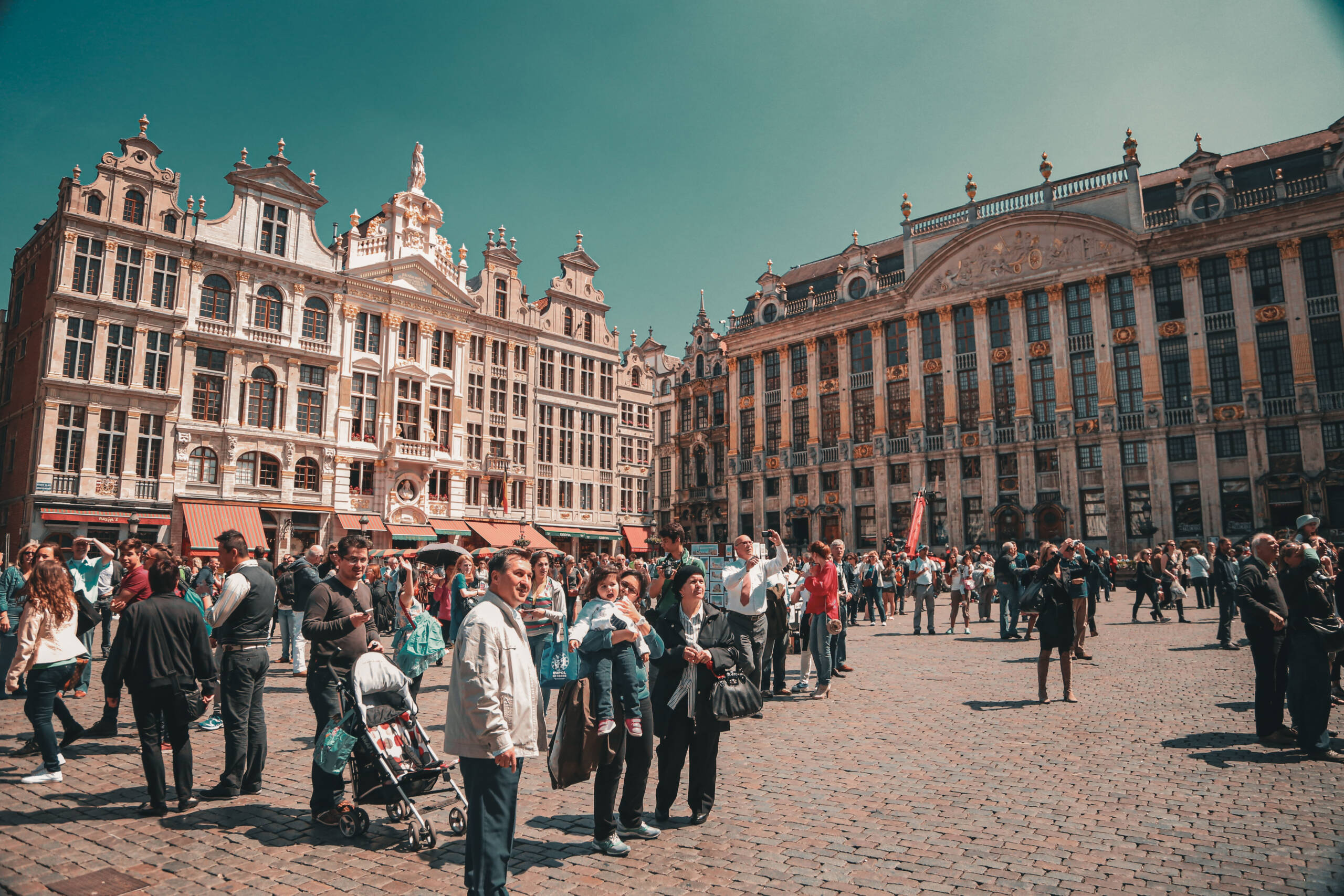
The square itself is full of life. Tourists drift across the cobblestones in small clusters, pausing, pointing, photographing, talking. Near the center of the frame a man stands slightly turned toward the camera with a relaxed expression, as if he has just stopped mid-walk to take in the surroundings. Beside him a family group gathers around a stroller, the small child inside becoming an unexpected focal point in the crowd. A woman holds another child in her arms while someone nearby lifts a phone high into the air, framing the buildings in a snapshot. Everywhere you look there are small gestures of curiosity—people craning their necks upward to study the architecture, others adjusting camera straps, a few simply standing still as if absorbing the atmosphere.
Shadows from the buildings stretch across the square, creating darker pockets along the edges where people gather in loose lines or clusters. Toward the right side of the scene, a long façade with evenly spaced columns and tall windows anchors the composition, giving the square a sense of scale. The building’s ornamentation—gold accents, sculpted reliefs, symmetrical window patterns—feels almost theatrical against the bright sky. Meanwhile, the left side features more playful architectural silhouettes, with stepped gables and decorative rooflines that seem lifted from Flemish paintings.
What gives the photograph its vintage travel feeling isn’t just the historic architecture. It’s the color palette and the slightly cinematic contrast between warm stone tones and the cool sky. The scene carries that nostalgic atmosphere found in mid-century travel posters and early color film photography, when European squares were presented as places of discovery and wanderlust. The crowd adds to the effect. Instead of feeling staged, it captures that spontaneous moment travelers know well: arriving somewhere famous, pausing, and realizing you’re standing in a place that has existed for centuries while dozens of other visitors are experiencing that same small moment of awe.

Travel photography often tries to isolate landmarks, but scenes like this remind us that the real character of a place appears when people enter the frame. The movement of tourists, families, and curious onlookers turns a historic square into a living environment rather than a museum piece. Here the architecture provides the grand backdrop, while the human activity gives the image warmth and scale. For a photographer, that mix of monumental setting and everyday motion is exactly what makes European city squares so endlessly photogenic.
Leave a Reply