Salamanca is one of those Spanish cities where history is not confined to museums or monuments. It surrounds you, rising from narrow streets, university courtyards, ancient churches and magnificent sandstone buildings. Yet one of the most memorable ways to experience the city is to leave its streets behind and climb onto the rooftops of its extraordinary cathedral complex.
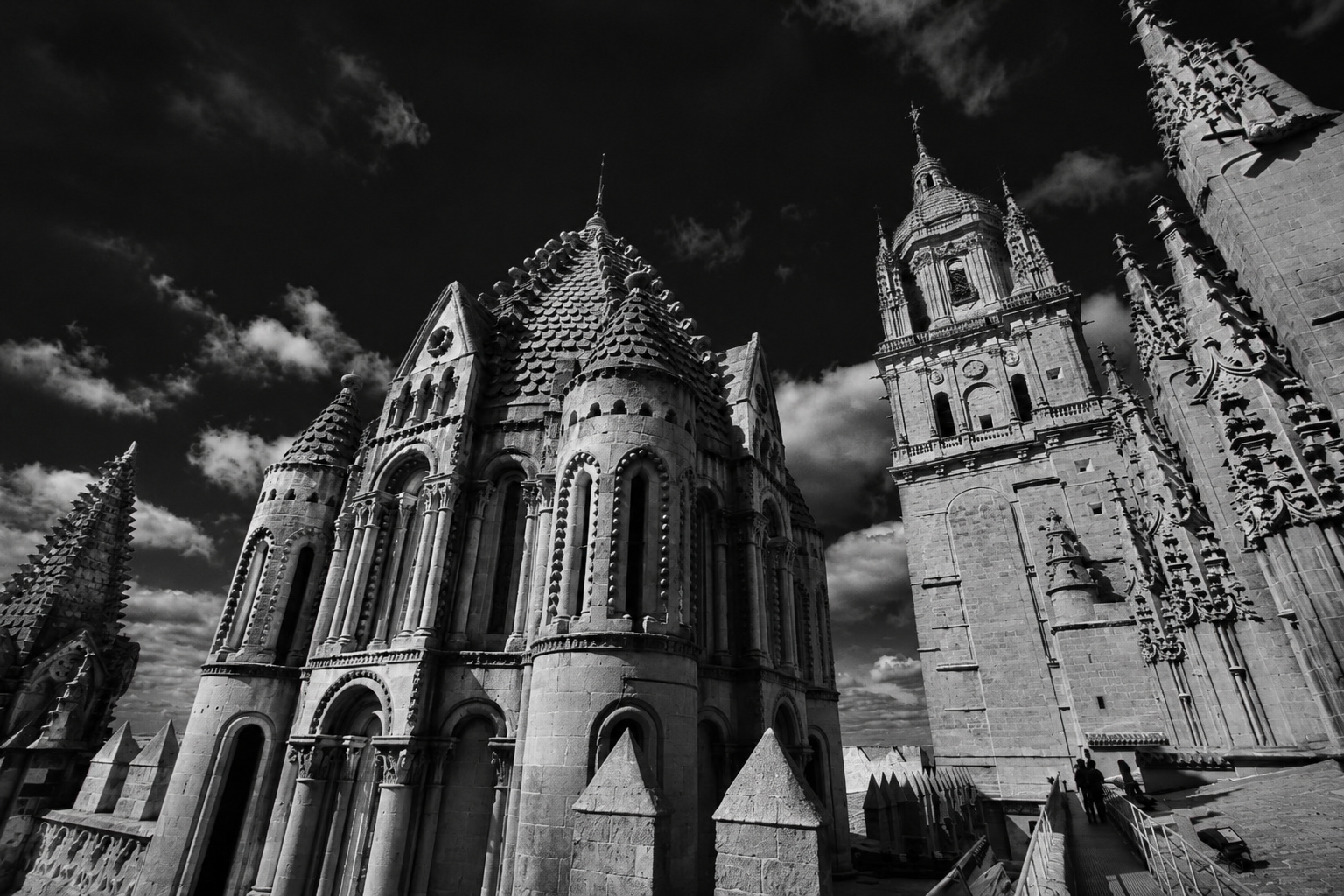
The photograph captures a remarkable architectural encounter between Salamanca’s Old and New Cathedrals. In the foreground stands the Romanesque Torre del Gallo, with its distinctive patterned stone roof, rounded turrets, narrow arched windows and intricate carvings. Behind it rises the monumental bell tower, while the elaborate Gothic ornamentation of the New Cathedral dominates the right side. A narrow elevated walkway, with a few visitors providing a sense of scale, winds between the buildings. In dramatic black and white, the scene reveals extraordinary textures of centuries-old masonry beneath a nearly black sky, interrupted by luminous clouds.
Salamanca possesses something unusual even among Europe’s great historic cities: two cathedrals standing together, representing different architectural periods and ambitions. The Old Cathedral, begun in the 12th century, preserves the powerful simplicity of Romanesque architecture, while the New Cathedral introduces the soaring proportions and decorative richness of late Gothic design, together with Renaissance and Baroque influences. Their proximity makes the complex a fascinating architectural timeline.
The Ieronimus tower tour offers an especially rewarding perspective. Rather than simply viewing the cathedral from the square below, visitors climb through historic chambers, narrow staircases and elevated passages to reach terraces overlooking the rooftops and old city. From here, the Torre del Gallo becomes more than a distant landmark. Its stonework, unusual dome and defensive-looking details can be examined from close range. The route also reveals the enormous scale of the New Cathedral, whose towers and buttresses seem even more impressive when encountered from above.
There is something particularly compelling about photographing Salamanca from these heights. The city’s famous golden sandstone creates beautiful warm tones in sunlight, but monochrome photography reveals another personality altogether. The absence of color draws attention to architectural geometry, deep recesses, weathered surfaces and the contrast between delicate ornamentation and massive stone walls. Suddenly the cathedral complex feels almost theatrical, as if its towers were emerging from another century.
Beyond the cathedrals, Salamanca rewards slow exploration. Its historic university, monumental Plaza Mayor, intimate streets and lively cafés create an atmosphere in which grand architecture remains part of everyday life. It is a city best appreciated on foot, with enough time to look upward, wander without a fixed destination and discover how many architectural details are hidden above ordinary street level.
For visitors interested in architecture, history or photography, the cathedral rooftop experience deserves a prominent place on the itinerary. The Ieronimus route takes approximately 90 minutes, although the views and architectural details may tempt photographers to linger wherever permitted. Consult the Salamanca travel guide on TravelMarket.org for visitor information and access details.
Salamanca is often described as one of Spain’s most beautiful historic cities. Standing high among its cathedral towers, looking across nearly nine centuries of architectural achievement, it becomes easy to understand why. And perhaps that is Salamanca’s greatest attraction: it does not merely preserve history. It allows visitors to walk through it, sometimes quite literally above the rooftops.