There are cakes that impress with elaborate decorations, layers of cream and carefully arranged fruit. And then there is the Basque burnt cheesecake, which looks as though somebody forgot it in the oven. Its surface is dark brown, sometimes almost black, its sides are irregular, and its appearance would probably horrify a traditional pastry chef. Yet beneath that deliberately scorched exterior lies one of Spain’s most irresistible desserts: a rich, creamy cheesecake with a delicate interior and a caramelized top that gives it a character entirely its own.
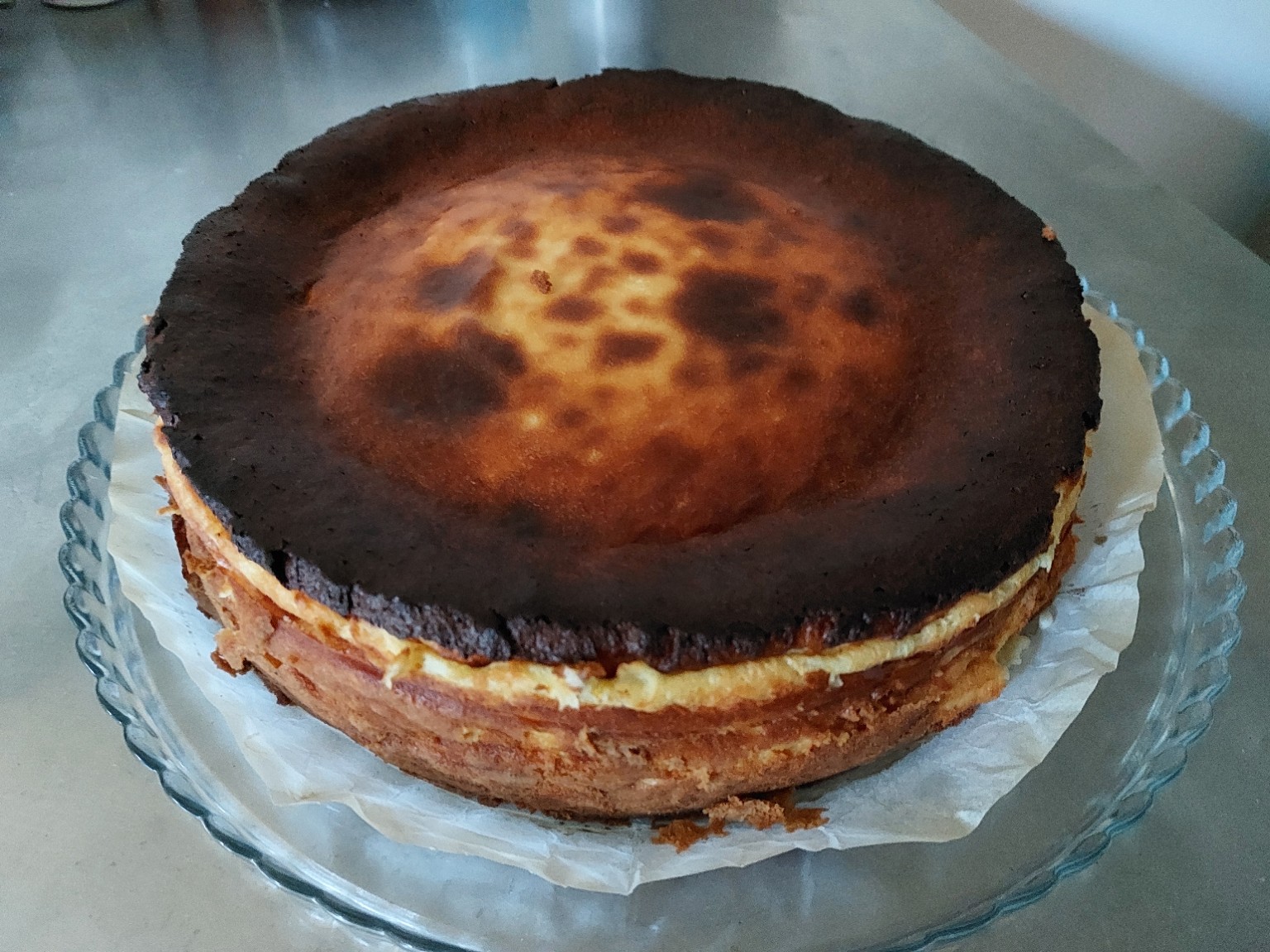
The photograph captures precisely what makes this cake so intriguing. A substantial, homemade-looking cheesecake sits on a scalloped glass serving plate, still resting on crumpled baking parchment. The top is dramatically dark around the edges, almost charcoal-colored, while the center reveals a patchwork of golden brown, amber and toasted caramel tones. Along the sides, a pale layer of baked cheese filling emerges between the dark upper crust and the more deeply browned lower portion. There is nothing particularly elegant about its presentation, and that is part of the appeal.
The original Basque burnt cheesecake, known in Spain as tarta de queso vasca, comes from San Sebastián, the gastronomic capital of Spain’s Basque Country. More precisely, the modern version that conquered the world is associated with a small bar in the city’s Old Town, where a seemingly ordinary cheesecake became an international culinary phenomenon. Today, variations appear in bakeries and restaurants from Madrid to Barcelona, and far beyond Spain. But for travelers who want to understand what makes this dessert special, there is no better place to begin than where the obsession started.
The story begins at La Viña, at 31 de Agosto Kalea, 3, in San Sebastián’s Parte Vieja. Around 1990, Santiago Rivera developed the cheesecake that would eventually become famous worldwide. Unlike the familiar American cheesecake, his creation had no biscuit base, no decorative topping and no need for a fruit sauce. It relied on cream cheese, eggs, sugar, cream and a small amount of flour, baked at a relatively high temperature until the surface became deeply caramelized while the center remained soft. The contrast was the revelation. The top offered a faint bitterness, the interior was rich without being excessively dense, and the whole thing tasted rather more sophisticated than its humble appearance suggested.
Visiting La Viña today is almost a culinary pilgrimage. The bar occupies a lively stretch of the Old Town, surrounded by pintxo establishments, traditional restaurants and the constant movement of visitors discovering Basque cuisine. A slice of cheesecake here is not presented as a luxury dessert. It arrives simply, allowing the flavor and texture to do the work. There may be a queue, particularly during busy travel periods, but this is one of those occasions when a little patience seems entirely reasonable. The original is also a useful benchmark: after tasting it, visitors can better appreciate how much other pastry chefs have changed the formula.
San Sebastián offers plenty of opportunities to continue the investigation. Bassk Cheesecakers, on Calle San Jerónimo, specializes in cheesecake and provides an interesting contrast with the original bar experience. Garage Cheesecake in the Gros neighborhood is another dedicated pastry destination worth investigating. There is something enjoyable about comparing a traditional slice eaten at a crowded bar with a contemporary bakery interpretation. It also makes an excellent excuse to explore different neighborhoods rather than spending the entire day in the Old Town.
Madrid, meanwhile, has developed a cheesecake culture of its own. One of the best-known names is Álex Cordobés, whose shop on Calle Velázquez in the Salamanca district has helped turn cheesecake into a fashionable specialty. Here the attraction is not strict loyalty to the San Sebastián original but experimentation with flavors and textures. Alongside traditional cheesecake, the business offers versions featuring pistachio, chocolate and dulce de leche. Purists may object that some of these creations have moved a long way from the original Basque concept. Fair enough. But culinary traditions remain interesting precisely because chefs refuse to leave them alone.
Another Madrid address worth remembering is Cañadío, a restaurant associated with northern Spanish cooking and celebrated for its cheesecake. It belongs to a somewhat different tradition, emphasizing a luxurious creamy texture rather than simply reproducing the dramatically scorched appearance of the Basque original. For travelers, this distinction matters. Spain does not have just one cheesecake. There is a whole family of regional and contemporary interpretations, and tasting several can reveal surprisingly different ideas about what the dessert should be.
Barcelona is another worthwhile stop for cheesecake enthusiasts. Jon Cake has become associated with cheesecakes that explore different cheese varieties and flavor profiles. It is an appealing destination for travelers interested in the ingredients themselves, rather than merely the fashionable burnt surface. Cheese is, after all, the defining ingredient, and changing its character can transform the entire dessert. A slightly salty or more assertive cheese can produce a very different experience from the familiar sweet, mild cream-cheese filling.
What, then, makes the perfect burnt Basque cheesecake? The answer is more complicated than simply baking it until the surface turns black. A good example should have a pronounced caramelized top, with toasted flavors that balance the sweetness rather than overwhelm it. The center should be smooth, creamy and gently yielding. Some versions are almost fluid in the middle; others are more firmly set but still exceptionally soft. Neither approach is necessarily wrong. The important point is that the cake should not become dry, rubbery or unpleasantly bitter. A deeply darkened edge can be delicious, but actual carbonization is not a culinary achievement.
Temperature matters, too. A cheesecake served straight from the refrigerator may taste firmer and less aromatic than one allowed to approach room temperature. The fat softens, the flavors become more apparent, and the interior develops the texture that makes this dessert memorable. This is worth remembering when ordering a slice, particularly at bakeries where cakes may have been chilled for storage. Sometimes the difference between a good cheesecake and a remarkable one is simply a little time.
For travelers planning a Spanish food itinerary, San Sebastián remains the essential destination. Madrid is a compelling second stop for modern variations, while Barcelona offers another perspective on the growing culture of specialist cheesecake bakeries. Yet there is no need to organize an entire holiday around dessert. The pleasure of discovering a good tarta de queso often comes unexpectedly, at the end of a long lunch or in a small neighborhood establishment that hardly advertises its baking.
The greatest surprise is that such an extraordinary dessert emerged from such a straightforward idea. There is no elaborate pastry construction, no complicated decoration and no attempt to make every cake look identical. Indeed, the uneven edges, cracked surface and unpredictable browning are part of its identity. In a world of increasingly photogenic desserts, Basque burnt cheesecake is a welcome reminder that appearance and taste do not always follow the same rules.
And if there is only time for one slice in Spain, make it La Viña in San Sebastián. Not necessarily because no other chef can improve upon it, but because tasting the original gives the whole story a beginning. Order the cheesecake, find somewhere to stand, take a forkful and consider how an apparently overbaked cake from a modest Basque bar managed to become one of the world’s most recognizable desserts. It is a rather wonderful culinary success story.
Photograph: Burnt Basque-style cheesecake, supplied by the contributor.