Travel trade shows are fascinating places. Thousands of people move between exhibition stands, hotel representatives exchange business cards, tourism officials promote destinations, and hospitality companies try to convince everyone that their particular corner of the world deserves attention. But if I own a small pension hotel with perhaps 10 or 15 rooms, should I spend my money attending one of these events? Will I return with new customers, or merely a suitcase full of brochures and business cards that never produce a reservation?
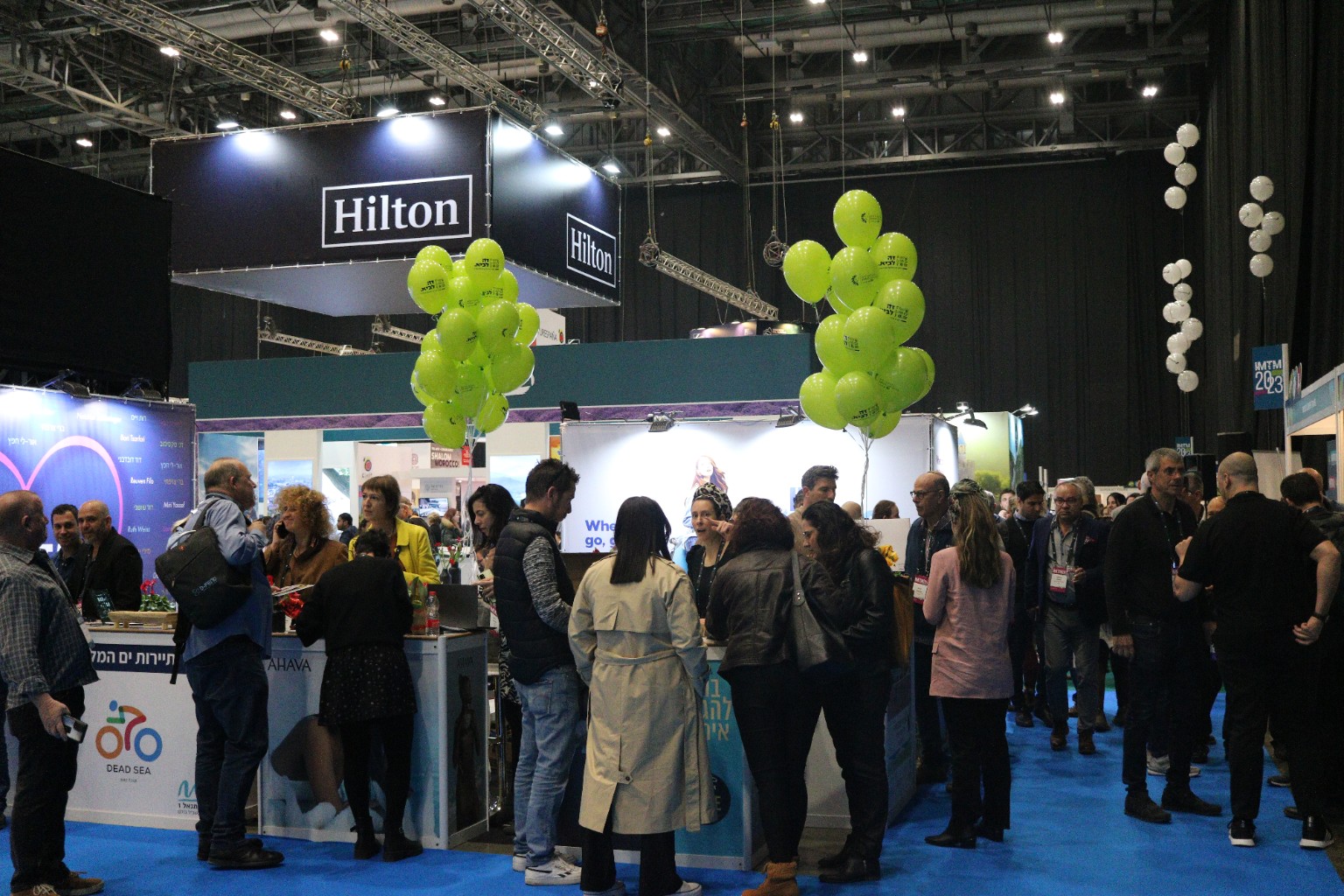
The accompanying photograph captures a busy tourism exhibition particularly well. Beneath the large Hilton sign, visitors and exhibitors gather around promotional counters, talking and examining what different destinations have to offer. Bright green balloons rise above the stands, a blue carpet runs between exhibitors, and Dead Sea tourism branding is visible in the foreground. Some participants seem deeply engaged in conversations; others are exploring. This is the travel industry meeting face to face, far removed from the online platforms where most hotel reservations now take place.
For a small hotel owner, the economics are different from those of Hilton or a national tourism organization. A chain has thousands of rooms and a large marketing budget. A small pension has to recover every promotional dollar through additional profitable bookings. If my goal is to attract individual weekend travelers, a trade show may not be the right channel. Guests usually find small properties through search engines, maps, booking platforms, social media and recommendations.
However, a hotel near hiking routes, a historic town, a cycling destination, a pilgrimage site or a wine region may appeal to specialized tour operators. A single operator bringing several small groups each year could be more valuable than months of advertising. Trade shows work best as business-to-business marketplaces, not necessarily as places to sell individual nights directly.
There is also a crucial distinction between attending and exhibiting. Attending as a visitor can be inexpensive, particularly near home. Exhibiting means paying for a stand, equipment, brochures, transportation, accommodation and staff time. For my first experiment, I would almost certainly attend as a visitor rather than rent a stand.
Consider a simple example. Suppose my pension has 12 rooms, an average nightly rate of $110 and an operating contribution of $65 per additional occupied room-night after variable costs. A $1,500 exhibition visit requires roughly 24 additional room-nights to break even. A $6,000 stand requires about 93. These are illustrative figures, but they make the point: business cards are not a return on investment. Profitable bookings are.
A tour operator may also ask for discounted rates, flexible cancellations, guaranteed allocations or delayed payment. Filling rooms is not the same as earning a profit. If an operator takes rooms that would otherwise sell at full price on a busy summer weekend, the deal could be counterproductive. If that same operator fills empty rooms on quiet weekdays in February or November, the relationship may be excellent. I would therefore target operators who can strengthen weak periods, rather than simply replace existing guests.
The choice of event matters. Large international exhibitions such as ITB Berlin and World Travel Market London gather professionals from many countries, but a major operator moving thousands of travelers may have little interest in a 12-room pension. A specialist in walking holidays, culinary tours, cycling, religious travel or small cultural groups may be a better match. A modest regional workshop with carefully selected buyers could outperform a huge exhibition.
I would also investigate a shared stand organized by a regional tourism authority or hotel association. That can lower costs and place my property within a destination that operators already want to sell. But even then I would arrange meetings in advance rather than wander through the hall hoping for luck.
My sales materials would be straightforward: excellent photographs of the rooms, breakfast area, building and surroundings; a concise property fact sheet; room capacity and amenities; accessibility details; nearby attractions; and a realistic seasonal trade-rate proposal. I would be equally candid about limitations such as reception hours, stairs, group size or late check-in. Small properties can be memorable precisely because they are personal, but an operator needs reliable details, not surprises.
Follow-up matters as much as the show. I would record each serious conversation, including the operator’s market, group sizes, travel seasons and rate expectations. Within a few days I would send a personalized message and then track actual bookings over the following months. Some relationships take time; others never convert. That is normal, and it is why immediate enthusiasm on the exhibition floor is a poor measure of success.
Before spending on travel, I would try another approach: identify 30 specialized operators already selling my destination and contact them directly. A strong website, professional photographs and a thoughtful offer may start the same relationships without a show. If several respond, meeting them at an event becomes much more worthwhile. The exhibition should accelerate an existing sales effort, not replace it.
For many pension owners, improvements to the website, booking process, photography, guest reviews and map listings will bring a better return. Those less glamorous investments reach customers when they are actually deciding where to stay. Yet I would not dismiss personal contact. An operator who has met the owner and understood the property’s character may remember it. An independent pension’s personality and local knowledge can be genuine selling points.
My decision would be cautious but positive. I would attend one relevant regional or specialist event without an expensive stand, arrange appointments beforehand, set a strict budget and assess the resulting profitable room-nights over six to twelve months. Only if that experiment worked would I consider a larger show or a dedicated exhibition stand.
There is no particular glory in having a beautiful stand at a major tourism exhibition. The achievement is a hotel full of satisfied guests at sustainable rates. A small pension does not need to become famous across the global travel industry. It needs to become known to the right travelers and a handful of reliable partners who can bring those travelers to its door.