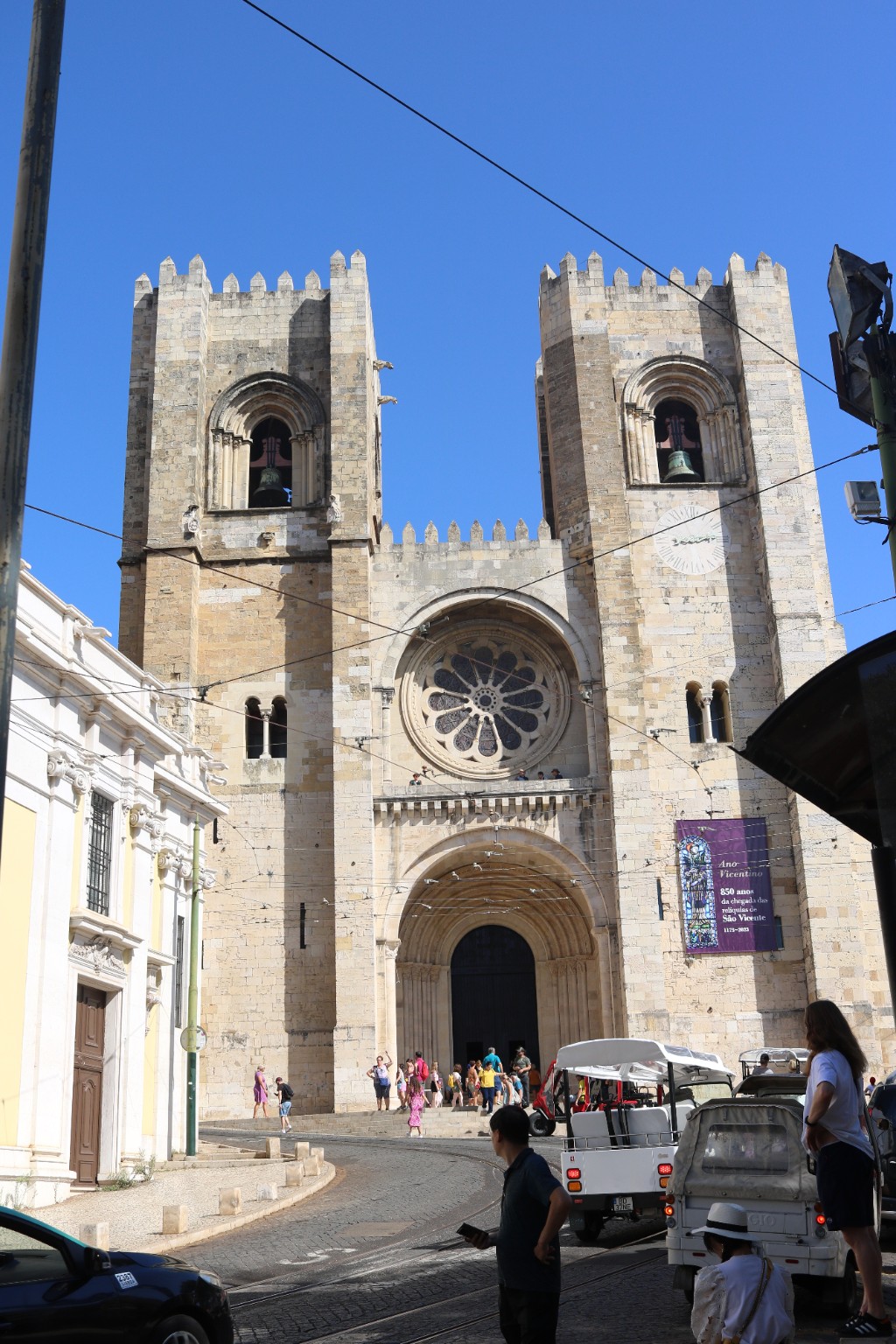
Lisbon is a city where centuries of history appear around almost every corner, but few landmarks capture that contrast quite as dramatically as the Lisbon Cathedral, known locally as Sé de Lisboa. Rising above a narrow, sloping street in the historic Alfama district, the cathedral looks almost like a medieval fortress, with two massive stone towers, battlements, Romanesque arches and a magnificent circular rose window dominating its facade.
The photograph captures something particularly characteristic of Lisbon: ancient architecture surrounded by the movement of everyday urban life. Tourists gather on the cathedral steps, small sightseeing tuk-tuks compete for space with cars, overhead tram wires crisscross the brilliant blue sky, and the cobblestone street curves past elegant neighboring buildings. It is not a carefully isolated postcard view. It is Lisbon as visitors actually encounter it, a little crowded, a little chaotic, and full of character.
Construction of the cathedral began in 1147, following the Christian conquest of Lisbon under King Afonso Henriques. Over the centuries, earthquakes, rebuilding campaigns and architectural additions transformed the building, leaving a mixture of Romanesque, Gothic and later influences. The great earthquake of 1755 caused extensive damage, making the cathedral’s survival and subsequent restoration an important part of Lisbon’s architectural history.
For travelers exploring Alfama, the cathedral is an excellent starting point. From here, the streets climb toward São Jorge Castle and descend toward the Tagus River, passing viewpoints, traditional restaurants, tiled facades and small squares. The cathedral itself deserves more than a quick photograph from outside. Its interior, cloister and treasury offer additional insight into the religious and cultural history of Portugal’s capital.
Perhaps the most appealing aspect of Sé de Lisboa is that it remains part of a living neighborhood rather than a monument separated from the city around it. Lisbon continues to move, change and welcome visitors around walls that have witnessed nearly nine centuries of history. That combination of permanence and everyday activity is precisely what makes the city so rewarding to photograph and explore.