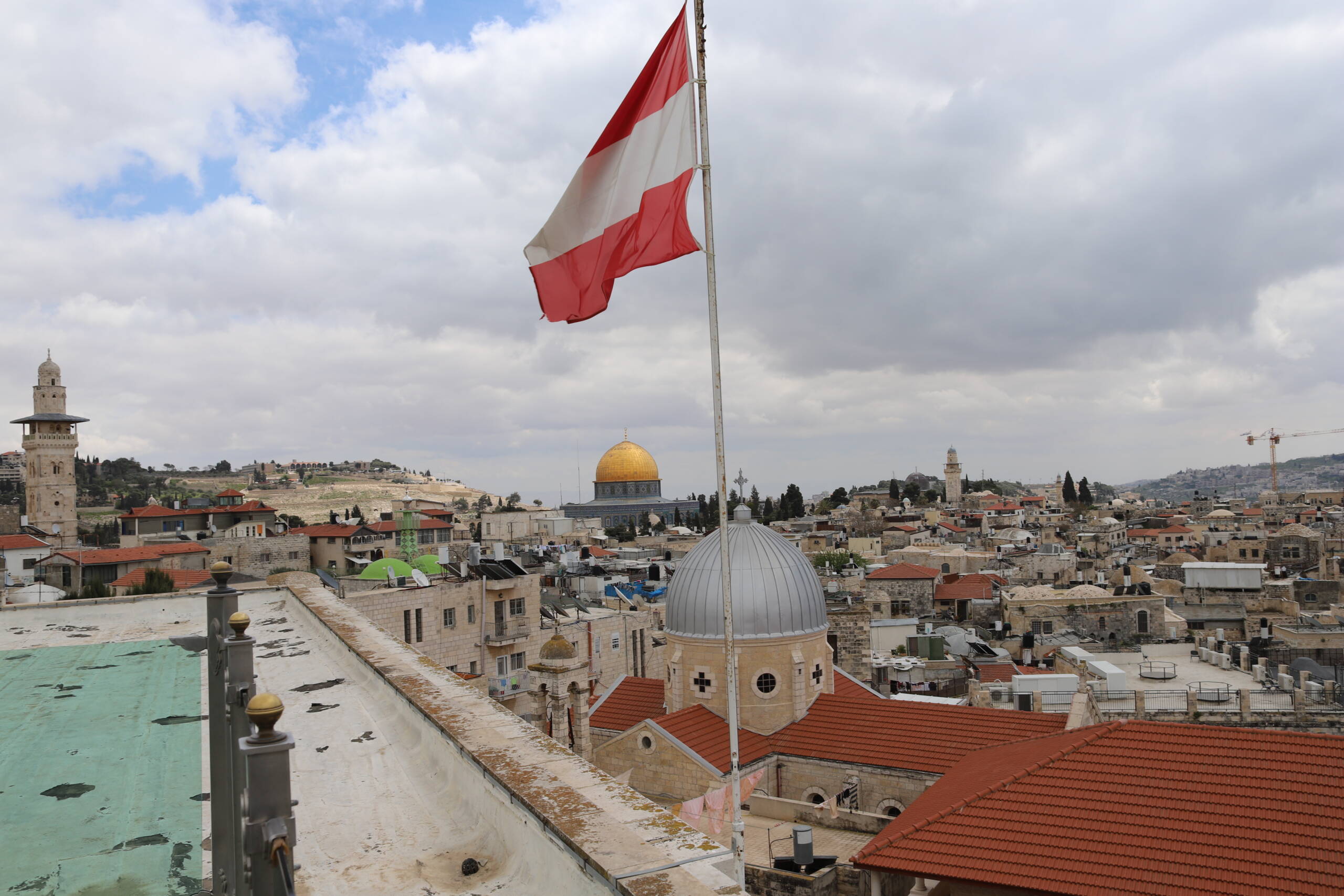
There is a rooftop in Jerusalem where, for a few shekels and the willingness to climb several flights of stone stairs, the entire Old City spreads out before you in one uninterrupted panorama. It belongs to the Austrian Hospice on Via Dolorosa — a pale, symmetrical building that has occupied the same address since 1863, when the Habsburg Empire still had enough reach to plant an institution of this permanence in the middle of Ottoman Palestine. The Austrian flag flies from a pole at the roof’s edge. Red, white, red. It snaps in the wind off the Judean Hills like it owns the place, which in a narrow historical sense it once did.
The View from Here
Stand at the parapet and the city arranges itself into a kind of involuntary religious geography. To the right, the gold dome of the Mosque of Omar — the Dome of the Rock — catches the light and holds it, luminous even under a heavy, cloud-streaked sky. It sits on the Temple Mount, the single most contested piece of real estate in human history, a platform built by Herod the Great that has been a Jewish temple, a Roman temple, a Byzantine church, an early Islamic mosque, a Crusader church, and an Islamic shrine in more or less uninterrupted succession. The gold dome was added in the late seventh century and has not changed much since.
Below and closer, a grey dome with a cross marks a Christian church — one of the dozens that crowd the Christian Quarter, layered over each other in a palimpsest of denominations, each convinced it holds the correct address for events that happened two thousand years ago. To the far left, a minaret rises from the Muslim Quarter. Satellite dishes and solar water heaters cover the flat rooftops of the houses in every direction, the infrastructure of ordinary life stacked on top of extraordinary history.
The Mount of Olives rises in the background, studded with the white shapes of tombs. In Jewish tradition it is the site of the resurrection of the dead at the end of days, which has made it the most coveted burial ground in the world for three millennia running. The waiting list is, in the most literal sense, eternal.
Getting There
Jerusalem’s Old City is entered through one of eight gates cut into walls built by Suleiman the Magnificent in the sixteenth century. The Austrian Hospice is a short walk from Damascus Gate, which is the northern gate and the most architecturally impressive — a double-arch Ottoman structure that drops you directly into the Arab souk of the Muslim Quarter. From there, Via Dolorosa runs roughly east-west through the city, marked by small blue signs and by the steady movement of pilgrims carrying wooden crosses on Fridays.
The Hospice is at the corner of Via Dolorosa and the Street of the Chain. It does not look like a hotel from the outside, which is appropriate, because it is not quite a hotel in the conventional sense. It was built as a pilgrim hospital, became a prisoner-of-war camp during World War I when the British interned its German and Austrian staff, was returned to Austrian administration after the war, and has operated as a guesthouse and cultural center more or less continuously since. The cafe on the ground floor serves Viennese coffee and apple strudel, which in the middle of the Old City feels like an act of mild surrealism.
The rooftop terrace is open to non-guests for a small fee. Go in the morning, before the tour groups arrive.
The Old City in Layers
One of the disorienting things about Jerusalem is that the ground level you walk on is not the ground level of the city’s history. The streets of the Old City are built over the streets of earlier cities, which are built over earlier streets still. The current street level in many places is several meters above the surface that Roman soldiers walked on. In the Jewish Quarter, a section of the Herodian street that ran along the base of the Temple Mount has been excavated and is open to visitors — you descend into it like descending into a basement, and then you are walking on stones laid two thousand years ago, the original city pressing up through the archaeology.
This vertical compression gives the Old City a density that photographs do not fully capture. The alleys are narrow enough that residents on opposite sides of the street can shake hands from their windows. The souks are roofed with vaulted stone ceilings that date to the Crusader period, reused by the Ottomans and still in use today. At any given moment you are probably standing on, next to, or inside something of significant historical or religious importance, most of which is unmarked.
The four quarters — Muslim, Christian, Jewish, Armenian — are not rigidly separated. They bleed into each other, the boundaries approximate and contested. The Armenian Quarter, the smallest, occupies the southwestern corner and is the least visited, which means it is also the most peaceful. The Armenian Cathedral of Saint James is open for services and is one of the most beautiful interiors in the city: dark, hung with lamps, the floor covered with Armenian ceramic tiles, the smell of incense deep in the stone.
The Dome Up Close
If you leave the rooftop and walk east into the Muslim Quarter and through the Cotton Merchants’ Gate, you come out onto the Temple Mount — the Haram al-Sharif, the Noble Sanctuary — itself. Non-Muslims are permitted entry during limited hours from the western and northern entrances, subject to dress codes and security checks that are enforced with varying strictness depending on the political temperature of the day.
Up close, the Dome of the Rock is even more arresting than it is from a distance. The tiles covering the drum and the drum’s supporting walls are a deep Ottoman blue, geometric and precise, replaced and restored multiple times over the centuries but continuous in style with the original seventh-century conception. The dome itself, recovered in gold-colored aluminum in a 1990s renovation funded by the late King Hussein of Jordan, catches and throws back whatever light is available.
Inside — and entry for non-Muslims has been restricted to the exterior for many years — sits the Foundation Stone, a bare outcropping of rock that is simultaneously the site from which the Prophet Muhammad ascended to heaven in Islamic tradition and the site of the Holy of Holies in the Jewish Temple. The same rock, two traditions, incompatible claims. This is Jerusalem’s operating condition.
The Church of the Holy Sepulchre
A five-minute walk west from the Austrian Hospice brings you to the Church of the Holy Sepulchre, which occupies the site where, according to Christian tradition, Jesus was crucified, buried, and resurrected. The exterior is underwhelming — a facade of mismatched additions accumulated over centuries, the entrance perpetually crowded, a ladder on a window ledge above the door that has not moved since 1757 because no one among the six Christian denominations that share custody of the building can agree on who has the authority to move it.
Inside, the scale surprises you. The church is vast and dim, its interior a dense accumulation of shrines, chapels, lamps, candles, and the competing liturgical schedules of the Greek Orthodox, Roman Catholic, Armenian Apostolic, Coptic, Ethiopian, and Syriac Orthodox churches that each control different sections of the building. The Edicule, a small ornate structure in the center of the Rotunda, encloses what is believed to be the tomb itself. Queues to enter it can run to two hours on busy days.
The Ethiopian monks live on the roof of the Coptic section, in small cells they have occupied since the seventeenth century when they lost their chapel inside the church to debt. They remain there still, their position in the building’s hierarchy unresolved and probably unresolvable.
The Western Wall
East of the Jewish Quarter, the Western Wall plaza opens up suddenly after the compressed alleys of the souk — a wide, bright expanse of Jerusalem stone that feels almost suburban in its openness after the density of everything else. The Wall itself, the last remaining retaining wall of the Herodian Temple platform, is divided by a mechitza into sections for men and women. Visitors of all backgrounds are welcome to approach; men require a head covering, available free at the entrance.
The scale of the stones is impressive even in photographs and overwhelming in person. The lowest courses, laid by Herod’s engineers in the first century BCE, are enormous — some stones weigh over a hundred tons — and are fitted together without mortar with a precision that modern engineers still find difficult to explain. The stones higher up are smaller, added in subsequent centuries, but the lower courses communicate something of the ambition and capability of the civilization that built the platform above them.
Notes and prayers folded into the cracks between the stones are cleared twice a year and buried on the Mount of Olives, because they are considered sacred objects. The Wall receives approximately a million notes per year.
Logistics and Practicalities
The Old City is small enough to walk entirely in a day, but most visitors find two or three days more realistic if they want to go beyond the surface. The major sites — the Western Wall, the Church of the Holy Sepulchre, the Via Dolorosa, the Temple Mount, the Yad Vashem Holocaust Memorial outside the Old City — each deserve several hours. The souks require time to navigate and resist.
The Austrian Hospice accepts advance reservations and tends to book up, particularly around Christian holidays. The rooftop is worth the stop regardless of where you are staying. Friday noon is a poor time to visit the Muslim Quarter because of prayers and the resulting closures; Friday afternoon is often the busiest time on Via Dolorosa for the Christian procession. The Jewish Quarter is largely closed on Saturday.
The light in Jerusalem is particular — a pale, clear light reflected off limestone that gives the city its characteristic color at any time of day, but most dramatically in the late afternoon when the stones turn gold and the Dome of the Rock becomes briefly indistinguishable from the sky.
Go in spring, before the summer heat sets in, when the clouds are still moving through and the hills are still green. Stand on the Austrian Hospice roof. Let the flag snap.