Every European city has a central square. Rome has the Piazza Navona and the Campo de’ Fiori and a dozen others competing for the designation. Prague has Staroměstské náměstí. Vienna has the Stephansplatz. Amsterdam distributes its civic weight across a network of canal-side spaces that resist the concept of centrality entirely. But Munich’s Marienplatz is something more specific than a central square in the tourist-brochure sense. It happens to be one of the most functionally dominant public spaces in the continent — not just a tourist focal point but the actual operational heart of the city, the zero-kilometer marker from which distances are measured and around which the S-Bahn and U-Bahn networks radiate. To visit Marienplatz is not to make a detour toward a sight. It is to pass through the point from which every other part of the city is reached.
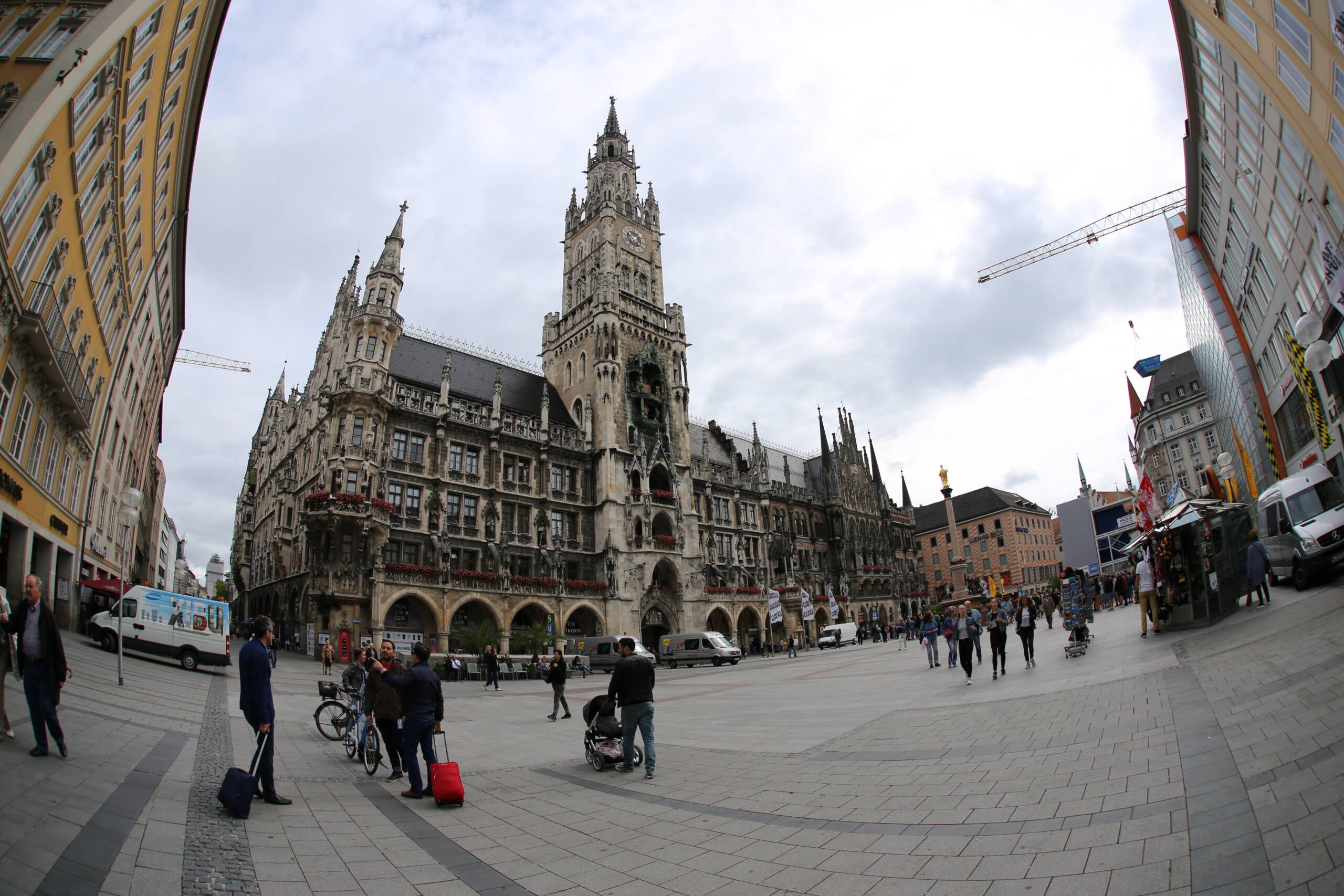
Image Credits: Travel photography with fisheye lens
This distinction matters for how you experience the square. Most of Europe’s famous public spaces are destinations in themselves, places you go to and then leave from. Marienplatz is a junction. The foot traffic on any given weekday morning is a mix of tourists with cameras and cyclists cutting across the paving and office workers on routes to the U-Bahn entrance and market vendors moving equipment toward Viktualienmarkt and delivery drivers navigating what is theoretically a pedestrian zone. The square functions because it is used, and it is used by people who have somewhere else to be as much as by people who have arrived. This gives it an energy that purely touristic spaces — the ones that attract only visitors and the commerce that follows visitors — can’t replicate. You are always aware in Marienplatz that you are standing in a city that is doing things around you.
Marienplatz has held this role since 1158, when Heinrich der Löwe — Henry the Lion, Duke of Saxony and Bavaria — founded the city of Munich and established the market that would grow into the square. The founding itself was an act of infrastructure aggression: Henry destroyed a bridge across the Isar River that belonged to the Bishop of Freising, built his own bridge slightly upriver, and redirected the salt trade route through his new settlement, extracting toll revenues that funded the city’s early growth. Munich was, from its first moment, a city built around controlling movement and commerce. Marienplatz was where that commerce happened.
The name comes from the Mariensäule, the column topped with a gilded Virgin Mary statue visible to the right of the New Town Hall, erected in 1638 to mark the city’s survival of the Thirty Years’ War and a subsequent plague outbreak. Before the column went up, the square was simply called the market square — Marktplatz — and was filled on most days with the stalls and noise and smell of a working urban market. The Mariensäule changed the square’s symbolic register. It became a site of civic devotion as well as commerce, a place where the city’s history was made physically present. The column still stands at the square’s center, still gilded, still serving as the visual anchor between the two town halls on opposite ends of the space. It is easy to overlook in the presence of the more imposing architecture surrounding it, but the square is named for it, not for either of the halls.
The square itself is older than the column by several centuries, having served continuously as Munich’s market, parade ground, and civic gathering space across its entire history. Jousting tournaments were held here in the medieval period. Public executions took place here. The city celebrated and mourned here. During the Third Reich, the square was a stage for Nazi demonstrations and the route of party processions; in 1938, the Munich Agreement that handed Czechoslovakia’s Sudetenland to Hitler was signed in the city, and the weeks around it saw Marienplatz used as a backdrop for the political theater that preceded the war. The square carries this history without marking it particularly. There are no plaques on the paving stones. The architecture that frames the space was largely rebuilt after the war’s bombing damage and projects the confidence of a city that has moved past what happened rather than the ambivalence of one that is still working through it.
The New Town Hall — Neues Rathaus — dominates the western and northern edge of the square with a confidence that the word “dominates” barely captures. The building occupies the entire northern flank, its facade running for approximately 100 meters before turning the corner, its central tower climbing 85 meters above the paving. Despite the name, it dates to the 1860s through 1908, built in Flemish Gothic Revival style by the Munich architect Georg von Hauberrisser across four decades of construction as the city’s administrative needs grew beyond what the medieval Old Town Hall could accommodate. The decision to build in Gothic Revival rather than in the Neoclassical style that dominated contemporary German civic architecture was deliberate and somewhat retrograde even at the time — a choice to anchor Munich’s identity in a medieval past rather than a Enlightenment present. The effect is a building that looks considerably older than it is, which was presumably the point.
The facade is worth extended attention before the crowds thicken around midday. It is organized in horizontal registers from street level upward, each band carrying its own program of carved figures, relief panels, and architectural ornament. The arcade arches at street level — Gothic pointed arches running the length of the building — shelter the entrances and a passage that cuts through to the interior courtyard, which is open to the public and considerably quieter than the square outside. Above the arcade runs a balcony level, then a string of elaborate window surrounds, then a parapet lined with Gothic pinnacles, then the tower itself, which carries a further layer of figural sculpture before the clock face appears and the architecture transitions into the spire. The density of ornament across all of this is extreme by any standard. There are around 400 figures carved into the facade’s exterior surfaces. The scale of the enterprise — forty years of construction on a single municipal building — is comprehensible only when you consider that Munich in the late nineteenth century was positioning itself as the cultural capital of Germany, competing with Berlin through sheer architectural ambition.
The tower houses the Glockenspiel, a 43-bell carillon with 32 life-sized mechanical figures that performs three times daily in summer — at 11am, noon, and 5pm — and twice daily in winter. The performance lasts approximately twelve minutes and depicts two scenes: a tournament held in 1568 to celebrate the wedding of Duke Wilhelm V to Renata of Lorraine, in which jousting knights on the upper tier circle and compete, and a Schäfflertanz — a coopers’ dance — on the lower tier, performed by barrel-makers who according to tradition danced through the streets of Munich in 1517 to lift the spirits of a population ravaged by plague. The Glockenspiel is not, by the standards of European mechanical clock displays, the most sophisticated or the most beautiful. Prague’s Orloj predates it by about four centuries and operates on a more complex astronomical mechanism. Strasbourg’s cathedral clock is more elaborate. But the Munich Glockenspiel performs at a scale — the figures are genuinely life-sized, visible from the square below without binoculars — that makes it a genuine spectacle rather than something you squint to appreciate.
The performance draws reliable crowds at 11am and noon, the heaviest of the three daily showings. Arriving early for a position on the square requires no special planning — the space is large enough to absorb substantial numbers without feeling compressed. The paved area in front of the Town Hall extends far enough that even a few hundred people watching the performance leaves significant space between groups. The best viewing position is center-square, directly in front of the tower, far enough back that you can see the full height of the facade. A zoom or telephoto lens is worth having if you intend to photograph the figures rather than the building as a whole; from ground level, the individual figures are legible to the naked eye but the mechanical detail is not.
The Old Town Hall — Altes Rathaus — occupies the eastern end of the square in deliberate contrast to its replacement. Where the Neues Rathaus is Gothic Revival maximalism, the Altes Rathaus is a reconstructed medieval structure, its tower dating in its current form to the 1470s and rebuilt after World War II damage destroyed much of the original. The building has served various municipal functions over the centuries and now houses a toy museum — the Spielzeugmuseum — across four floors of the tower. The museum’s presence is either a perfect use of a historic structure whose original civic function was long ago superseded, or an absurd one, depending on your relationship to Munich’s particular brand of civic whimsy, which tends toward the comfortable and the self-consciously charming. The toy museum is beloved and consistently reviewed well. It is also, unmistakably, a toy museum in a Gothic tower in the middle of one of Europe’s great civic squares.
Standing in Marienplatz with both halls visible simultaneously makes the city’s self-image legible in a way that no amount of reading about Munich quite achieves. The Neues Rathaus says: we are ambitious, we are serious, we build for centuries, we compete with Vienna and Berlin on their own terms. The Altes Rathaus with its toy museum says: we are also comfortable, we have a sense of humor about ourselves, we do not need everything to be monumental. These are not contradictory positions. Munich holds them simultaneously, and Marienplatz is where the tension between them is most visible.
Practically speaking, Marienplatz functions as a transit hub as much as a sight, and understanding this changes how you use it. The S-Bahn station directly below the square is the central node of Munich’s commuter rail network — all S-Bahn lines converge here before continuing outward to the city’s suburbs and beyond. Lines S1 and S8 run to Munich Airport in approximately 45 minutes; the Bayern Ticket, a day pass valid across Bavaria’s regional rail network, covers this journey from €29 for a single traveler, with additional travelers added at low incremental cost, making it considerably cheaper than a taxi or rideshare for most group sizes. The U-Bahn lines serving Marienplatz — U3, U6 on one platform; U4, U5 on another — connect to Schwabing in the north, the Englischer Garten access points, the Olympiapark, and Giesing in the southeast. Getting anywhere in Munich from Marienplatz takes at most two connections.
The pedestrian zone extending in multiple directions from the square is Munich’s main commercial artery and the city’s primary surface-level circulation route for visitors. Kaufingerstrasse and its continuation Neuhauser Strasse run west toward Karlsplatz and the central station, lined with department stores, international chains, and the occasional holdout independent retailer. The street is wide and flat and navigable by anyone; it is also, particularly on weekday afternoons and weekends, extremely congested with foot traffic. Moving through it with any efficiency requires treating it like a lane of traffic — maintaining consistent speed, not stopping suddenly to look at something, and identifying the pedestrian equivalent of a passing lane along its edges. The passages leading south from the square toward Viktualienmarkt are narrower and more interesting, threading through covered arcades and past the facades of buildings that have been in continuous commercial use for centuries.
Viktualienmarkt, three minutes south of Marienplatz on foot, is Munich’s daily food market and operates as both a functional provisioning ground for the city’s residents and a tourist destination in its own right. The distinction between these two functions is increasingly blurry — the market has gentrified significantly over recent decades, with premium pricing and a merchandise mix that reflects tourist demand as much as local grocery needs — but it remains a genuine market where Bavarian produce, cheese, sausage, bread, and flowers change hands every morning. The central beer garden, surrounded by maypoles representing Munich’s brewing guilds, serves beer from a rotating selection of Munich’s major breweries, with each brewery taking a season in rotation according to a traditional arrangement. Sitting in it on a weekday morning with a Weißwurst and a Weißbier before noon is one of the more specifically Bavarian experiences Munich offers, and it costs roughly what a coffee and pastry would cost in a tourist-facing café closer to Marienplatz.
Accommodations closest to the square skew expensive in ways that are difficult to justify against the actual convenience gained. The hotels immediately adjacent to Marienplatz charge a significant premium for an address that is, in Munich’s compact and well-served transit network, unnecessary. The better strategy for most travelers is a U-Bahn or S-Bahn stop out — Sendlinger Tor to the southwest, Isartor to the east, or Karlsplatz to the west — where mid-range hotels bring the square to within a ten-minute walk without the rate premium. Sendlinger Tor in particular has developed a cluster of reasonably priced hotels in the streets between the gate and the U-Bahn station, with easy connections to the Marienplatz platforms and walking distance to the Sendlinger Strasse shopping street and the Asamkirche, one of Munich’s most extraordinary Baroque interiors and perpetually undervisited relative to the more famous churches further north.
The square itself is free to enter at any hour, which sounds like a trivial observation about a public space but is worth stating explicitly given the number of European attractions that have introduced timed entry, paid access, or crowd management systems that effectively close off central civic spaces to casual movement. Marienplatz remains open, unpaid, unmanaged, and accessible at four in the morning if you want it. The view of the illuminated New Town Hall at night — the Gothic pinnacles backlit against a dark sky, the clock face glowing, the ornament rendered in warm artificial light that the daytime overcast suppresses — is worth setting an alarm for. The foot traffic clears significantly after 10pm, and by midnight the square belongs to late drinkers cutting through from the bars of the old town, cyclists heading home, and the occasional tourist who bothered to stay up. The building looks different at night. It looks, if anything, more like itself — more theatrical, more excessive, more unapologetically Gothic than the flat daylight allows. The fisheye lens that made sense in the morning makes sense again then, for different reasons.