On the morning of April 10, 2026, the European Union’s Entry/Exit System — years in the making, delayed repeatedly, and hyped as a historic leap toward frictionless, data-driven border security — finally switched on. By that evening, passengers across a dozen Schengen airports were marooned in three-hour queues. Flights were taking off half-empty. Families were stranded in Italian departure halls, watching their planes disappear from the departure board. Within 72 hours, the aviation industry’s verdict was already in: the EES rollout had been, in the measured language of industry bodies, “a systemic failure.”
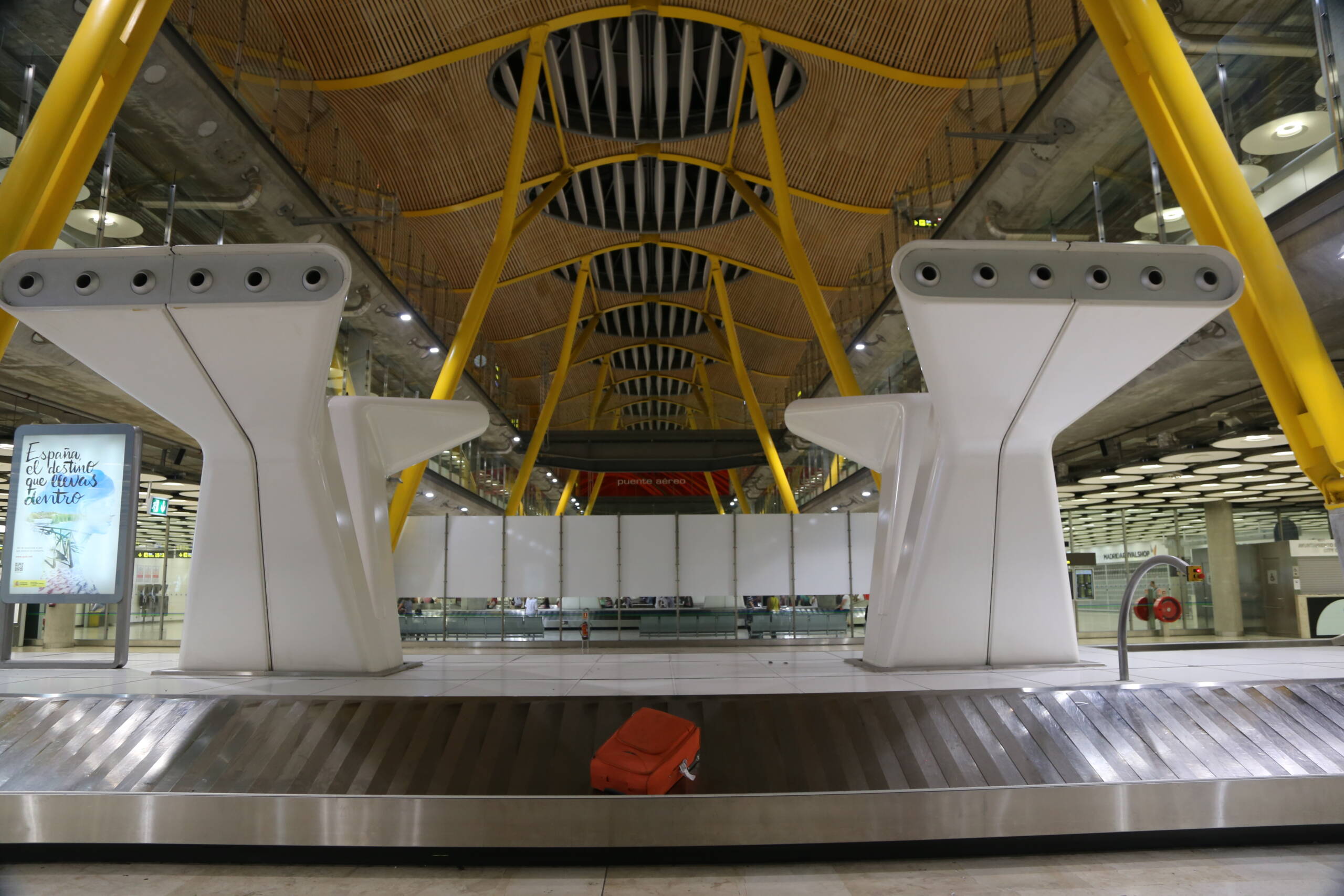
A solitary bag on the carousel at Madrid-Barajas T4. Under the EU’s new Entry/Exit System, the baggage sometimes arrives before the passenger does. Image Credits: Pho.tography.org
Madrid-Barajas Terminal 4 — Richard Rogers’ iconic bamboo-vaulted ceiling and yellow steel armatures receding into the distance — shot from the baggage hall, where a single orange suitcase sits unclaimed on an otherwise empty carousel. The terminal is still, almost deserted. It is an image of absence: the infrastructure of mass transit with almost no one in it. For a post about passengers stranded on the wrong side of a border control queue, watching flights leave without them, the lone suitcase on the belt reads as an accidental metaphor — luggage that made it through; its owner, presumably, did not.
What was supposed to be modernization arrived looking a lot like collapse.
What Is the EU Entry/Exit System?
The Entry/Exit System is the EU’s flagship overhaul of Schengen border management — the most significant structural change to how non-EU nationals cross into and out of the bloc in decades. Replacing the traditional ink-stamp passport check, it creates a centralized biometric database tracking every entry and exit of third-country nationals making short stays (up to 90 days within any 180-day period) across the 29 Schengen member states.
At each crossing, the system captures four fingerprints, a facial image, and full passport details. It logs entry and exit timestamps, records refusals of entry, and flags overstays — automatically and in real time. The goal, from the EU’s perspective, is a more secure, data-rich picture of who is inside the Schengen zone at any given moment and whether they have any right to be there.
The security logic is coherent enough. Passport stamping is manual, inconsistent, difficult to audit at scale, and easily manipulated. A centralized biometric record is harder to game, more verifiable, and provides enforcement authorities with tools that ink never could. The system had been in development since at least 2016 and was formally authorized by Regulation (EU) 2017/2226. It had originally been scheduled to launch in 2022, then 2023, then 2024. A phased rollout finally began in October 2025, starting at 10 percent of Schengen ports of entry, expanding to 35 percent by January 2026, and reaching 50 percent by March 2026 before full 100 percent coverage activated at 00:01 CET on April 10.
The EU also has a related system in the pipeline: ETIAS, the European Travel Information and Authorization System, which will require most non-EU nationals from visa-exempt countries to obtain pre-travel authorization online before boarding — analogous to the US ESTA. ETIAS is expected to launch later in 2026. Together, EES and ETIAS represent a structural convergence of EU border management toward the kind of data-intensive pre-screening architecture long operated by the United States and Australia.
How the Rollout Fell Apart
The problems were not a surprise to anyone paying attention. They were, if anything, overdetermined.
The aviation industry had been raising alarms for years. In a joint statement issued as recently as February 11, 2026, Airports Council International Europe (ACI EUROPE), Airlines for Europe (A4E), and the International Air Transport Association (IATA) warned the EU Commissioner for Migration, Magnus Brunner, of a “complete disconnect” between the European Commission’s confidence in the system and conditions on the ground at airports. They cited understaffing at border posts, inadequate numbers of functioning kiosks, low uptake of the Frontex pre-registration app, and technical failures that had already surfaced during phased rollout.
Portugal had been forced to fully suspend the system at Lisbon as early as December 2025. Gran Canaria experienced system crashes. ACI EUROPE reported that processing times at some locations had already increased by 70 percent before full launch, just from the partial rollout.
None of this prompted a course correction. The European Commission maintained its schedule and defended the system’s modeled performance — claiming that average registration should take approximately 70 seconds per traveler at full operational capacity. That figure would prove catastrophically optimistic.
What the Commission’s model apparently failed to account for was a simple reality: on April 10, 2026, every non-EU traveler passing through a Schengen border was a first-time registrant. The system had to capture their biometrics from scratch. There was no legacy database to cross-reference. There was no speed advantage to be gained from prior enrollment. In practice, processing times regularly stretched to two to three minutes per person — and at understaffed border posts with limited kiosk infrastructure, the queues built rapidly and did not stop building.
The Scenes at the Airports
The first day of full EES operations was, in the dry language of an ACI EUROPE and A4E joint statement released that same day, “marked by passenger disruptions, delays and missed flights.” On the ground, it was considerably less bloodless than that.
At Milan’s Linate airport on Sunday, April 12, an EasyJet flight to Manchester was booked with 156 passengers. After hours-long border queues chewed through the terminal, only 34 made it to the gate in time. One hundred and twenty-two passengers stood in Italy and watched their aircraft leave without them. One family, trying to get home, spent more than £1,600 booking a rerouted connecting flight via Luxembourg — arriving home 24 hours late. An EasyJet spokesman told the BBC that the border delays were “unacceptable” and called on border authorities to ensure adequate processing capacity for passengers.
Similar scenes played out at airports across the Schengen zone. At one unnamed hub, a departing flight left with 51 passengers still in the queue. At another, no passengers at all had reached the boarding gate by the time it closed — some were still undergoing initial biometric screening more than 90 minutes after they should have been airside. Spanish airports, including Malaga, and major French hubs reported queues stretching three hours or more at peak periods.
At a structural level, what was happening was predictable physics. Border facilities at many Schengen airports were designed for an era when a typical entry procedure took 30 seconds — a document check, a stamp, and a wave through. EES biometric enrollment routinely takes two to three minutes. Even granting the Commission’s 70-second optimistic estimate, that is more than double the prior throughput rate. With the same number of booths, the same physical space, and the same staffing, throughput approximately halves. Queues grow. Flights depart.
Industry Pushback and the Regulatory Bind
The industry response was immediate and unambiguous. Olivier Jankovec, Director General of ACI EUROPE, and Ourania Georgoutsakou, Managing Director of A4E, issued a statement on April 10 itself calling for emergency flexibility: specifically, the option for member states to fully suspend EES operations when queues become excessive, not merely to invoke partial suspensions that allow them to skip biometric capture in some cases. They also asked Brussels to extend both partial and full suspension authority through the peak summer 2026 travel period.
“The only feasible solution,” A4E stated, “is for the European Commission to allow for the full and partial suspension of EES until the end of summer, where necessary.”
The regulatory position is awkward. Full member-state suspension authority for EES expired on April 10, the same day the system went live at full scale. Partial suspension authority — allowing border authorities to skip biometric collection in some circumstances — remains in place, but industry bodies argue it is insufficient to prevent severe congestion during peak travel. A partial suspension that still requires passport checks and manual verification does not meaningfully reduce processing time enough to unblock a three-hour queue.
ABTA, the UK trade association representing travel agents and tour operators, had already contacted the European Commission directly before launch to raise concerns about summer disruption, urging Brussels to actively encourage the use of contingency measures. The warning was not heeded in any visible way before April 10.
A Phased Rollout That Still Wasn’t Ready
In fairness to the Commission, the rollout was not a sudden switch. The phased introduction that began in October 2025 was designed precisely to allow airports to build capacity gradually, identify technical failures early, and let registrations accumulate before full deployment. That Lisbon suspended the system entirely in December 2025, that Gran Canaria experienced crashes, and that processing times were already up 70 percent in some locations during the phased period should have been actionable warning signs. They were not treated as such.
Part of the problem is structural to the system design. There is no way to build up a meaningful registration database before launch: the database only populates when travelers cross the border. Until a critical mass of regular travelers have been enrolled, every crossing is a first-time enrollment. The phased rollout could smooth out technical issues and train border personnel, but it could not change the fundamental fact that the first day of full deployment at 100 percent coverage would also be the day with the highest proportion of first-time registrants.
Pre-registration options exist — notably the Frontex-developed “Travel to Europe” mobile app, which allows travelers to load passport data and a facial scan up to 72 hours before arrival. But uptake has been extremely low. The app was not aggressively marketed, awareness among non-EU travelers is minimal, and even where it has been used, integration with airport processing systems has been inconsistent. An enrolled traveler at a kiosk that is not properly synced with the pre-registration database gains little from having registered in advance.
Who Is Actually Affected?
EES applies to third-country nationals — people who are not citizens of EU or Schengen member states — entering any Schengen country for short stays. This overwhelmingly means British travelers following Brexit (who were EU nationals until the end of the transition period and are now subject to Schengen third-country rules), as well as nationals of the United States, Canada, Australia, and other non-EU countries. It does not apply to EU citizens, who continue to use EU lanes at border control.
This creates an asymmetry in the disruption. British passengers traveling to European holiday destinations — Spain, Greece, Italy, France, Portugal — bear a disproportionate share of the burden, both at entry into Schengen and at exit. The political resonance in the UK is sharp: Brexit was partially sold on the premise of escaping EU bureaucracy, and the EES now delivers a very tangible new layer of it every time a British family flies to Malaga for half-term.
The disruption also extends to business travelers, students, and transit passengers from non-EU countries. Family groups are processed individually — children cannot share biometric enrollment with parents. The processing load scales linearly with group size, with no efficiency gains for families. Third-country nationals who are family members of EU citizens receive some processing exemptions under EU Directive 2004/38/EC, but the exception is narrow and does not cover the general category of non-EU traveler.
The Financial and Legal Exposure
One of the harder edges of the EES rollout is the liability gap it creates. In most jurisdictions and under most airline ticketing terms, airlines are responsible for delays and missed flights caused by circumstances within their control — mechanical faults, crew scheduling failures, air traffic control restrictions attributable to the carrier. Immigration and border processing are considered third-party governmental functions, outside the airline’s operational control and therefore outside their compensation obligations.
A passenger who misses a flight because they spent three hours in an EES queue has, in most cases, no legal route to compensation from the airline. They are holding a ticket for a flight that left without them, through no fault of the carrier. The airline met its obligations. The state did not meet its processing capacity. The passenger bears the financial consequence.
For the family at Linate who spent £1,600 on alternative routing to get home, there is no straightforward mechanism for recovery. Travel insurance policies may cover some costs if the policy includes specific coverage for missed departures caused by documented border delays — but many policies exclude government-caused delays, and documentation requirements can be burdensome. The practical advice now circulating in the travel industry — obtain comprehensive travel insurance, arrive four hours before departure at major hubs, pre-register via the app where possible, keep boarding passes as proof of entry and exit in the absence of physical stamps — reflects an industry adapting to a system that is not yet delivering on its stated efficiency promises.
Summer 2026: The Real Test Is Coming
The April chaos has occurred in what is, by the standards of European leisure travel, an off-peak period. Easter traffic is significant, but nothing compared to the volume that moves through Schengen airports in June, July, and August. The European Commission’s insistence that registration speeds will improve as the database populates is theoretically correct — a returning traveler who was enrolled in April will proceed through the system faster in August than a first-timer will in either month. But the volume surge in summer will more than offset whatever throughput gains come from accumulated registrations.
ACI EUROPE’s projections, if anything, suggest the worst may be ahead. The industry bodies have not withdrawn their calls for emergency flexibility. France’s Parafe e-gates — which use facial recognition and process many air travelers — still did not process UK or US passports as of March 2026, meaning even travelers arriving at e-gate-equipped airports were being funneled into standard manned lanes. Spanish airports like Malaga, which receive enormous volumes of British and non-EU leisure travelers, are particularly exposed.
The Commission has indicated that some flexibility remains for member states to use partial suspension options beyond April 10, but the scope of that flexibility is contested and the political incentives cut against broad suspension use — member states that suspend biometric collection are explicitly not operating the system as designed, which creates legal and reputational complications.
The Longer View
Stepped back from the immediate disruption, the EES is not an obviously bad idea. The EU has a real and well-documented interest in knowing who enters and exits the Schengen zone, particularly in the context of irregular migration, overstays, and the security challenges associated with large, opaque short-term visitor populations. Replacing an inconsistent manual stamp system with a centralized biometric record is a rational upgrade in capability. The Commission’s claim that the system will improve over time — as registrations accumulate, as hardware is upgraded, as kiosk numbers increase and staff become practiced — is probably correct.
The problem is not the destination. The problem is the transition. Airports were not rebuilt for the new processing requirements. Staffing was not scaled. Kiosk deployment was insufficient. The pre-registration app was not embedded into the travel booking ecosystem in any meaningful way. The phased rollout identified problems that were not fixed. And then the system went fully live at 100 percent, in April 2026, with peak summer already visible on the horizon and no adequate mechanism to ease the pressure once queues exceeded manageable lengths.
The passengers left behind at Linate — 122 of them, watching an EasyJet plane push back from the gate — did not lose their flights because of a bad policy goal. They lost them because of an implementation failure of a fairly ordinary kind: underestimating the physical throughput constraints of existing infrastructure, overestimating the speed at which a new system would normalize, and proceeding on schedule despite clear warnings from the people who actually run the airports and the airlines.
That is a failure of governance, not of concept. Whether the EU addresses it fast enough to prevent a genuinely catastrophic summer at Schengen borders is a question that the next few months will answer.
The EU’s Entry/Exit System is now operational across all 29 Schengen Area countries. Non-EU travelers are advised to allow significantly more time for border processing, check airline and airport guidance before departure, and consider travel insurance policies with missed departure coverage. The ETIAS pre-travel authorization system is expected to launch separately later in 2026.