Grand-Place, Brussels: Where the City’s History Stands in Stone
Stepping onto the cobbled surface of Brussels’ Grand-Place—known locally as the Grote Markt—feels less like arriving at a square and more like walking directly into the living core of the city. The space opens suddenly, framed by ornate facades that shimmer with gold accents and sculpted details, and for a moment it’s hard not to stop in place and simply look around. Recognized as a UNESCO World Heritage site, the square carries centuries of history in its stones, its buildings, and the rhythms of daily life that still pass through it.
For generations the Grand-Place has functioned as the beating heart of Brussels. In medieval times it served as the city’s central marketplace, where merchants from across Europe gathered to exchange goods, ideas, and news. Traders, guild members, travelers, and locals all converged here, turning the square into both an economic hub and a meeting place for the wider world. The square that visitors encounter today reflects that long continuity—less a preserved relic than a space that has evolved while retaining its historical gravity.
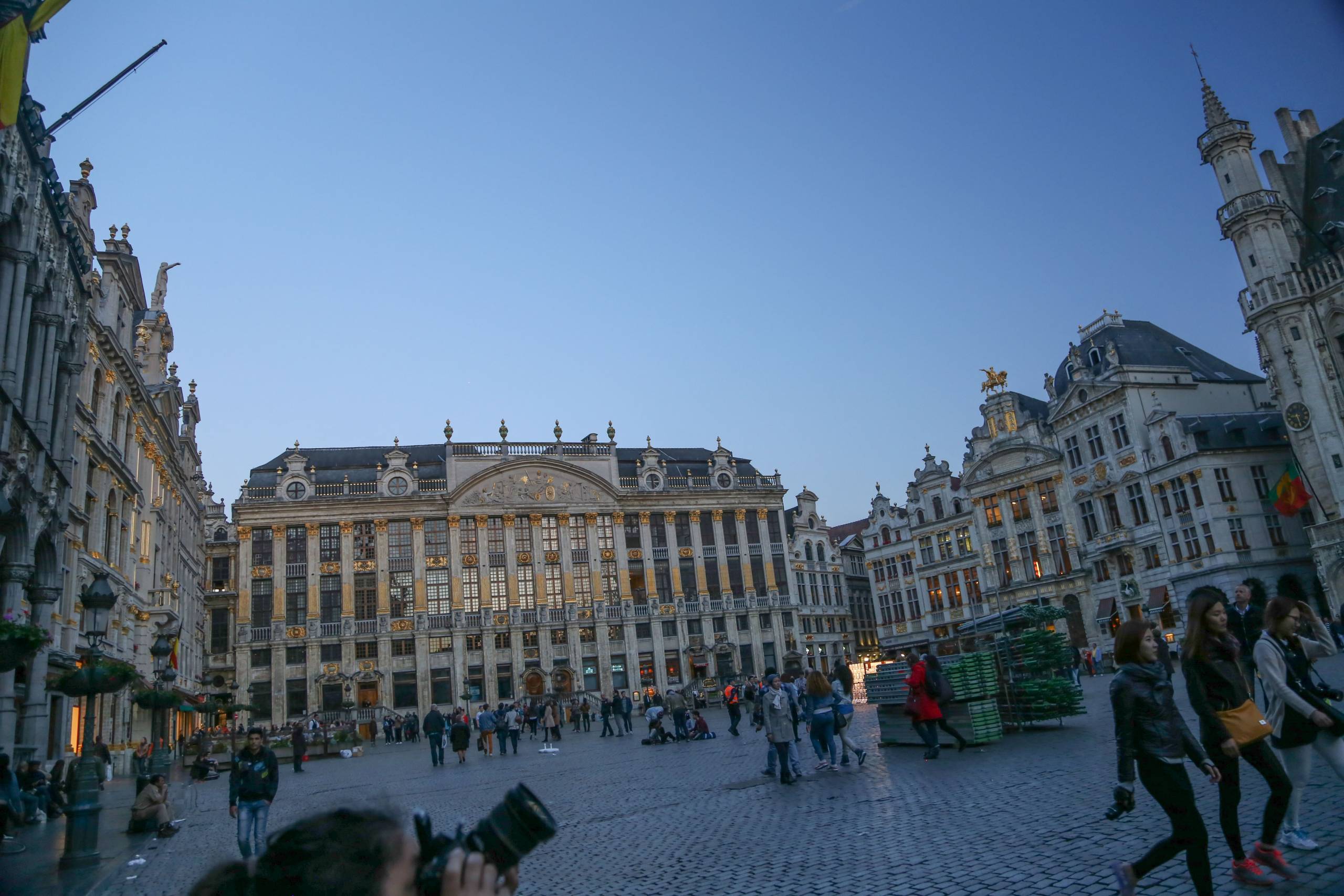
The Grand-Place or Grote Markt is the central square of Brussels, Belgium. It is surrounded by opulent Baroque guildhalls of the former Guilds of Brussels and two larger edifices; the city’s Flamboyant Town Hall, and the neo-Gothic King’s House or Bread House building, containing the Brussels City Museum. The square measures 68 by 110 metres and is entirely paved. Street and Travel Photography with the Canon R8
What makes the Grand-Place particularly striking is the architectural drama that surrounds it. Each side of the square is lined with richly decorated guildhalls—former headquarters of the city’s powerful medieval trade guilds. Their facades rise in elaborate layers of sculptures, pilasters, gilded ornaments, and crest-like symbols that hint at the professions once represented there: brewers, bakers, boatmen, and merchants. The craftsmanship is meticulous, almost theatrical in its exuberance.
Dominating the square stands the Brussels Town Hall, an unmistakable Gothic structure crowned by a slender spire that seems to pierce the sky above the rooftops. The tower is asymmetrical, which you only really notice after staring for a while, but somehow that slight irregularity adds to its character. Across the square sits the King’s House—also known as the Bread House—whose neo-Gothic façade contrasts with the flamboyant guild buildings around it. Today it houses the Brussels City Museum, preserving artifacts and stories tied to the city’s long and sometimes turbulent past.
Beyond architecture, the Grand-Place regularly transforms into a stage for one of Europe’s most visually memorable events: the Brussels Flower Carpet. Every two years the square becomes a vast living tapestry formed from thousands of begonias arranged in intricate geometric patterns. For a few days the cobblestones disappear beneath a dense mosaic of color and fragrance. Visitors lean over the balconies surrounding the square to take in the design from above, watching the sunlight shift across the petals during the day and the illumination transform the display at night.
Throughout the year the square hosts other celebrations that keep its historic space very much alive. Cultural events, festivals, and historical pageants bring crowds back again and again. The Ommegang procession recreates the pageantry of sixteenth-century Brussels with elaborate costumes and ceremonial parades, while music festivals fill the air with performances that echo between the tall facades. Even on an ordinary afternoon the square carries a sense of occasion.
Part of that atmosphere comes from the everyday life that surrounds it. Cafés and restaurants line the perimeter, their terraces spilling into the edges of the square. The smell of fresh waffles drifts through the air alongside the darker aroma of Belgian coffee. Street musicians set up near the corners, artists sketch the buildings, and tourists wander slowly across the stone pavement, often pausing in the middle just to absorb the view.
Visiting the Grand-Place is best done with a bit of patience. Daylight reveals the full detail of the facades, especially when the sun hits the gilded ornaments and the buildings seem to glow. It’s easy to spend time at one of the cafés along the square, watching the constant flow of visitors while enjoying a drink or a simple meal. Weekends can be busy, of course—the square is one of Brussels’ most famous landmarks—but the energy of the crowd also adds to the sense that this place remains very much the city’s gathering point.
Leaving the Grand-Place often comes with that lingering feeling of having stood inside a piece of history rather than merely observing it. The architecture, the music of street performers, the hum of conversation from terrace tables—all of it blends into an experience that feels both monumental and strangely intimate. Brussels has many beautiful corners, but the Grand-Place holds them together, a square where the past and present seem to share the same stones.
Grand-Place at Dusk: Gold, Stone, and the Gathering of Travelers
Evening settles gently over Brussels’ Grand-Place, and the square begins to glow in that peculiar way only historic European plazas seem to manage. The sky above the rooftops fades into a soft pale blue, almost pastel, while the ornate facades of the guildhalls catch the last light of the day. What stands before the viewer is not merely architecture but a layered stage of history, decoration, and human curiosity unfolding all at once.
The photograph captures a row of monumental guild buildings rising from the cobbled square like an elaborate stone tapestry. Their pale grey facades are richly ornamented with sculpted columns, carved reliefs, gilded accents, and decorative pediments that stack upward toward elaborate rooflines. At the center of the frame stands one of the most striking guildhouses, crowned with a golden statue of a mounted figure gleaming against the evening sky. The gold detailing scattered across the buildings catches the fading light, giving the impression that parts of the architecture are almost illuminated from within.
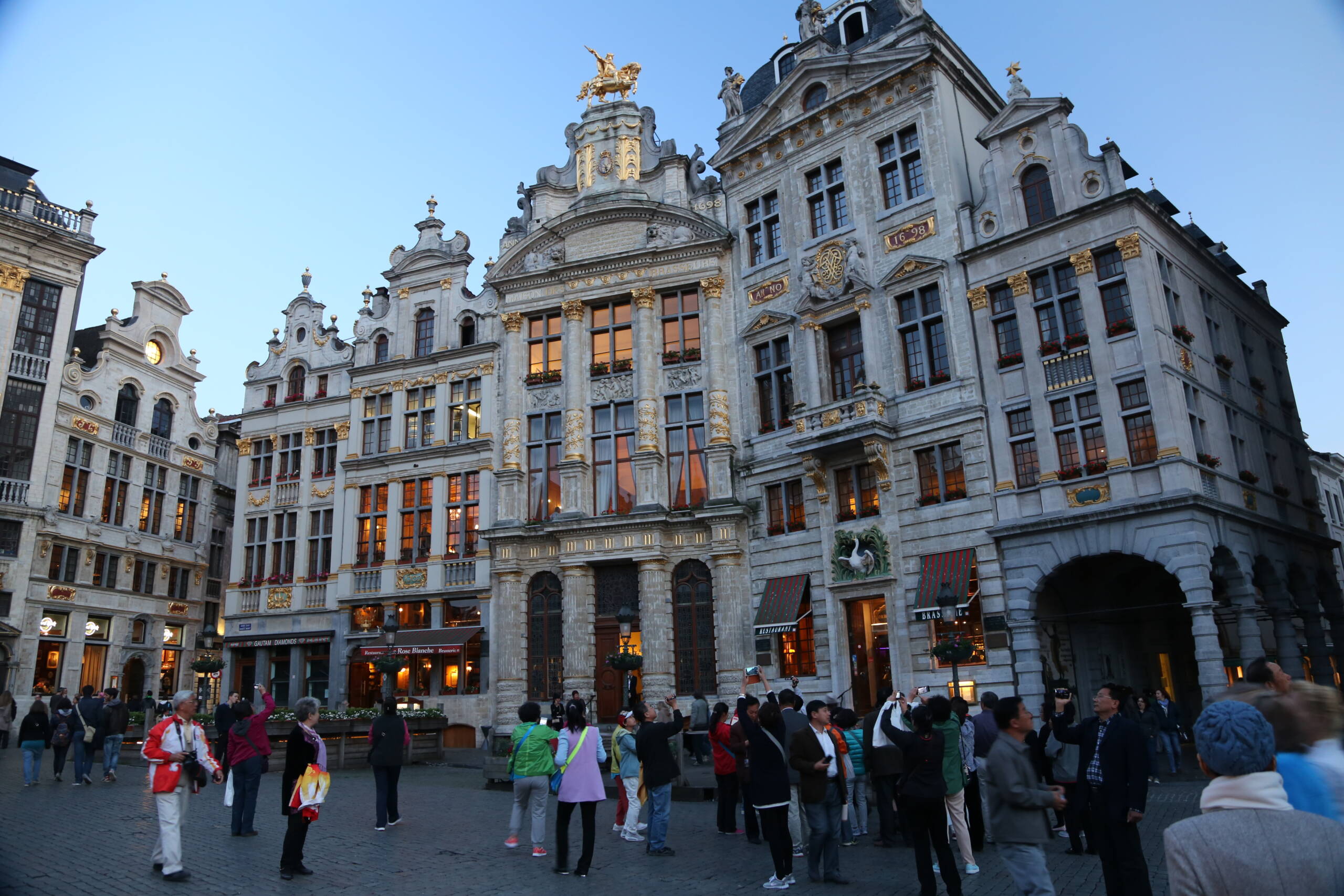
Tall windows line the façades in precise vertical rows, and inside several of them warm amber light glows softly, hinting at restaurants, cafés, or private rooms hidden behind the historic walls. Window boxes filled with small red flowers run beneath many of the panes, adding subtle color to the otherwise pale stone palette. Some entrances at street level are marked by striped awnings in muted red and green, suggesting cafés or shops that blend modern life into the centuries-old structures.
The buildings themselves feel theatrical in their composition. Ornamental columns frame the central facade, while sculpted crests and gilded medallions sit between floors like decorative punctuation marks in stone. Above them rise curved Baroque rooflines and sculptural figures placed along the edges, as if the buildings are watching over the square. One roofline features elaborate scroll-like gables, another carries statues poised along its crest, each adding to the sense that this entire block of architecture was meant not only to function but to impress.
In the foreground the square is alive with people. Tourists gather in small clusters across the cobblestones, many of them holding smartphones upward toward the buildings. Several visitors stand with arms raised, photographing the ornate facades as if trying to capture the entire square in a single frame—an impossible task, really, but everyone seems determined to try. A few figures in colorful jackets—reds, greens, and blues—add human contrast against the grey stone backdrop.
The crowd itself feels international. Some visitors stand quietly studying the architecture, others gesture toward decorative details high on the buildings, pointing out statues or gold ornaments to companions. One man in a bright red jacket appears to be framing his own photograph, while nearby another group leans back slightly, phones angled upward toward the golden statue atop the guildhall.
The cobbled pavement of the square spreads outward across the foreground, textured and slightly uneven, reflecting faint hints of the surrounding lights. These stones have carried centuries of footsteps—merchants, soldiers, traders, nobles, travelers—and now the modern flow of tourists continues that quiet tradition.
What makes the scene especially striking is the balance between the monumental scale of the buildings and the smallness of the people below them. The guildhalls tower above the visitors, their ornate façades reminding everyone in the square that Brussels’ history is written in stone, decoration, and civic pride. Yet the square does not feel distant or museum-like. Instead, it feels alive, animated by the simple human act of gathering, looking, photographing, and wandering.
The photograph captures that brief moment when daylight has not quite faded and the buildings have already begun to glow with interior light. It is a transitional hour, a kind of architectural twilight, where the Grand-Place reveals both its historic grandeur and its present-day role as one of Europe’s most captivating public spaces.
Leave a Reply