There’s something quietly hypnotic about Bologna at night. It doesn’t try to seduce you the way Florence does, and it doesn’t flaunt its beauty like Venice. Instead, it waits — almost amused — knowing that eventually, you’ll fall for it. And sooner or later, you do.

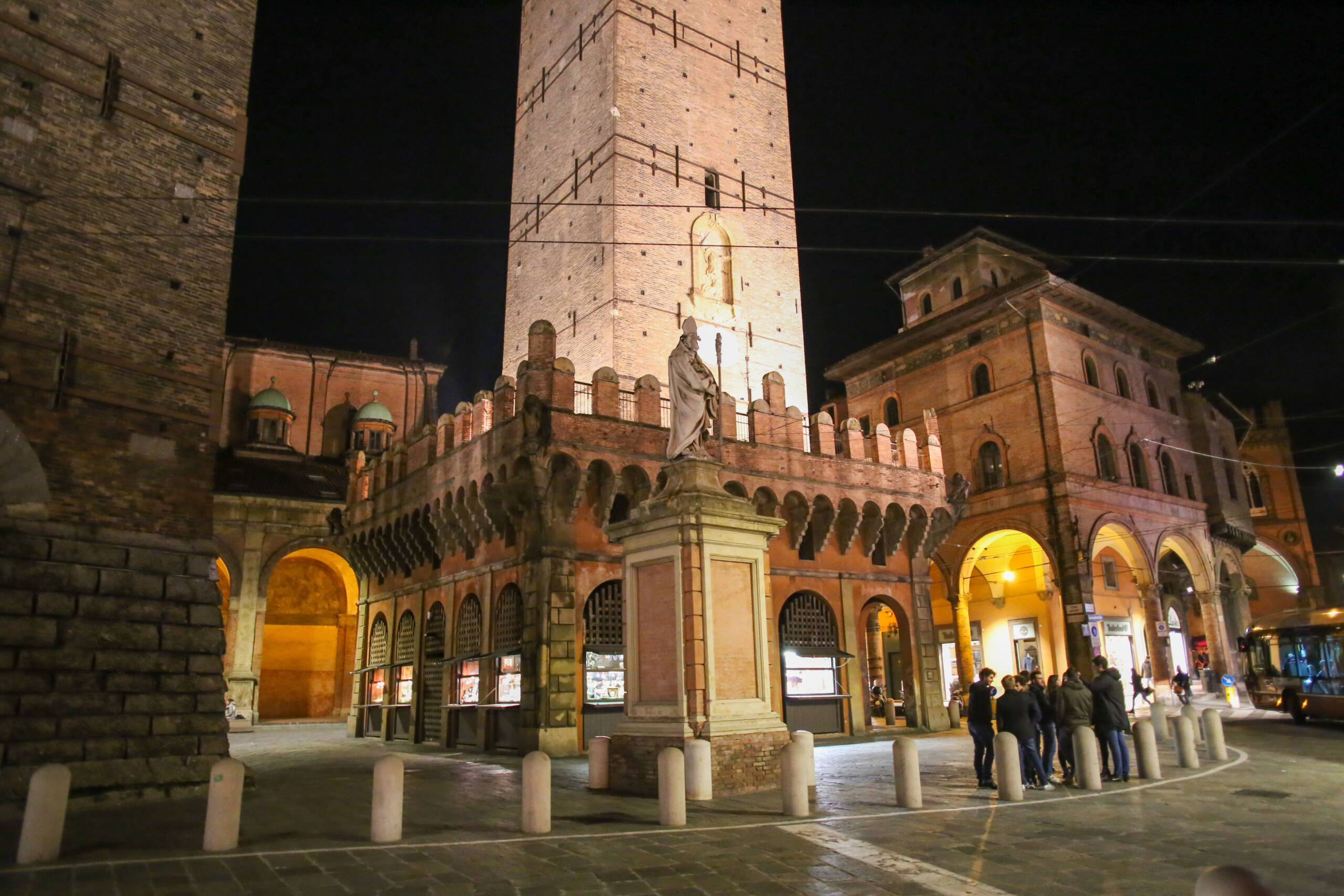
The first scene opens at a crossroads framed by ochre façades glowing in the warm streetlight. A bronze statue stands on its pedestal, pointing forward — maybe guiding travelers, maybe scolding late-night wanderers. Below it, a few people linger, chatting like they’re in no rush to get anywhere. A blurred passer-by rushes across the zebra crossing, almost ghostlike. The city feels calm, but never empty. Standing there under the warm glow of Bologna’s streetlights, Luigi Galvani looks frozen in the act of explaining a revelation — his bronze arm stretched forward, coat flowing behind him, as if wind and urgency still cling to him centuries later. Most people walking past don’t stop long enough to think about it. They see another statue, another old man in metal, another name from a schoolbook. But the truth is, Galvani wasn’t just another academic — he was one of those strange minds who didn’t simply observe life, but questioned it at a microscopic, borderline obsessive level.
Legend says that somewhere in Bologna — in a modest kitchen rather than a pristine laboratory — Galvani’s wife was preparing frog legs for dinner when he first noticed them twitch from stray sparks of static electricity. That tiny, absurd movement sparked a theory that would eventually contribute to modern neurology, medical equipment, and the entire concept of bioelectricity. A twitch of a frog’s leg… and mankind moved a step closer to understanding the nervous system.
Maybe that’s why his statue stands in such a casual crossroads rather than on a pedestal in a quiet museum courtyard. Bologna wanted him among life — among moving bodies, conversations, cigarettes, scooters, and footsteps. Here, he points not toward a laboratory or a university gate, but toward whatever chaos happens to be unfolding in front of him. And on certain nights — when rain slicks the pavement and the city’s glow softens just enough — it does look like he’s mid-sentence, explaining the universe to whoever happens to walk close enough. Some statues are memorials. Galvani’s feels like a challenge.
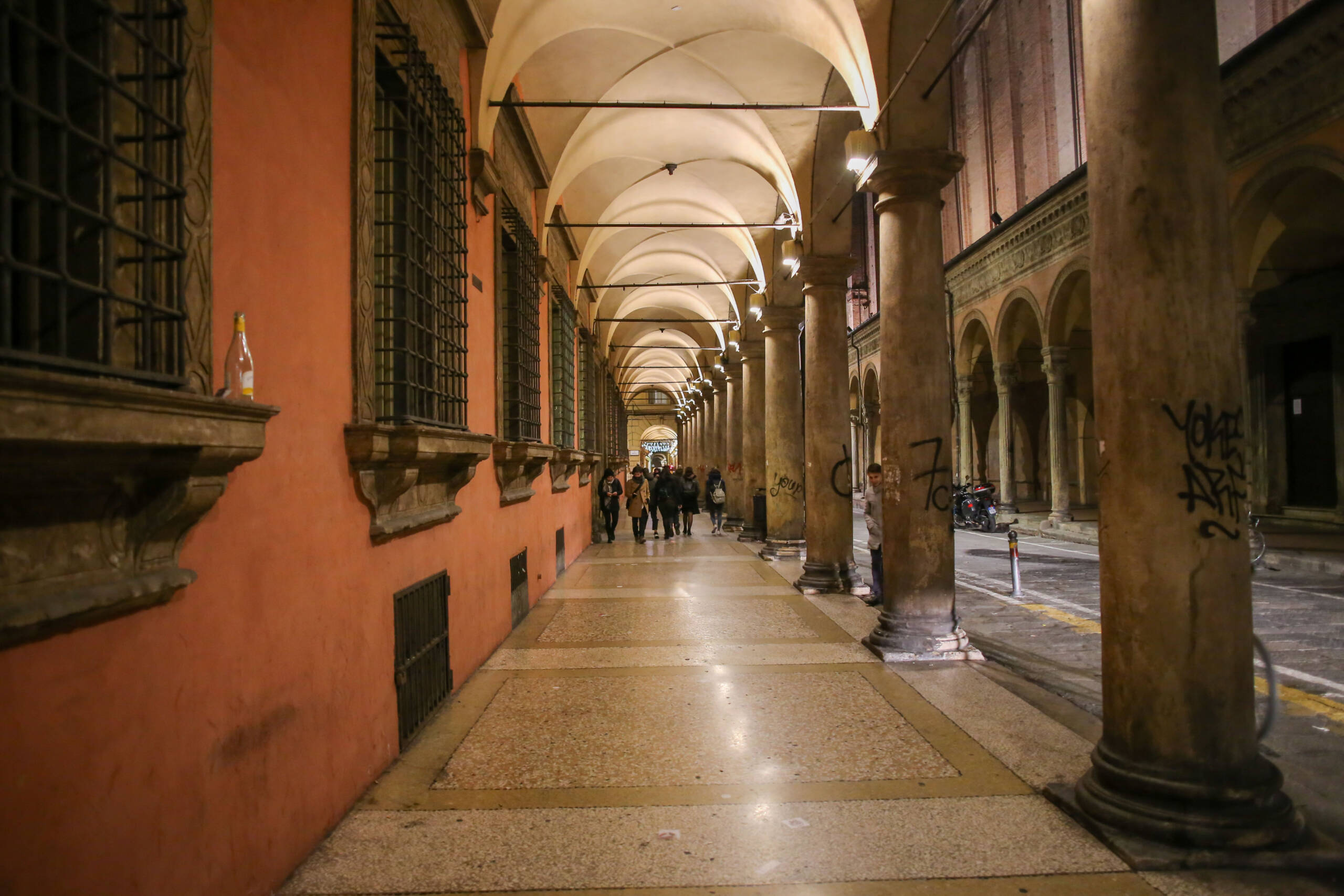
Walking through these long porticoes feels like entering a living corridor of history. The arches stretch endlessly, lit by warm amber lamps that leave pockets of darkness between columns. Some corners feel elegant, others slightly rough around the edges, with graffiti scribbled onto stone pillars that have stood here longer than most modern countries. There’s a bottle left on a window ledge in one of the arcades — the kind of detail cities don’t curate for tourists. It exists simply because life happens here, unfiltered.
Then, the real icons rise from the darkness.
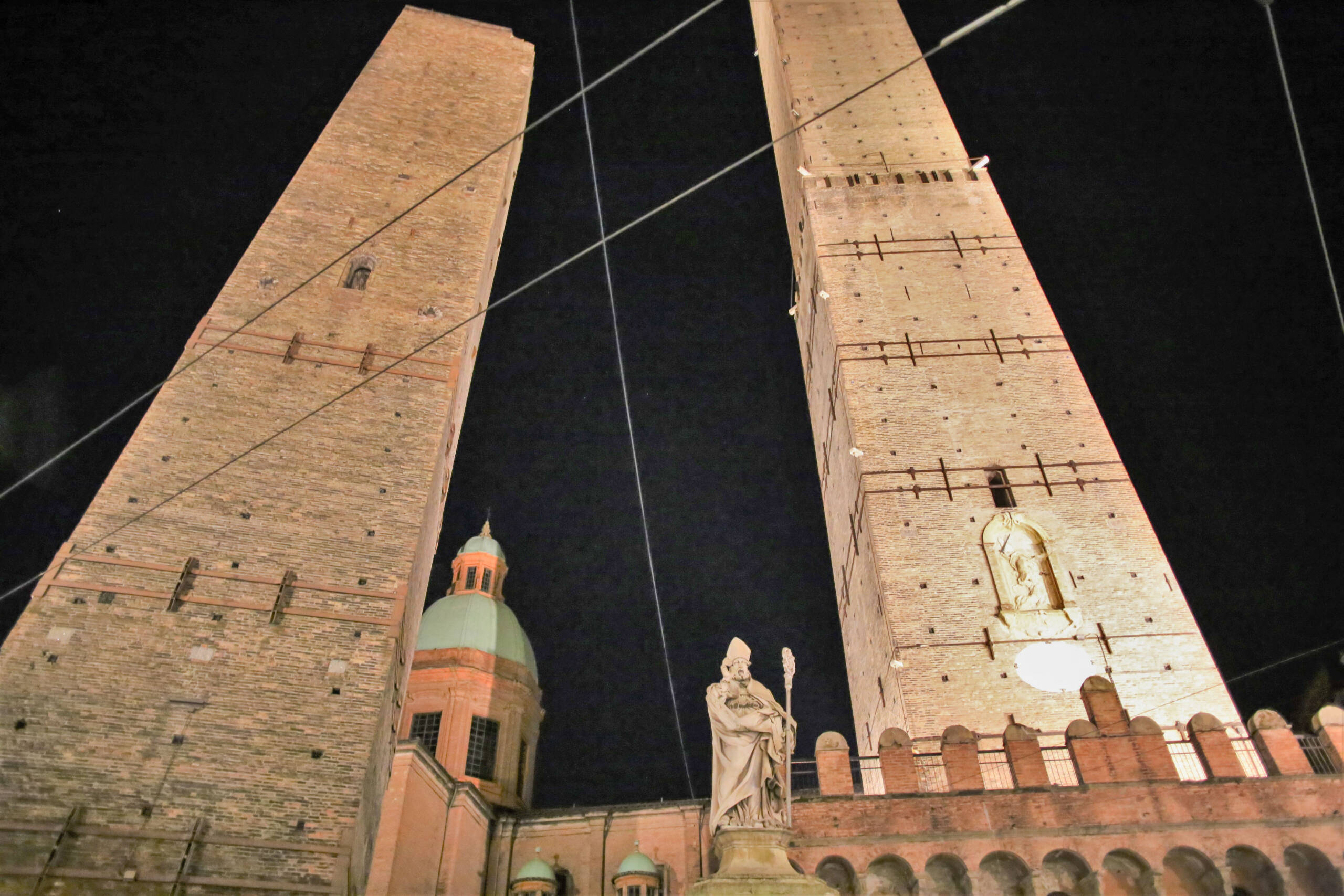
Bologna’s Two Towers — Asinelli and Garisenda — are impossible to ignore. They tilt and loom with an almost medieval arrogance, like they remember a time when the skyline was full of rival family towers. At night, they’re even more dramatic. The bricks catch the artificial light in a way that makes the towers look ancient and imposing, and yet somehow gentle. People gather beneath them — groups of friends laughing, taking photos, or just leaning against the cold stone, pretending not to be impressed by structures that have stood here for nearly a thousand years.
Between the towers and the porticoes, there’s a rhythm to Bologna: shadows, arches, stone, voices, footsteps, and the occasional distant scooter echoing down a silent street.
You notice the tiny things — the wrought iron balconies, the shuttered windows, the reddish tones of the buildings that somehow glow rather than fade in the night. The architecture here doesn’t just frame the city — it wraps around you, creating a sense of intimacy even in open squares.

Bologna at night isn’t polished. It’s textured, lived-in, cinematic.
There’s this feeling — maybe it’s the students from the university, maybe the constant low hum of human presence — that the city never fully goes to sleep. It just slows down long enough to let you breathe with it.
If you come to Bologna expecting a postcard-perfect experience, you’ll get something better: authenticity. The kind you don’t recognize immediately but feel days later — when you miss the echoing footsteps under the arcades, the way the towers slice through the night sky, and the silent confidence of a city that doesn’t need to prove anything.
Bologna doesn’t perform. It simply exists — beautifully, stubbornly, unmistakably itself.
And once you see it like this — lit by soft lamps, wrapped in its arcades, watched over by ancient towers — you start to understand why so many people never leave.