The photograph catches Rockefeller Center in that very specific winter state where everything feels busy and hushed at the same time, like a city holding its breath while still moving. In the foreground, slightly off-center and framed by dark vertical steel columns, three people in heavy black winter jackets huddle together over a smartphone. Their posture is inward, protective, shoulders slightly raised against the cold, heads bent close enough that the glow of the screen becomes a shared point of warmth. One of them is mid-gesture, finger hovering above the glass, as if explaining something important or simply scrolling for directions, tickets, messages—hard to tell, and that ambiguity is part of the charm. At their feet, a small child in a green parka and a knit hat looks upward, dwarfed by the scale of the place, already learning what it means to wait in a city built of lines and schedules.
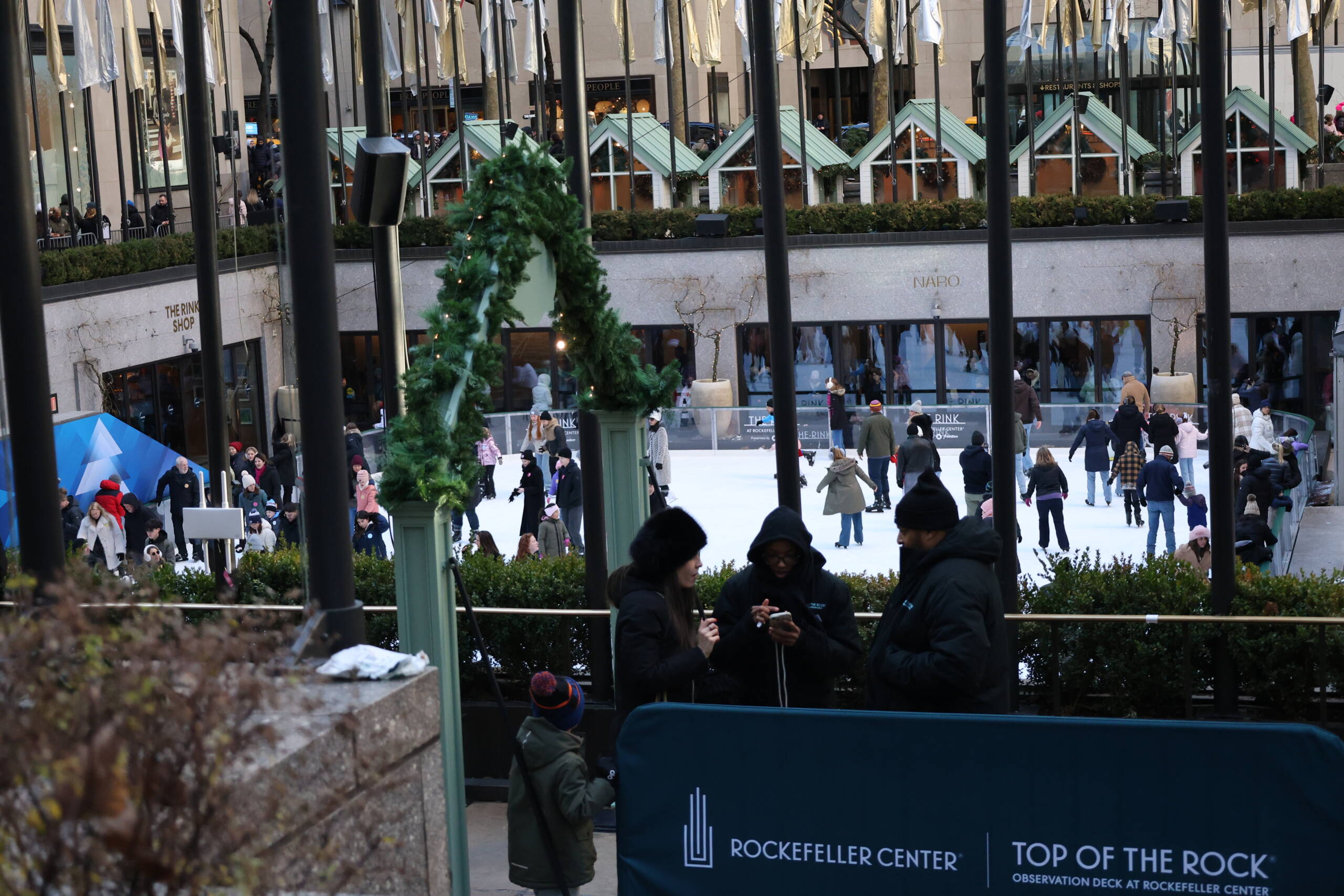
Behind them, the ice rink opens up like a bright stage. Skaters move in loose orbits, some confident and upright, others tentative, arms extended for balance. The ice itself is a pale, almost matte white, absorbing sound and reflecting winter light rather than shining. Around the rink, people cluster along the edges, bundled in coats of beige, navy, and black, forming a soft, human border. Above, a row of small chalet-style structures with green roofs lines the upper terrace, decorated with garlands and lights that signal holiday season without shouting it. They feel temporary, almost toy-like, perched against the heavy stone and glass of the surrounding buildings, a seasonal layer laid gently on top of permanent architecture.
What gives the image its rhythm are the verticals: the black columns slicing the frame into narrow segments, the tall buildings rising out of view, even the garland-wrapped post arching gently near the center like a festive counterpoint to all that rigidity. These lines create a sense of being both inside and outside the scene at once, as if the viewer is peeking through a fence or from a slightly hidden vantage point. At the bottom right, a dark blue barrier carries the Rockefeller Center branding, understated but unmistakable, grounding the image in a very specific place while also reminding you that this is a curated experience, a destination designed as much for memory-making as for movement.
Yet the photograph doesn’t feel like a postcard. It’s not chasing perfection or spectacle. Instead, it lingers on the in-between moments: people checking phones before skating, parents waiting while children tug at sleeves, strangers passing without interaction. The rink becomes less about performance and more about ritual, something New York does every winter whether anyone photographs it or not. The cold is implied everywhere—in the heavy coats, the tucked chins, the way bodies cluster close—but so is a quiet comfort, the shared understanding that this is exactly where you’re supposed to be at this time of year, even if only for a few minutes, even if just to stand and look.
Leave a Reply