Stand on a Manhattan sidewalk on a weekday morning and the scene repeats itself with almost comic precision: a line snakes past a narrow, pale-wood storefront, people quietly scrolling, dressed like a shared mood board, all waiting for a cup of coffee that costs more than a full breakfast used to. What looks irrational at first—voluntary waiting, minimal seating, barely any food—is actually one of New York’s most refined social rituals. These coffee shops aren’t selling caffeine alone. They sell calibration. In a city that moves too fast, choosing to stand still becomes a statement. Waiting in line says you have time, or at least control over how you spend it. The cup at the end of the queue becomes a receipt for belonging, proof that you understand the current language of taste and restraint.
The coffee itself is treated like a performance. Machines gleam like laboratory instruments, baristas move with rehearsed calm, and beans arrive with origin stories that feel closer to wine tasting than breakfast fuel. Shops such as Blue Bottle Coffee helped codify this style years ago, while others turned it into something nearly architectural: light wood, concrete, muted colors, just enough greenery to soften the edges. Nothing feels accidental. The space is quiet but not empty, busy but not chaotic. You’re meant to notice the care, even if you can’t always taste every promised note. The coffee doesn’t just wake you up; it reassures you that precision still exists somewhere in the city.
Then there’s the food—or rather, the deliberate lack of it. A couple of croissants, maybe a bun, something wrapped in paper with a small label. No sandwiches, no toasts, no menus that demand decisions. This is not neglect, it’s design. Full kitchens bring smells, noise, grease, unpredictability. A sandwich turns coffee into a meal; a croissant stays politely in the background. These places are optimized for flow: order, wait, sip, leave—or sit quietly with a laptop and one cup for an hour. Food would anchor you, slow you down, complicate the rhythm. Minimalism keeps the experience weightless. You’re not committing to lunch, conversation, or hospitality. You’re just passing through, intentionally.
That absence also acts as a social filter. Traditional cafés serve everyone; minimalist coffee bars curate their crowd by omission. Families, tourists hunting for value, people looking to linger over plates tend to self-select out. What remains is a narrower demographic with similar schedules and habits, which makes the space feel oddly predictable and safe. Meals are outsourced—to home, delivery apps, business lunches. Coffee becomes the one indulgence that fits neatly between obligations. It’s consumed alone, or semi-alone, a private ritual performed in public. The lack of food is what makes that possible.
Underneath the calm aesthetic sits a brutally efficient business model. Coffee has high margins, predictable demand, and fast turnover. Remove the kitchen and you remove cooks, dishwashers, complex supply chains, and most food waste. Labor narrows to baristas trained for a limited set of tasks. Space shrinks. A seven-dollar drink contains well under a dollar in raw ingredients, even when quality is high. Long lines look inefficient, but they’re actually evidence of demand perfectly tuned to throughput—enough waiting to signal desirability, not enough to choke sales. The minimal pastry case isn’t just tasteful; it minimizes risk. Unsold croissants are a rounding error compared to unsold sandwiches.
What makes the model especially powerful is that the austerity justifies the price. Customers don’t feel shortchanged; they read the lack of options as focus. They’re not buying calories, they’re buying a mood, a pause, a sense that someone has edited the city down to something manageable. Because coffee is habitual, not occasional, the cost fades into routine. Once embedded in a daily rhythm, it stops being questioned. The line moves, your name is called, the cup is warm in your hand, and for a few minutes New York feels legible again.
So yes, these minimalist coffee houses are extremely profitable, but not in a loud or flashy way. They extract value quietly, cup by cup, through discipline rather than abundance. What looks like restraint is actually precision, both cultural and economic. In a city addicted to excess, selling less—carefully, confidently, and at exactly the right price—turns out to be one of the smartest businesses around.
Queued for Coffee, Framed for Content: Influencer Culture in New York Coffee Houses
Street and Travel Photography with the Canon R8
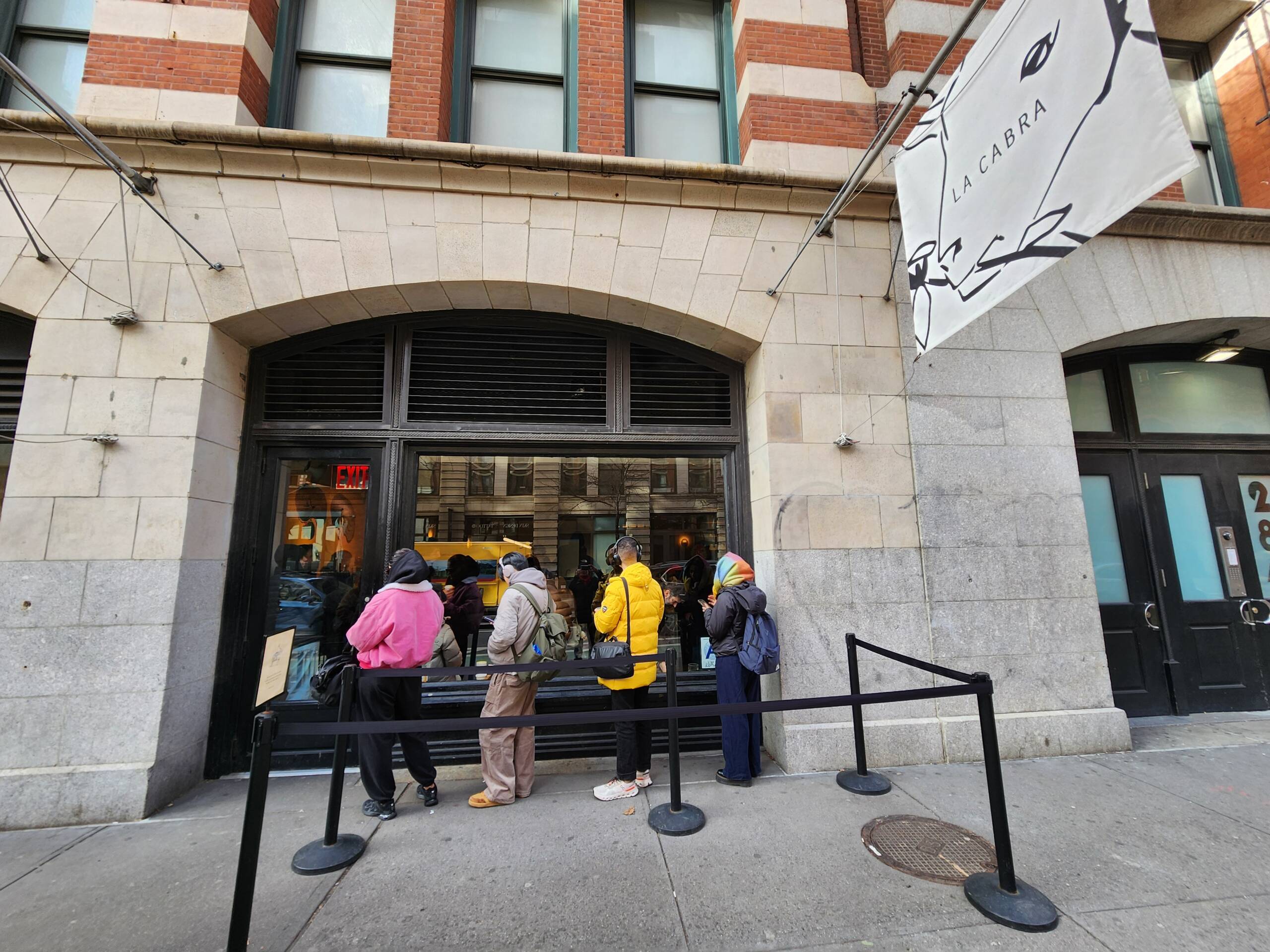
The first image already tells the whole story before you even step inside. A narrow New York sidewalk, old brick and pale stone arching over a tall storefront window, and a line that feels oddly ceremonial. People stand patiently behind black stanchions, bundled in winter layers that read like a mood board: a bright yellow puffer jacket anchoring the center, a soft pink fleece nearby, neutral trousers, sneakers chosen with intent. Heads tilt slightly downward, phones in hand, not quite doomscrolling but not fully present either. Above them, a minimalist flag flutters with the stark, graphic logo of La Cabra, signaling not just coffee but affiliation. This isn’t a queue driven by caffeine desperation; it’s a queue driven by participation. Waiting becomes part of the performance, a visible proof that you know where to stand, literally and culturally. Standing outside is already content-adjacent, a soft announcement to the city: I belong to this micro-ritual.
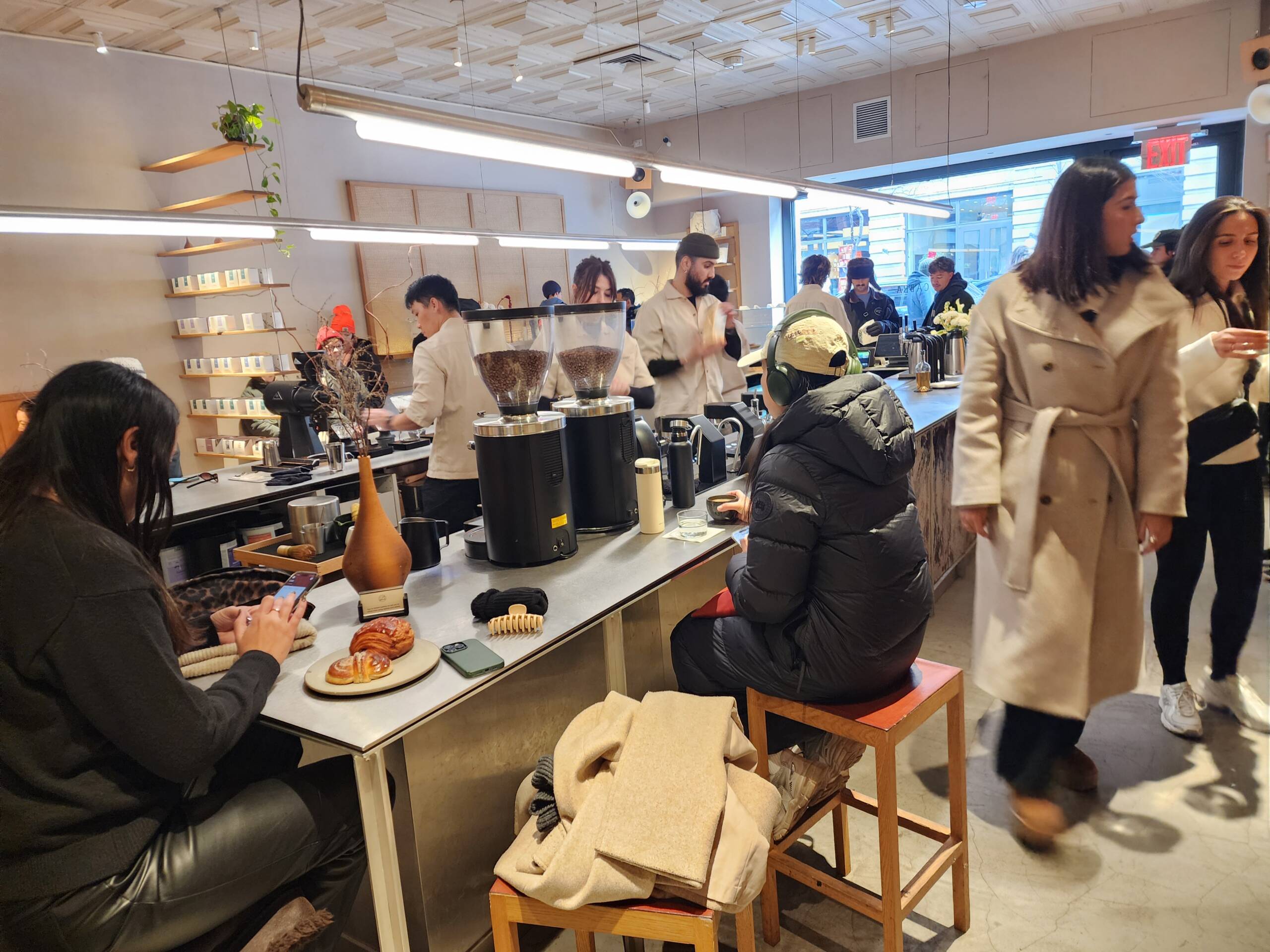
Inside, the tone shifts from urban exterior to carefully calibrated calm. The café interior is bright but gentle, washed in pale wood, matte surfaces, and long linear lights that feel more like a gallery installation than retail fixtures. The counter becomes a stage where baristas move with practiced efficiency, wearing neutral uniforms that blend into the aesthetic rather than dominate it. Customers orbit the bar slowly, some seated on simple wooden stools, others drifting past, coats still on, never quite settling. Phones appear again, lifted briefly for a photo, lowered again, as if everyone has learned the choreography: capture without lingering, observe without intruding. The grinders, identical and symmetrical, hum quietly like part of the design language. Even the pastries are placed with restraint, spaced just enough to be photographed individually, each one quietly asserting its sculptural value.
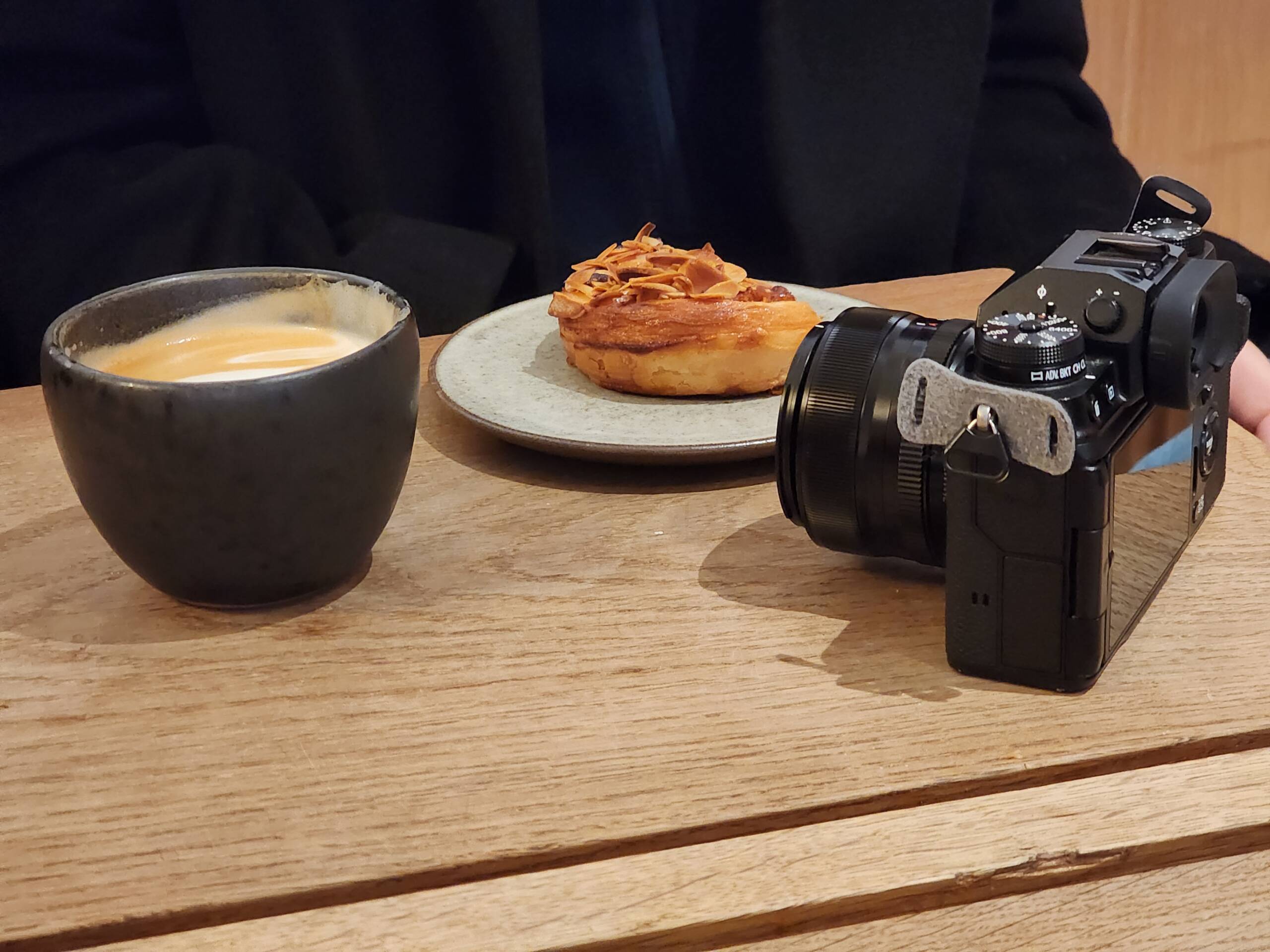
Then there’s the still life, the moment every influencer knows by instinct. A ceramic cup with a thin layer of crema, not too foamy, not too bare, sits on a wooden table that looks deliberately unpolished. Next to it, a pastry—laminated layers visible, topped with toasted almonds that catch the light just right. And beside that, a compact mirrorless camera, resting casually but clearly included on purpose, strap tucked away so it doesn’t interrupt the frame. The camera isn’t being used in this moment; its presence is symbolic. It says this coffee matters enough to be documented properly, not just snapped on a phone and forgotten. This is the influencer’s quiet flex: signaling seriousness without saying a word, letting objects do the talking. Coffee here is less about consumption and more about curation.
What makes New York coffee culture particularly fertile ground for influencers is its density and pace. These cafés are small, often crowded, always temporary-feeling, as if you’re meant to pass through rather than stay. That transience encourages documentation. You don’t linger long enough to fully inhabit the space, so you capture it instead. The aesthetics are intentionally restrained—neutral colors, natural materials, soft lighting—because restraint photographs well and ages slowly online. Nothing screams for attention, yet everything is designed to be noticed. Even the lack of signage or overt branding becomes a brand in itself, a kind of visual whisper that travels farther on social feeds than loud logos ever could.
Underneath it all, influencer culture in New York coffee houses isn’t really about coffee, though the coffee is excellent and obsessively sourced. It’s about alignment. Being seen in the right place, holding the right cup, framed by the right light, signals taste, awareness, and belonging to a certain urban tribe. The queue outside, the quiet inside, the composed still life on the table—each is a chapter in the same story. You come for the espresso, sure, but you leave with something more portable: an image, a moment, proof that for a brief slice of time, you were exactly where you were supposed to be.
Leave a Reply