There’s a special alchemy to travel photography that goes far beyond clicking the shutter. It’s not just about capturing a place; it’s about distilling the mood, the textures, the chaos, and the calm into a frame that whispers stories long after the journey is over. Anyone can take a snapshot of a famous monument, but to make a photograph that feels alive—something that breathes with the memory of the moment—that requires patience, a touch of intuition, and the willingness to see differently.
At its heart, travel photography is storytelling without words. Think of walking through a bustling market in Marrakech: spices piled high in bursts of saffron yellow and chili red, the hum of bargaining voices, the warm air dusted with cumin and smoke from grilled kebabs. The challenge isn’t just to capture the visual—a quick photo of spice pyramids won’t do—it’s to weave in the atmosphere so someone seeing your image years later can almost smell the cardamom. This is where composition, light, and perspective all conspire together. Step lower, crouch close, frame the piles against the weathered hands of a vendor—that one shift suddenly pulls the viewer into the scene instead of leaving them hovering above it.
There’s a certain irony in the scene of a beach photographer—camera at the ready, giant telephoto lens pointed toward the waves—while all around him people are simply living their own holiday moments. In this image, the man in the foreground, shaded by his beige cap with its tree emblem, becomes almost a character out of a film. His lens is enormous, practically as long as his forearm, and it suggests intent: he’s not just snapping casual shots, he’s hunting for something specific. Maybe it’s the perfect candid expression of a child splashing in the surf, or maybe a bird gliding low across the water. Whatever it is, his focus is absolute, even as the tide of beach life carries on without him.
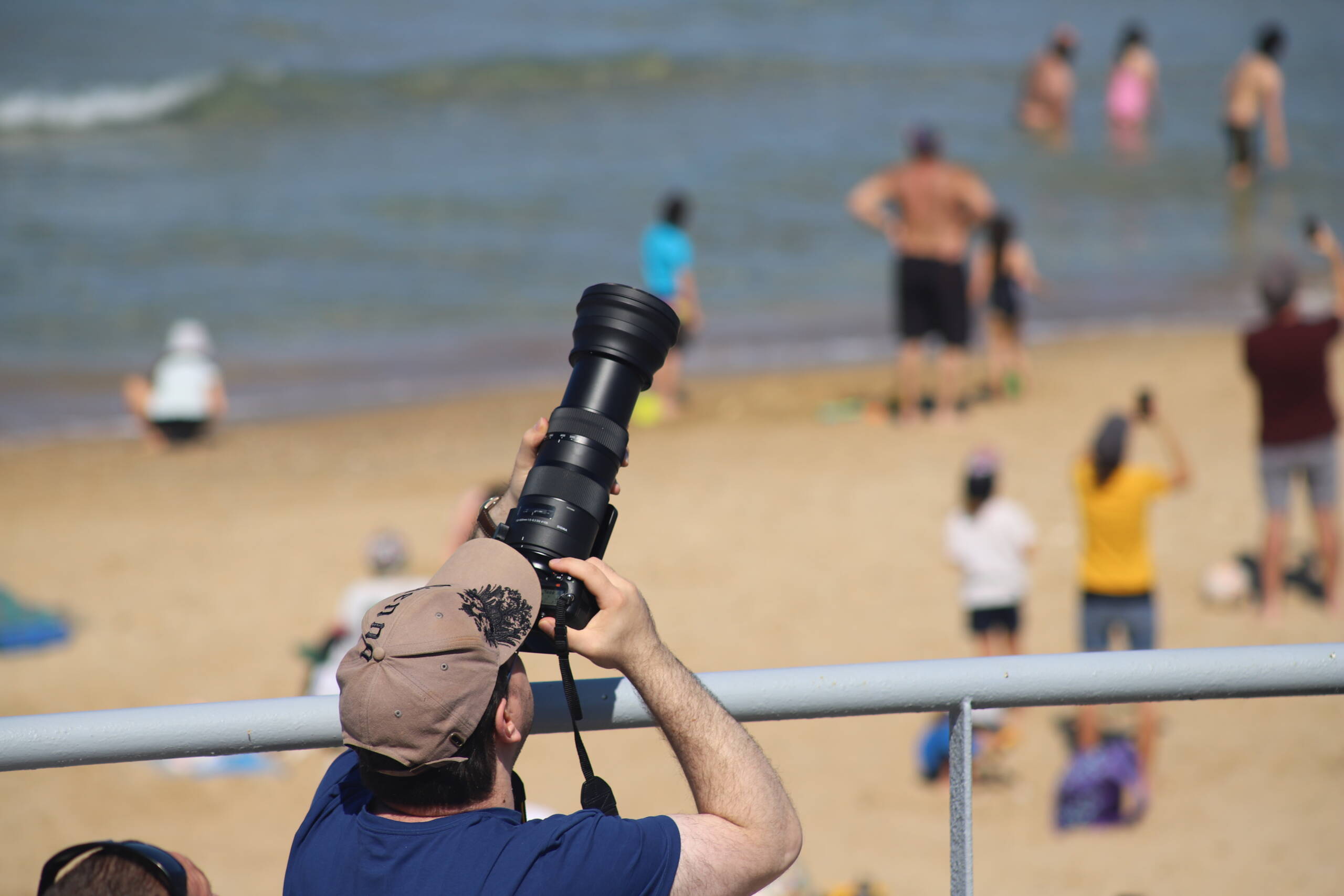
Behind him, the beach plays out a parallel narrative. People scatter in soft focus—some knee-deep in the water, others still rooted in the sand, phones raised like pocket-sized cameras of their own. A man stands with his hands on his hips, watching over children. A woman in a bright yellow shirt holds her phone aloft, capturing her own slice of memory. No one is posed, no one is staged—it’s the sort of casual choreography that travel photographers thrive on, where randomness forms a fleeting composition.
The beauty here is in the layering. You have the professional or hobbyist with his heavy gear, representing the art of patience and technical skill. Then, blurred into the background, you have everyday travelers documenting the moment in their own way—quick taps, instant sharing, memories caught without fuss. It’s a contrast that defines the art of travel photography: the tension between craft and immediacy, between investing in the tools to see deeper and embracing the spontaneity of simply being there.
On a beach, this balance becomes even more poetic. The ocean is in constant motion, light shimmers differently with every passing minute, and people drift in and out of frames like passing shadows. To photograph such a scene well is to accept imperfection, to anticipate motion, to find beauty in both clarity and blur. That giant lens might catch a crisp close-up of a wave breaking, but the blurred figures in the distance—sunlit, carefree, imperfect—say just as much about what it means to travel and observe.
Travel photography, after all, isn’t just about what we see; it’s about how we choose to see it. Some lean in with patience, waiting for light and angle. Others just raise their phones, capture the instant, and move on. And sometimes, the most telling image is of the observer themselves, standing slightly apart, turning a holiday moment into something timeless. On that beach, under the sun, with sea spray in the air, the art of travel photography unfolded not just in the shots taken—but in the act of seeing itself.
The play of light is another character in this art form. A cobblestoned alley in Lisbon at noon is one story—shadows sharp, tourists everywhere, flat colors—but return at golden hour and the same stones glow with honey, the buildings soften, and silhouettes lengthen across the street like stretched memories. Travel photographers learn to chase light more than locations. Often the photograph worth keeping isn’t at the postcard spot but around the corner, where a grandmother waters plants from her balcony and the sun glances off the spray in a fleeting sparkle. You learn, over time, that patience is as important as your lens; sometimes the best decision is simply to wait for light to do its quiet work.
But travel photography is also about embracing imperfection. A horizon that isn’t perfectly level, motion blur from a child dashing across a plaza, or an umbrella half cut off in the frame—all of these can add more life than clinical precision ever could. Perfection can flatten; imperfection can animate. Think of a beach scene in Cascais where the sea is wild and a tourist’s towel has blown halfway across the sand into your frame. You could crop it out later, sure, but maybe that bit of chaos is the point—it says something honest about being there in the wind and spray. The world isn’t symmetrical, and travel photography sings when it leans into that truth.
One overlooked ingredient is interaction. Photos of people taken without acknowledgment can feel hollow, even invasive. But talk to someone first, make eye contact, maybe share a smile—that exchange, however small, often transforms the energy of the photo. A fisherman in Croatia holding up the catch of the day, a fruit seller in Montenegro laughing mid-sentence, or a group of teenagers in Prague striking goofy poses because you bothered to ask instead of steal the shot—those images vibrate with human warmth. Travel photography at its best isn’t about extracting images; it’s about building small, respectful bridges that last at least as long as the click of a shutter.
Gear matters, but less than people think. Sure, a full-frame camera with a sharp prime lens can render a scene beautifully, but some of the most resonant travel images come from phones, disposable cameras, even battered compacts that survived three countries longer than expected. The key isn’t resolution but perspective. Where were you standing? What did you notice that others passed by? Why did you choose that moment to press down? Travel photography is less about megapixels and more about mindset.
Perhaps the most delicate art is editing. It’s tempting to over-process, to crank up saturation until the sky looks like a candy wrapper or smooth every wrinkle out of an old man’s face until he looks like a wax figure. Editing should refine the story, not rewrite it. Enhance the shadows to show the depth of a Roman ruin, lift the highlights to reveal the gleam of wet cobblestones after rain in Paris, but leave the grit, the wrinkles, the grain. Those details are not flaws—they are the narrative threads.
What makes this art addictive is that it never quite settles. Every journey reshapes how you see. The same square in Florence you shot ten years ago will look and feel entirely different today, not just because the light changed but because you did. Travel photography evolves with you; it’s both a mirror and a map, reflecting who you are while guiding you forward.
And perhaps that’s the truest art of it: learning that travel photography isn’t only about remembering places—it’s about remembering yourself within them. The camera becomes less a machine for documentation and more an excuse to pause, to notice, to connect. That’s why years later, when you look back, the photographs carry not just images of distant lands but fragments of who you were when you stood there, finger poised, seeing the world with fresh eyes.