In the Louvre’s galleries, where light filters softly across vaulted ceilings and stone walls, one encounters a figure unlike the serene gods or triumphant emperors so often associated with Greco-Roman statuary. Standing alone against a pale wall, sculpted in dark marble that seems to drink in the light, this captive commands a different kind of attention. His body is wiry and aged, less idealized than many of his classical counterparts, and yet he radiates a dignity forged from suffering. His arms extend slightly outward, his head tilted upward as if addressing unseen powers. What he conveys is not the calm of victory but the pathos of defeat.
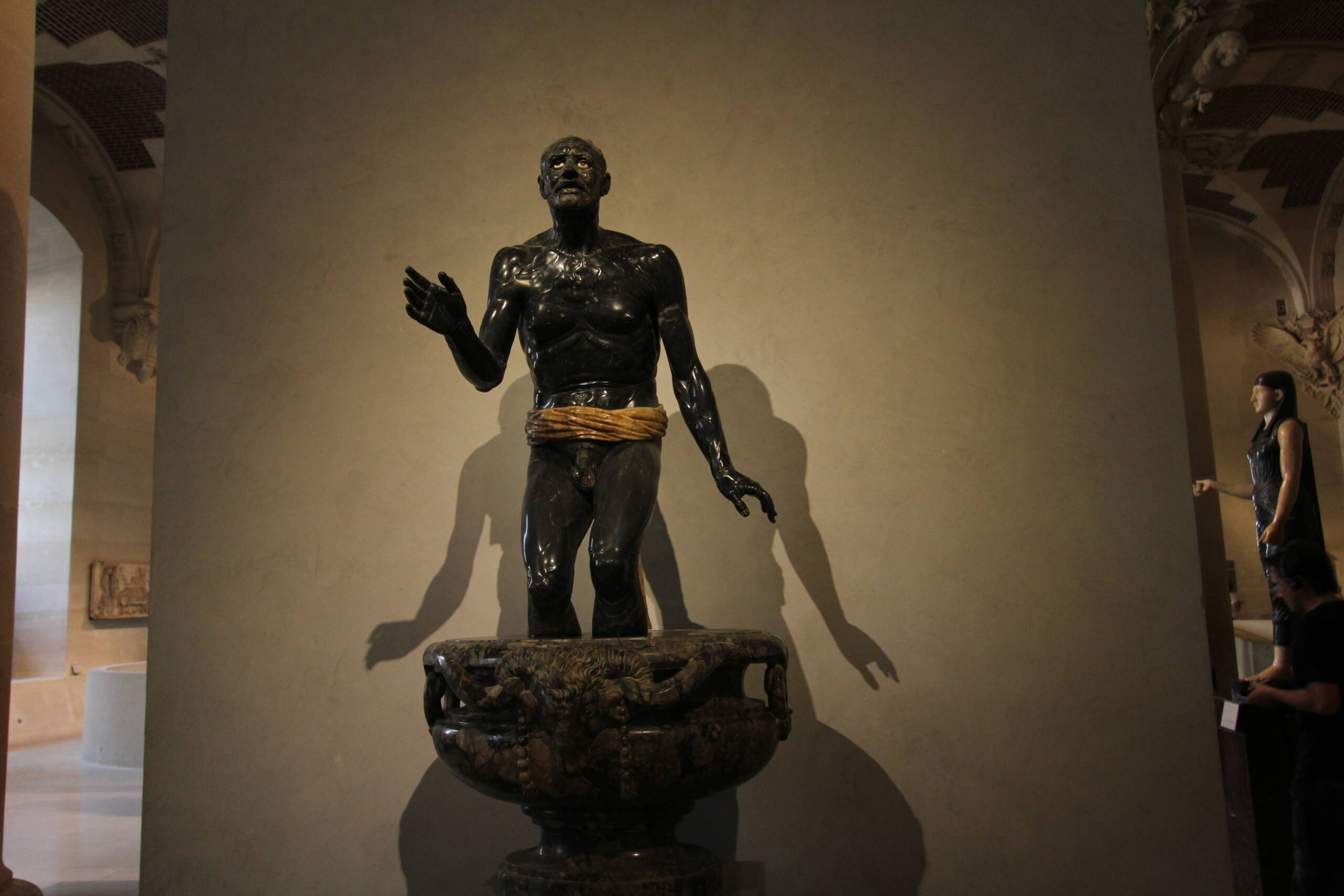
This sculpture, often identified as one of the Captive Barbarians or Dacians, offers a haunting contrast to the white marble prisoners displayed nearby. Where those figures are monumental in size and muscularity, this dark stone body emphasizes frailty, endurance, and psychological tension. His ribs protrude, his abdomen sinks inward, and his thin arms suggest exhaustion rather than strength. The yellowed sash that girds his waist provides a startling accent, drawing the viewer’s gaze to the intersection of vulnerability and resistance, of adornment and restraint. The medium itself—black marble—intensifies the atmosphere, creating a play of light and shadow that imbues the figure with a ghostly, almost living presence.
The Louvre’s setting heightens the emotional charge of the work. Tourists wander past, their voices and footsteps echoing, yet the captive remains locked in his eternal gesture. His shadow falls on the wall behind him, doubling his presence, as if reminding us that the memory of defeat lingers not just in stone but in its spectral afterimages. Unlike the victorious monuments of antiquity, this statue does not glorify the conqueror; it confronts us with the cost of conquest, with the humanity of those who were subjugated.
Philosophically, the sculpture invites a meditation on the visibility of suffering. Michel Foucault spoke of how power is inscribed onto bodies, and here we see that inscription carved into stone. The captive’s posture embodies submission, yet the upward gaze resists complete annihilation of agency—it is as if he is appealing to a higher justice, or perhaps addressing eternity itself. Giorgio Agamben’s concept of bare life again feels relevant: the figure has been stripped of political identity, reduced to a body on display. And yet, paradoxically, his survival across centuries, now in the heart of the Louvre, allows him to exercise a new form of agency. He becomes a witness, a reminder that history is never written only by the victors.
The contrast with the nearby white-marble captives is also crucial. Together, they form a spectrum of representation: some embody the raw physical strength neutralized by chains, others the slow erosion of vitality under captivity. Displayed within the Louvre, a museum built upon layers of royal privilege, revolutionary fervor, and imperial collecting, these works resonate as more than antiquities. They confront Europe’s long entanglement with conquest and display, with turning the defeated into objects of art and power.
To stand before this black marble captive in the Louvre is to be reminded that art is not only about form and beauty. It is also about memory, loss, and the ethics of representation. His posture, his shadow, his very materiality speak to the endurance of those who were meant to be silenced. He is not merely a monument to defeat, but a stubborn reminder that the humanity of the conquered endures—even in stone, even in shadow.