There’s a moment, right before you step into the Galleria dell’Accademia in Florence, where you almost underestimate what’s waiting inside. The hallway feels quiet in that museum-kind of way, and the light seems a bit too soft, almost unremarkable. Then you turn the corner, and there he is — Michelangelo’s David — standing under the natural dome of soft skylight, towering over the room like he’s both frozen in time and somehow still breathing. The first reaction is almost always the same: silence. You don’t speak, because there really isn’t a word that lands properly. The sheer scale of it hits first — 5.17 meters of flawless marble — but then the little details draw you in, things you never really notice when you’ve only seen the postcard version. The veins running across the hands. The slight tension in the neck as if he’s holding his breath before the fight. The gaze — focused, confident, but not arrogant — aimed slightly to the left as if Goliath is still somewhere just out of your sightline.
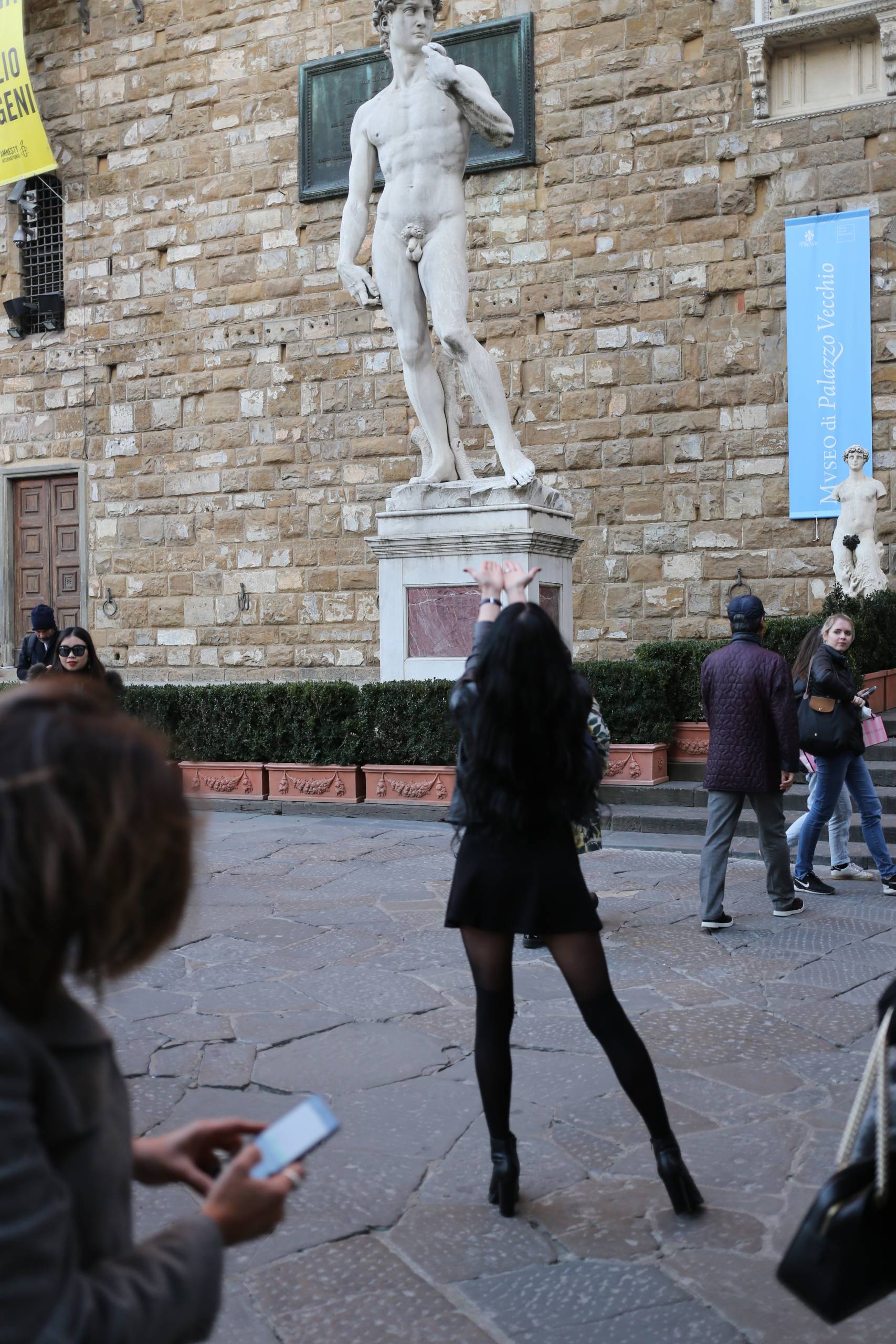
I found myself staring longer than expected, moving around him slowly because every angle feels like a different sculpture entirely. From one side, he looks calm and measured; from another, he looks ready to spring forward. The realism is almost unsettling when you stare too long — muscle tension, the gentle twist of the torso, the asymmetry that makes him feel like a real human rather than a mathematical ideal. Some people sit on the benches beneath him and just stay there, almost like they’re waiting for the statue to move. It’s surprisingly emotional, and a bit surreal, especially when you remember Michelangelo carved this from a single block of marble that had been left abandoned for nearly 40 years because other sculptors thought it was flawed and useless.
Florence has a lot to offer — the Duomo, the Arno, endless Renaissance masterpieces — but David feels like the city’s heartbeat. Once you’ve seen it with your own eyes, the replicas around town feel like mannequins pretending to be something alive. If you go, go early or late when the crowds thin out a little. Stand close, then far, then somewhere in the middle. Don’t rush it. Let your eyes wander over the tiny imperfections left by tools five centuries ago, because they’re part of the magic. And when you walk back outside into the warm Florentine air — with gelato somewhere nearby, scooters buzzing, conversations floating through alleys — you’ll probably still feel the weight of what you just saw lingering for a while. It’s one of those rare travel moments that stays with you, quietly, in the background of your memory.
Leave a Reply